How to Choose the Best EV Repair Shop Near Me (Compared)
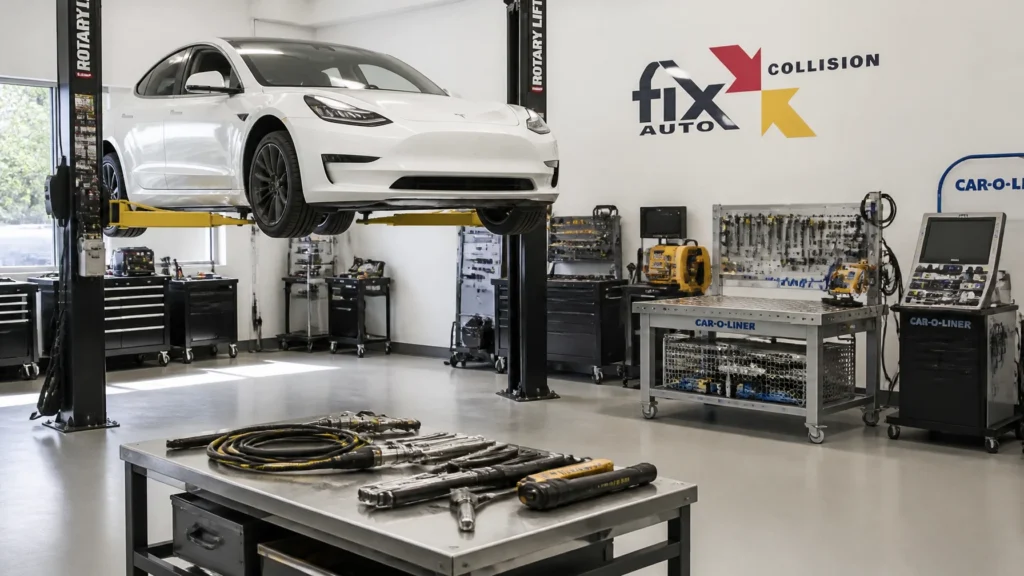
As a Tesla, Rivian, Ford, and Honda certified collision center with over 21 years of experience in the Inland Empire, RVCCR has witnessed the dramatic shift from traditional internal combustion engine (ICE) vehicles to the complex, high-voltage world of Electric Vehicles (EVs). When you are searching for an "ev repair shop near me," you aren't just looking for someone who can pull a dent; you are looking for a facility capable of managing a 1,200-pound lithium-ion battery, specialized structural aluminum, and sophisticated driver-assistance software that requires precise calibration.
Choosing the wrong shop doesn't just result in a poor paint job: it can compromise the structural integrity of your vehicle and the safety of its high-voltage system. The gap between a general body shop and a manufacturer-certified EV facility has never been wider…
The Evolving Landscape of EV Collision Repair
The automotive industry is currently undergoing its most significant transformation since the introduction of the assembly line. For owners in Redlands, San Bernardino, and the greater Inland Empire, this means the criteria for selecting a repair facility have fundamentally changed. You can no longer rely on the shop "down the street" just because they’ve been there for thirty years.
Electric vehicles are built differently. They use different materials, different joining methods, and require an entirely different approach to safety. While a traditional car uses a steel unibody or frame, many EVs: like those from Tesla and Rivian: utilize a mix of high-strength steel and structural aluminum. Repairing aluminum requires specialized "clean rooms" to prevent cross-contamination with steel dust, which can cause galvanic corrosion. If a shop tells you they can fix your Rivian but doesn't have a dedicated aluminum repair station, they aren't equipped for the job.
Furthermore, the integration of technology in EVs is far more pervasive. Every sensor, camera, and radar unit is tied into a central computer system. A minor bumper scrape on a Tesla Model 3 might involve several ultrasonic sensors and the Autopilot camera system, all of which require specific calibration procedures that only a Tesla certified collision center is truly qualified to perform.
Why Certified EV Repair Costs More (The Data)
It is a common observation among EV owners that insurance claims seem higher than they did for their previous gasoline-powered cars. This isn't just a perception; it is backed by industry data. According to CCC Intelligent Solutions, repair costs for electric vehicles are consistently higher than those for ICE vehicles.
In fact, recent data from CCC Intelligent Solutions reveals that EV repair costs are 46.9% higher than repairs for traditional internal combustion engine vehicles. This isn't due to "price gouging" by shops; it is a direct reflection of the labor intensity and specialized parts required. CCC’s data further highlights that the labor share of EV repair costs is 43.3%, significantly higher than the industry average for ICE vehicles.

When you break down that 43.3% labor share, you begin to see where the time goes. It isn't just "turning wrenches." It includes:
- High-Voltage Disconnect/Reconnect: Safely de-energizing the battery before any structural work begins.
- Diagnostic Scanning: Pre-repair and post-repair scans to ensure every computer module is communicating correctly.
- Calibration: Ensuring the Advanced Driver Assistance Systems (ADAS) are accurate to within millimeters.
- Specialized Joining: Using structural adhesives and specialized rivets instead of traditional spot welding.
The Danger of the "General" Body Shop
Many vehicle owners feel pressured by insurance companies to use "preferred" or "network" shops. While these shops are often great for traditional repairs, many lack the specific certifications required for modern EVs. When you search for an "ev repair shop near me," you must verify their credentials.
At RVCCR, we hold certifications from Tesla, Rivian, Ford, Honda, Mazda, and Subaru. Each of these manufacturers has its own specific repair manual and required tooling. A general shop might attempt to "figure it out" as they go, but in the world of high-voltage batteries, there is no room for trial and error.
Structural Integrity and Aluminum Repair
Structural aluminum is a cornerstone of EV design because it offers a high strength-to-weight ratio, which helps offset the weight of the battery. However, aluminum has no "memory." Unlike steel, which can sometimes be pulled back into shape, structural aluminum components often require complete replacement if they are even slightly deformed.
A certified technician knows exactly where the "cut lines" are and which rivets must be used. Using the wrong rivet or an unapproved adhesive can lead to a structural failure in a subsequent accident.

High-Voltage Safety: A Non-Negotiable Requirement
The most significant difference between an EV and an ICE vehicle is the presence of a high-voltage (HV) battery. These batteries typically operate at 400 to 800 volts: enough to be fatal if mishandled.
A reputable shop performing EV collision repair must follow strict safety protocols. This includes:
- De-energizing the System: Removing the service plug or disconnecting the 12V system to ensure the HV contactors are open.
- Battery Monitoring: Checking the battery for "thermal runaway" or physical damage. If a battery is compromised, it must be stored in a specialized quarantine area away from the main building.
- Insulated Tooling: Technicians must use tools rated for 1,000 volts, along with Class 0 rubber insulated gloves that are regularly tested for integrity.
If you walk into a shop and don't see high-voltage warning signs, specialized safety equipment, or a technician who can explain their "power down" procedure, turn around and leave. Your safety: and the safety of the technicians: depends on these protocols.

The Rivian Structural Challenge
Rivian repairs deserve their own section because a Rivian is not just "another electric truck." The R1T and R1S were engineered around a very specific mix of materials, packaging constraints, and crash-performance goals. That is great news for drivers who want capability, range, and stiffness. It is less great news for any collision shop that thinks it can treat one like a conventional pickup or SUV.
The first thing owners notice after an accident is how quickly the conversation turns technical. A Rivian does not simply have body panels attached to a basic ladder frame in the way many people imagine a truck does. Its structure is heavily integrated. The battery pack is a major mass component mounted low in the vehicle, the surrounding structure is designed to manage crash energy carefully, and many repair decisions affect not just cosmetics but alignment, sensor operation, sealing, and long-term corrosion protection.
That matters because on the R1T and R1S, what looks like a "small hit" can become a structural repair question very quickly. Impact energy can travel through aluminum members, mounting points, suspension pickup areas, and panel interfaces in ways that are not obvious from the exterior. On a Rivian, a bed-side hit, quarter impact, rocker damage, or front corner collision can lead to detailed measuring and repair planning before anyone should promise a timeline.
A certified Rivian repair process is built around manufacturer procedures, approved tooling, and technicians who understand where replacement is required instead of straightening. That is where the Inland Empire challenge shows up. Certified Rivian technicians are rare because the training path is not casual, the equipment investment is not small, and the repair environment has to support advanced aluminum work, structural measuring, scanning, calibration, and high-voltage safety all at once.
In other words, the shortage is not about a lack of interest. It is about the fact that very few shops are willing or able to build the full ecosystem required to do the work correctly.
Why are certified Rivian technicians scarce in this region? A few practical reasons:
- Training is specialized: Rivian certification is not the same as general collision experience. Technicians have to learn model-specific repair procedures, structural methods, and safe handling requirements tied to EV architecture.
- Tooling is expensive: Dedicated aluminum repair capability, approved weld-bond or rivet-bond systems where applicable, measuring systems, and OEM-directed fixtures are not optional.
- Shop layout matters: Aluminum repair areas must stay clean and separated to reduce contamination risks. That is a facility decision, not just a technician decision.
- Repair information changes: EV repair procedures evolve. A shop has to stay current, not rely on habits formed from older vehicles.
- Demand is rising faster than capacity: Rivian ownership has grown, but the certified repair network remains selective. That creates real bottlenecks after collisions.
For owners, the takeaway is simple: rarity matters. If a non-certified shop says, "We work on everything," that is not automatically reassuring when your vehicle is a Rivian. On a conventional steel-bodied vehicle, broad experience may carry a shop a long way. On an R1T or R1S, broad experience without Rivian-specific process discipline can become a very expensive guessing game.
This is also where timelines can surprise people. Even if visible damage seems limited, a Rivian often requires:
- pre-repair scanning,
- detailed structural measurement,
- high-voltage safety checks,
- parts validation,
- manufacturer-directed repair planning,
- and post-repair calibrations.
That is one reason certified Rivian repairs can take longer than customers expect. It is not because the shop is dragging its feet. It is because the vehicle was engineered with a level of integration that demands more caution.
For Inland Empire owners, choosing a shop with actual EV and OEM credentials is the difference between a repair plan and a repair gamble. A Rivian should not be handed to a facility that is "pretty sure" it can manage the structure. It should go to technicians who know where the margins for error are effectively zero.
The Battery Quarantine & Fire Safety
Battery safety is one of those topics that gets reduced to headlines, when the real story is process. A certified EV collision center does not panic around a potentially damaged battery, but it also does not get casual. The right response is controlled, documented, and methodical.
If an EV arrives after a collision, one of the first questions is whether the high-voltage battery may have been compromised. That answer is not always visible from the outside. The battery enclosure may have suffered an impact, road debris intrusion, crush event, puncture, or abnormal loading path even if the upper body damage looks moderate. Shops cannot rely on appearance alone.
The walkthrough usually starts with vehicle intake and hazard assessment. Technicians identify the make, model, and condition of the vehicle, note warning messages, inspect for impact location, and determine whether the vehicle can be safely moved or must remain isolated immediately. If there is any sign of smoke, heat, hissing, electrolyte leakage, or active fault behavior, the response escalates fast.
From there, a certified shop follows a sequence that typically includes:
- Initial isolation: The vehicle is parked away from other vehicles and structures until technicians determine whether it can enter the main workflow safely.
- Power-down procedures: Following OEM service information, the vehicle is de-energized as required before structural teardown or close-contact repair planning begins.
- Thermal imaging: Technicians use thermal imaging equipment to check for abnormal heat signatures at the battery area and surrounding high-voltage components.
- Visual and scan-based evaluation: Diagnostic scans and physical inspection help determine whether there are battery-related fault codes, impact indicators, or signs of enclosure compromise.
- Safety-zone decision: If risk remains uncertain or elevated, the vehicle moves to a designated quarantine area with controlled access and clearance from other property.
Thermal imaging deserves a closer look because it is one of the most important pieces of the safety puzzle. A compromised battery does not always announce itself dramatically in the first few minutes. Heat patterns can reveal abnormal cell activity, internal damage progression, or localized hot spots that tell technicians the vehicle needs continued monitoring. Think of thermal imaging as an early warning system. It does not replace OEM procedures, but it gives the shop another critical layer of information before people start disassembly.
A proper battery quarantine area is not just an empty corner of a parking lot with a cone next to it. It is a deliberate safety zone. The purpose is to reduce exposure if a damaged battery begins venting, heating, or entering thermal runaway after the initial incident. Depending on the situation and OEM guidance, the vehicle may remain under observation for an extended period before the next repair decision is made.
That quarantine workflow usually includes:
- restricted access,
- clear hazard marking,
- separation from occupied work areas,
- repeat temperature checks,
- documentation of battery condition,
- and coordination with the manufacturer or qualified battery-handling partners when needed.
This is why EV collision repair is not simply "body work with orange cables." A battery event affects building safety, technician safety, neighboring vehicles, and the customer’s final repair path. If the pack is compromised, the question may not be "Can we continue body repair today?" The question may become "What is the safest next step for the entire vehicle?"
Fire safety planning is equally specific. Certified facilities prepare for a battery incident with site procedures that account for evacuation, isolation, emergency communication, and local first-responder coordination. The goal is not to create drama. The goal is to prevent improvisation. In high-voltage repair, improvisation is where small mistakes become large ones.
For EV owners, this should actually be reassuring. The shop you want is not the one that shrugs off battery concerns. The shop you want is the one that explains its thermal monitoring, quarantine logic, and safety perimeter in calm, boring detail. Boring is good here. Boring means trained.
The Role of I-CAR Gold Class Certification
While manufacturer certifications (like our Tesla or Rivian credentials) are the gold standard, the industry-wide benchmark is the I-CAR Gold Class designation. I-CAR (Inter-Industry Conference on Auto Collision Repair) provides the most comprehensive training in the collision industry.
To maintain Gold Class status, a shop must have "Platinum" level technicians in four key roles: Estimator, Non-Structural, Structural, and Refinish. In 2026, I-CAR training has expanded significantly into EV-specific modules. When evaluating an "ev repair shop near me," ask if they are an I-CAR Gold Class shop. This ensures the staff is up-to-date on the latest repair technologies and safety standards.
Why Redlands and Inland Empire Owners Choose RVCCR
For 21 years, RVCCR has been a family-owned pillar of the Redlands community. Our commitment to the Inland Empire isn't just about business; it's about keeping our neighbors safe. We combine our deep roots with cutting-edge technology, offering a "one-stop shop" that handles collision, paint, and complete mechanical work under one roof.
We understand the frustration of a collision. Whether you’re driving a Tesla Model S, a Rivian R1T, or a Ford Mustang Mach-E, the process is stressful. That’s why we coordinate directly with all major insurance companies and provide a written lifetime warranty on our work. Our collision repair testimonials reflect our dedication to restoring vehicles to factory specifications: not just "good enough" for the insurance company.
A Checklist for Choosing Your EV Repair Shop
If you are currently looking for a repair facility, use this checklist to compare your options:
- Do they have OEM Certifications? (Check for Tesla, Rivian, or other EV-specific badges).
- Are they I-CAR Gold Class certified?
- Do they have a dedicated aluminum repair area?
- Do they have high-voltage safety equipment and insulated tools?
- Do they use OEM (Original Equipment Manufacturer) parts? (Never settle for aftermarket parts on an EV structural repair).
- Do they provide a written lifetime warranty?
- Are they experienced with ADAS calibration?
Tesla Parts & Logistics
If you have ever wondered why Tesla repair timelines can feel less predictable than older collision jobs, parts logistics are a big reason. This is one of the least glamorous parts of EV repair, but it is one of the most important. A certified shop can have the right technicians, the right frame equipment, and the right paint booth, yet the repair still pauses if critical OEM parts have not landed.
Tesla vehicles are highly engineered systems, and structural repairs are not an area where shops have much room to freelance. Owners sometimes ask a fair question: "Can’t the shop just use aftermarket parts to speed this up?" For cosmetic trim in the wider automotive world, that question can sometimes have a practical answer. For structural Tesla collision work, the answer is often no.
That is because many structural components are tied directly to crash performance, fitment, corrosion protection, sensor alignment, and OEM repair procedures. If a manufacturer-approved repair calls for a specific replacement component, a certified shop is not supposed to substitute a mystery version from the internet and hope for the best. That might save a few days up front and create major problems later.
Why aftermarket is often not a real option for Tesla structural components:
- Crash management depends on exact design: Structural parts are engineered to deform and transfer energy in specific ways.
- Fit and tolerance matter: A few millimeters can affect panel fit, sealing, radar brackets, camera aiming, and downstream calibration.
- Material construction matters: High-strength steel grades, castings, aluminum sections, adhesives, and coatings are not interchangeable just because a part "looks close."
- Repair documentation matters: Certified repairs follow OEM procedures, and those procedures are built around OEM parts.
- Warranty and liability matter: A shop that chooses non-approved structural substitutes takes on serious risk.
Tesla logistics also involve planning, not just ordering. A well-run certified repair process starts with a thorough blueprint of the damage, because partial ordering creates delays. If the shop orders only the obvious damaged parts, teardown may reveal hidden components that restart the clock. On EVs, especially Teslas with tight packaging and integrated systems, hidden damage is not rare.
That is why experienced certified shops spend time up front on:
- complete disassembly where appropriate,
- parts mapping,
- OEM repair procedure review,
- insurer documentation,
- and realistic timeline communication.
It may feel slower at the beginning, but it usually prevents the much worse scenario where the vehicle is half repaired, waiting on one bracket, one casting-related part, one harness retainer, or one sensor mount that should have been identified earlier.
There is also a practical supply-chain issue: Tesla collision parts are part of a specialized ecosystem, not the broad mature aftermarket network people are used to for common ICE vehicles. A traditional sedan that has been on the road for years may have dozens of part sourcing channels. A Tesla structural repair may rely much more heavily on OEM distribution availability. When a needed component is constrained, the shop cannot simply invent a compliant replacement.
For customers, the key is understanding that parts delays and parts discipline are not the same thing. A parts delay is frustrating. A parts shortcut is dangerous.
A credible EV shop should be able to explain:
- which parts are structural,
- which parts are cosmetic,
- what can be repaired,
- what must be replaced,
- and where the repair depends on OEM-only sourcing.
That transparency matters because it protects the owner from two bad outcomes: an unrealistic promise on the front end, or an unsafe compromise on the back end. In the Tesla world, logistics are part of the repair quality equation. The supply chain is not a side note. It is part of doing the job right.
The Hidden Complexity of EV Paint and Finish
Beyond the structural and electrical components, even the paint on an EV can be unique. Manufacturers like Tesla use multi-coat pearl and metallic finishes that require precision color matching. Additionally, because EVs often use plastic, aluminum, and steel panels on the same vehicle, the "flex" and "adhesion" requirements of the paint can vary from panel to panel.
Certified shops use high-end paint booths with controlled environments to ensure a factory-quality finish. At RVCCR, we utilize premium paint systems that match the specific formulations used by Tesla and Rivian, ensuring that your repair is invisible to the naked eye.
The Science of EV Refinishing
This is where collision repair gets unfairly underestimated. Most people can imagine why structural repair is complicated. Paint, on the other hand, seems simple until you are trying to make a repaired Tesla disappear in full Inland Empire sunlight.
EV refinishing is a science project wearing a glossy finish. On modern electric vehicles, painters are often matching color across mixed materials, maintaining appearance across large body sides, and working with premium multi-stage finishes that show every shortcut. If a shop lacks discipline in prep, mixing, spray technique, flash timing, or bake conditions, the result is obvious.
Take Tesla Pearl White as an example. Multi-coat white finishes are not just "white paint." They are layered systems. The visual effect comes from the interaction between the ground coat, mid-coat, and clear coat. Change film build, gun distance, overlap, orientation, or curing conditions and the color can drift. Under shop lighting it may look acceptable. Under daylight, it can stand out like a mismatched refrigerator door.
A simplified way to think about a multi-coat system is:
- Ground coat/base layer: Establishes foundational tone and hiding.
- Effect or mid-coat layer: Adds pearl, mica, or depth characteristics that create flop and light response.
- Clear coat: Protects the finish and influences gloss, depth, and durability.
That means color matching is not just about choosing the right formula. It is about reproducing the way the layers interact. Certified refinish teams control spray-out testing, blend strategy, substrate prep, and booth conditions because the eye catches inconsistency fast on EVs with clean panel design and large reflective surfaces.
Then there is the chemistry side. Some EV finishes and clear coat systems are designed with heat management in mind. Solar load is not a minor issue on vehicles that rely on battery efficiency and cabin thermal control. While paint alone is not a magic shield, refinishing systems may be selected and processed to maintain the OEM appearance and performance characteristics of the vehicle’s exterior surfaces. In practical terms, that means the clear coat is doing more than making the car shiny. It contributes to durability, UV resistance, and the way the finish handles sunlight over time.
When people talk about solar-reflective clear coats, the important idea is this: coating systems can be engineered to manage how the surface responds to sun exposure and heat buildup. A certified shop does not casually swap in an unknown low-grade product because "clear is clear." Product compatibility matters. Bake schedules matter. Layer thickness matters. Long-term weathering matters.
Refinishing on EVs also has another challenge that traditional customers rarely think about: the vehicle may combine aluminum, plastic composites, steel, and flexible bumper materials in adjacent panels. Those surfaces do not all behave the same way during prep, priming, coating, and cure. So the painter is not just matching color. The painter is matching color, texture, gloss, and durability across different substrates.
That is why high-end EV paint work involves:
- precise substrate cleaning and contamination control,
- correct primer and sealer selection,
- formula verification with spray-out cards,
- blending into adjacent panels where required,
- controlled booth airflow and temperature,
- and strict curing procedures.
A great EV refinish should do two things at once: disappear visually and hold up physically. The owner should not notice the repair in the parking lot, and the finish should continue to perform through heat, UV exposure, washing, and everyday use. That is not luck. That is process.
Software-Defined Vehicles
Modern EVs are no longer just machines with software in them. They are software-defined vehicles with physical parts attached. That distinction matters after a collision because repair quality is no longer measured only by panel gaps, paint gloss, and alignment. It is also measured by whether the vehicle’s digital systems recognize the repair, communicate correctly, and return to normal operation.
This is where Over-The-Air updates change the repair conversation. In older vehicles, once the mechanical and body work were complete, the vehicle was largely done. In a modern Tesla, Rivian, or other advanced EV, that is only part of the story. The car is connected, module-heavy, and constantly operating within a manufacturer-managed software environment.
After a major repair, the vehicle may need to be scanned, reconfigured, calibrated, or validated so that its modules, sensors, and safety systems are all speaking the same language again. That process is sometimes described informally as a "handshake" with manufacturer systems. In plain English, the car needs to re-establish trust with the digital ecosystem that supports it.
Why does that matter? Because collision repairs can affect:
- sensor mounts,
- camera positions,
- radar alignment,
- airbag-related components,
- restraint system status,
- battery and charging system monitoring,
- gateway modules,
- and software logic tied to replaced parts.
An OTA update does not magically fix a poor repair, and a perfect physical repair still needs proper digital validation. Those two truths exist at the same time.
Imagine replacing structural or electronic components on a modern EV without completing the required scans and calibrations. The vehicle might drive. It might even look perfect. But if the camera calibration is off, if a module is not configured correctly, or if the system does not recognize a replacement component as expected, the customer is left with a vehicle that is physically restored but digitally incomplete.
Certified shops understand that post-repair procedures are not optional extras. They are part of the repair. This typically means:
- Pre-repair scanning to identify existing faults and collision-related issues.
- OEM procedure review to determine required calibrations and setup steps.
- Post-repair scanning to confirm system health after parts replacement and refinishing.
- Calibration and validation for ADAS and related systems.
- Manufacturer-aligned completion steps so the vehicle can return to service correctly.
The "handshake" concept matters most after significant repairs because software-defined vehicles rely on networked modules and verified system status. If the vehicle does not complete its expected post-repair path, you may see persistent warnings, unavailable features, charging issues, or safety-system concerns. None of that is acceptable on a modern EV.
This is also one more reason why a bargain repair can get expensive later. A non-certified shop may fix the visible damage and send the car out before the digital side of the repair is truly complete. Then the owner gets to play the world's least fun scavenger hunt: warning lights, intermittent errors, and follow-up visits nobody budgeted for.
The better path is straightforward. Repair the hardware correctly. Restore the software environment correctly. Confirm the vehicle is ready to return to normal life. In the software-defined era, "looks fixed" is not the same as "is fixed."
EV vs. ICE: A Long-Term Value Comparison
The higher cost of proper EV repair sometimes causes sticker shock, especially for owners comparing it to older gasoline vehicles they have owned in the past. That comparison is understandable, but it can be misleading if it stops at the initial invoice. The more useful question is not just, "What does this repair cost today?" It is, "What does this repair decision do to the vehicle’s long-term value?"
EVs, especially premium EVs from brands like Tesla and Rivian, often carry strong resale expectations because buyers pay close attention to condition, repair history, technology functionality, and brand-specific service standards. On these vehicles, a certified repair is not just a safety choice. It is also a value-preservation choice.
Why certified repair helps protect long-term EV value:
- Documented OEM-aligned repair procedures support buyer confidence.
- Proper structural repair helps preserve crashworthiness and vehicle integrity.
- Correct parts usage reduces concern about hidden compromise.
- Professional refinishing avoids visible mismatch that hurts appraisal appeal.
- Completed scans and calibrations help ensure tech features work as expected.
- Manufacturer-specific expertise reduces the chance of unresolved post-repair issues.
Compare that with the wrong kind of "cheaper" repair. Maybe the vehicle leaves with slight color mismatch, questionable panel fit, missing calibration steps, or undocumented structural shortcuts. The owner may save money in the short term and lose far more later when a buyer, dealer, or appraiser spots the inconsistencies. EV shoppers tend to be especially detail-oriented. They care about battery condition, charging behavior, software functionality, and repair quality. Sloppy collision work sticks out.
There is also a practical ownership point here. EVs often represent a higher-tech, higher-investment purchase than the average aging ICE commuter. The owners who buy them on the used market are not usually hoping for "good enough." They want evidence the vehicle was restored correctly. A certified shop helps provide that confidence because the repair path is tied to recognized standards, not improvisation.
This does not mean every EV repair is automatically a financial win, and it does not mean ICE vehicles do not deserve proper repairs. It means the downside of bad repair decisions can be unusually steep on modern EVs. Between structural design, battery safety, ADAS systems, software integration, and finish quality, there are simply more ways for a shortcut to haunt the next sale.
So yes, certified repair may cost more up front. But when it preserves safety, functionality, appearance, and market confidence, it protects something bigger than the immediate estimate. It protects the long-term value of the vehicle you plan to keep, enjoy, and eventually sell.
Understanding Total Loss in the EV World
Because repair costs are 46.9% higher for EVs, insurance companies are often quicker to "total" an electric vehicle than an ICE vehicle. This is why having an expert estimate is crucial. A shop that doesn't understand EV repair might overestimate the difficulty (leading to an unnecessary total loss) or, worse, underestimate the damage (leading to a vehicle that is unsafe to drive).
We work closely with insurance adjusters to provide accurate, data-driven estimates. We understand the nuances of the CCC Intelligent Solutions data and can explain exactly why a specific repair procedure is necessary for safety and longevity.
Restoring Your Peace of Mind
Your electric vehicle represents a significant investment and a commitment to a more sustainable future. Don't let a collision steal the joy of your drive. Whether you've experienced a minor scrape in a Redlands parking lot or a major structural accident on the I-10, you deserve a repair facility that treats your car with the technical respect it requires.
Our team at RVCCR is ready to bring your vehicle back to life. We specialize in the complex, the high-voltage, and the structural, all while maintaining the casual, trustworthy service you expect from a local family-owned business.
Drive your Tesla or Rivian with the confidence that it has been restored by the best in the Inland Empire. Call us today for a free estimate and let’s get your adventure back on track!
…
Need a repair estimate?
Skip the wait — send us a few photos and our team will get back to you fast.
Start a Photo Estimate →