Ford F-53 Motorhome Chassis Collision Repair: Technical Standards for Gas RV Owners in 2026
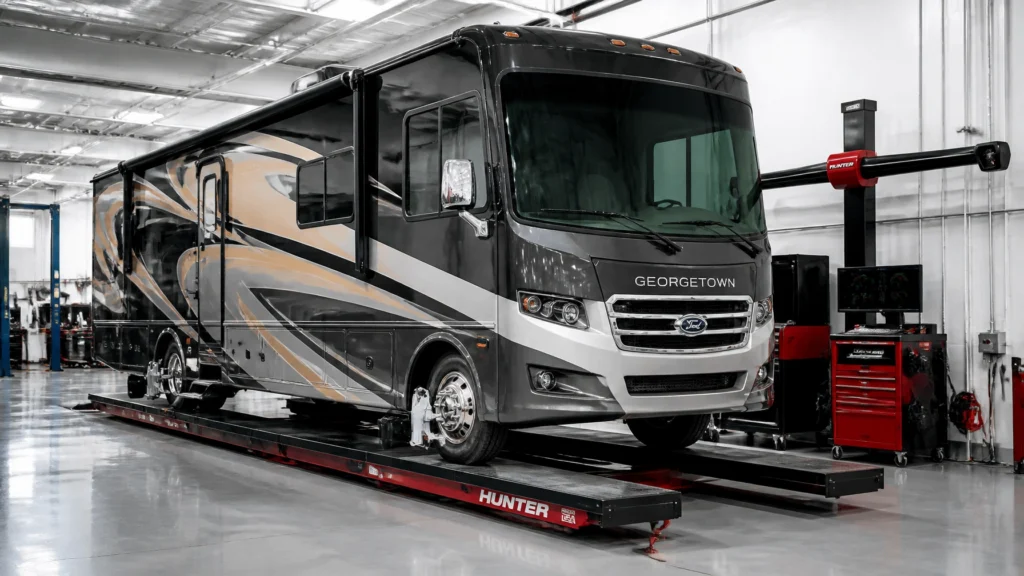
When a Class A gas motorhome is involved in a collision, the structural integrity of the entire vehicle hinges on a single, massive component: the Ford F-53 stripped chassis. As the backbone for over 80% of the gas-powered motorhomes on the road today: including those from Thor Motor Coach, Winnebago, Jayco, and Forest River: the F-53 is a marvel of commercial engineering designed to support up to 26,000 pounds of living space. However, its high-strength steel construction and specialized geometry mean that traditional automotive repair techniques are not just insufficient; they can be dangerous.
At RVCCR, we approach Ford F-53 repairs with the precision of a laboratory and the heavy-duty equipment of a commercial rail yard. Restoring a motorhome to factory specifications requires an intimate understanding of Ford’s specific metallurgy, the 1/8-inch tolerance standards required for safe tracking, and the complex interaction between the chassis and the coachbuilder’s fiberglass "house." Whether your RV has suffered a front-end impact that tweaked the frame rails or a rear-end collision affecting the hitch assembly, the path to a safe return to the road is paved with technical rigor and manufacturer-certified processes.
The complexity of these repairs is often underestimated by insurance adjusters and general auto body shops. From the heat-sensitive nature of the High-Strength Low-Alloy (HSLA) steel to the specific torque sequences of the body mounting brackets, the F-53 chassis demands a level of expertise that few facilities in the Inland Empire can provide…
Engineering the Backbone: Understanding the Ford F-53 Specifications
To understand why collision repair on a gas motorhome is so specialized, one must first look at the raw specifications of the Ford F-53. Unlike a standard pickup truck frame, the F-53 is a "stripped chassis," meaning it arrives at the coachbuilder as a bare frame with an engine, transmission, and steering column.
Gross Vehicle Weight Rating (GVWR) Ranges
The F-53 is not a one-size-fits-all platform. It is engineered in five distinct weight ratings to accommodate everything from 28-foot weekenders to 40-foot luxury gas pushers:
- 18,000 lbs: Found on entry-level, shorter Class A models.
- 20,000 lbs: The mid-range standard for many popular floorplans.
- 22,000 lbs: Features heavier-duty suspension components.
- 24,000 lbs: Utilizes a thicker frame rail and upgraded braking systems.
- 26,000 lbs: The flagship of the gas chassis world, requiring massive structural rigidity.
The Powertrain: V10 Triton and Beyond
For decades, the heart of the F-53 was the 6.8L V10 Triton engine, paired with the TorqShift 6-speed automatic transmission. In 2020, Ford transitioned to the 7.3L V8 "Godzilla" engine. In a collision, these engines represent a massive concentration of kinetic energy. Because the engine sits directly between the front frame rails, a front-end impact doesn't just damage the radiator; it often shunts the engine backward or sideways, transferring stress directly into the frame’s "kick-up" sections.
Frame Rail Construction
The F-53 utilizes a "C-channel" frame design. These rails are constructed from 1/4-inch thick high-strength steel with a yield strength typically ranging from 36,000 to 50,000 PSI. This material is chosen for its ability to flex under the weight of a moving motorhome while maintaining a rigid platform for the house. However, this high-strength steel (HSS) has a "memory." Once it is bent beyond its elastic limit in an accident, it cannot simply be hammered back into shape.

Common Collision Damage Patterns in Gas Motorhomes
When an RVCCR technician evaluates an F-53 chassis after an accident, they are looking for specific "damage signatures" that are unique to this platform.
1. Front Cap Impacts and Frame Rail "Sway"
The most common F-53 collision involves the front fiberglass cap. Because there is very little "crumple zone" between the front bumper and the driver’s feet, the impact forces are transmitted immediately to the front frame horns. This often results in "sway": where both frame rails are pushed to one side: or "diamonding," where one rail is pushed further back than the other. If the frame is swayed even a fraction of an inch, the motorhome will never track straight again, leading to rapid tire wear and dangerous handling.
2. Side Impacts and Body Mounting Brackets
Gas motorhomes are wide, making them susceptible to side-swiping accidents. While the fiberglass walls may take the brunt of the visible damage, the real concern lies beneath. The coachbuilder attaches the "house" to the F-53 chassis using a series of outriggers and body mounting brackets. These brackets are designed to be rigid, but a lateral impact can shear the bolts or bend the outriggers. If these aren't replaced or realigned to factory specs, the entire coach can become un-bonded from the chassis, leading to structural squeaks, leaks, and eventual failure of the wall-to-floor seals.
3. Rear Impacts and Hitch Distortion
Rear-end collisions in a motorhome often involve the hitch assembly. The F-53 frame rails extend far behind the rear axle, creating a long lever arm. An impact at the hitch can actually "tweak" the frame rails all the way up to the rear suspension hangers. We often see cases where a rear impact has caused the frame rails to "kick up" or "sag," which compromises the RV's ability to tow safely in the future.
The Ford-Certified Repair Protocol: Why Precision Matters
Repairing a Ford F-53 is not about "close enough." Ford’s official workshop and body repair manuals dictate very specific tolerances that must be met for a vehicle to be considered roadworthy.
The 1/8-Inch Tolerance Rule
While some general shops might think a quarter-inch of variance is acceptable on a vehicle that is 35 feet long, Ford’s engineering standards are much tighter. To ensure the front-end alignment can be brought back to factory specifications and that the thrust angle of the rear axle is correct, the frame must be straightened to within 1/8 inch (approximately 3mm) of its original dimensions across all datum points.
At RVCCR, we use laser-guided measuring systems that provide a three-dimensional map of the chassis. By comparing your damaged frame to the factory-original blueprint for your specific F-53 wheelbase, we can identify exactly where the metal has shifted.
"Cold Pulling" vs. Heat Straightening
One of the most dangerous mistakes a non-certified shop can make is applying heat to an F-53 frame rail. Modern high-strength steel is heat-treated at the factory to achieve its specific strength. If a technician uses a torch to "get the metal glowing" so it's easier to pull, they are effectively destroying the temper of the steel. This creates a soft spot in the frame that can buckle under the weight of the motorhome during the next bump or emergency maneuver.
Ford explicitly prohibits heat straightening on F-53 frame rails. We utilize heavy-duty "cold pulling" techniques, using hydraulic towers capable of exerting tens of thousands of pounds of force to move the steel back into its original "memory" position without compromising its molecular integrity.
Specialized Welding for High-Strength Steel
In cases where a frame rail is too damaged to be pulled, Ford allows for specific "sectioning" procedures: but only in designated areas. Welding on an F-53 frame is a high-stakes operation. You cannot weld on the top or bottom "flanges" of the C-channel, as this is where the highest tension and compression forces occur. All welds must be on the "web" (the vertical side) of the rail and must follow specific GMAW (MIG) welding protocols with approved wire types.

F-53 Gas Chassis vs. Freightliner Diesel Chassis: Key Differences in Repair
Many RV owners ask why their gas motorhome repair is handled differently than a neighbor’s diesel pusher. The differences between the Ford F-53 and a Freightliner S2RV or Custom Chassis are significant.
- Braking Systems: The F-53 uses a hydraulic braking system (often the Hydro-Max system), whereas diesel pushers use air brakes. A front-end impact on an F-53 requires a complete inspection of the master cylinder and hydraulic lines which are tucked tightly against the frame.
- Frame Profile: Freightliner and Spartan diesel chassis often use "I-beam" or massive "raised rail" configurations that are significantly thicker than the F-53's C-channel. While the F-53 is incredibly strong, it is more susceptible to "twisting" during an impact than the heavier diesel frames.
- Engine Orientation: In an F-53, the engine is in the front. This means a collision involves cooling systems, fuel delivery, and steering linkage all in one zone. In a diesel pusher, the engine is in the rear, meaning a front impact is mostly about the "house" and the steering gear.
Navigating these differences requires a shop that doesn't just do "collision repair," but understands the specific mechanical architecture of Ford's commercial vehicle line. This is why we emphasize the importance of OEM parts vs aftermarket when dealing with structural components; a generic bracket or bolt simply cannot match the grade-8 specifications Ford requires for these chassis.
Ford F-53 Technical Service Bulletins That Affect Collision Repairs
A Ford F-53 repair should not be based on general truck practice or a technician’s memory. It should be based on the exact service information that applies to that chassis. That includes Ford workshop procedures, body repair standards, and technical service bulletins that clarify how specific conditions must be inspected, corrected, and documented after damage. When a motorhome owner hears that a shop can “straighten the frame and line it back up,” that statement only becomes meaningful if the work also follows the specific Ford standards that govern structural condition, body mounting, and post-repair alignment.
For F-53 owners, three bulletin-level topics matter directly in collision repair because they affect whether the chassis can be safely repaired, how the coach body must be re-secured to the frame, and what alignment targets must be used once structural work is complete. These are not generic RV rules. They are the kind of model-specific details that separate a proper heavy-duty collision repair from a cosmetic patch job.
TSB 22-1245: Frame Rail Corrosion Inspection and Repair Limits
TSB 22-1245 addresses frame rail corrosion inspection and repair procedures for 2016-2025 Ford F-53 chassis. This matters in collision work because visible crash damage is only part of the structural story. On a motorhome that has seen years of travel, road spray, and storage in mixed climates, a collision estimate may uncover corrosion in the same frame area that now needs to be measured, pulled, sectioned, or reinforced. If a shop ignores that condition and treats the rail like clean, full-thickness steel, the repair plan can be wrong from the start.
The key threshold in this bulletin is direct and important: any frame rail with greater than 30% section loss must be replaced, not repaired. That is a major distinction. A rail that has lost too much material is no longer a candidate for simple straightening or localized patching, even if the damaged area looks small from the outside. The remaining steel no longer has the original section properties needed to carry the load of the coach body, suspension, drivetrain forces, and towing loads.
In real-world collision repair, this affects several decisions:
- Whether a rail can be cold-pulled and returned to spec.
- Whether sectioning is still structurally appropriate.
- Whether the insurer’s initial estimate is incomplete because replacement is required.
- Whether the repair timeline expands due to parts sourcing and disassembly.
On a Class A gas motorhome, this issue is amplified by the weight the F-53 carries every day. The frame is not only supporting the cab and drivetrain. It is carrying slide mechanisms, holding tanks, cabinetry, appliances, roof loads, and often hitch loads at the rear. Once corrosion reduces a rail beyond Ford’s allowable limit, restoring shape alone does not restore strength. Replacement becomes the safe path.
TSB 21-0987: Body Mounting Bracket Torque Sequence After Collision Repair
TSB 21-0987 covers the correct torque sequence for body mounting brackets after a collision repair. This is a detail that many general body shops underestimate because the brackets do not look dramatic compared with a bent frame horn or crushed cap. But on a motorhome, the relationship between the coach structure and the chassis is critical. If the body mounting system is reassembled incorrectly, the owner may end up with squeaks, stress cracks, water intrusion, ride complaints, and uneven load transfer back into the frame.
According to this Ford procedure, the body mounting brackets must be tightened in a specific center-out, alternating-side sequence and torqued to 120-140 lb-ft. They are not supposed to be tightened “until snug” or by feel. That matters because uneven bracket loading can introduce twist into the mounted coach structure even when the frame itself has already been measured and corrected.
After a side impact or a front-end hit that jars the coach body against the frame, the brackets and outriggers should be treated as part of the structural repair process, not as an afterthought during reassembly. The proper torque pattern helps ensure:
- The coach body settles onto the chassis evenly.
- Mounting loads are distributed instead of concentrated.
- Bracket movement does not preload one side of the body.
- Seal lines, floor support points, and wall-to-floor connections remain stable.
This is one of those procedures that does not create a flashy before-and-after photo, but it has a real effect on long-term durability. A large motorhome can hide poor bracket reinstallation for a while, then develop chronic noise, shifting, or seal problems months later. Following the exact torque sequence reduces that risk.
TSB 20-1156: Alignment Specifications After Frame Repair
TSB 20-1156 covers the front-end alignment specifications to be used after any frame repair on the Ford F-53 chassis. This is one of the most practical bulletin items an owner can ask about because an RV can look repaired and painted yet still drive poorly if the final alignment is handled like a generic truck setup.
Ford’s specified targets here are concrete:
- Caster: +4.5 to +5.5 degrees
- Camber: 0 to +0.5 degrees
- Toe: 0.08 to 0.16 inches total
Those are the actual F-53 specifications cited in the request, not broad commercial alignment ranges. They matter because a motorhome’s weight distribution, wheelbase, and steering feel are very sensitive to caster and thrust conditions. A shop that uses “close enough” truck numbers may deliver a coach that technically rolls straight out of the building but still wanders on the freeway, reacts poorly to crosswinds, or wears front tires unevenly.
After structural repairs, these specs should be treated as a required verification step, not an optional add-on. If the alignment machine printout does not show that the repaired chassis was brought back into Ford’s intended operating range, the repair is incomplete from a handling standpoint. For owners, that alignment report becomes part of the proof that the coach was not simply made to look straight, but was returned to a documented post-repair standard.
Suspension Geometry After Frame Repair: Why It Matters
A frame can measure straighter than it did on the day it arrived and still produce handling problems if the suspension geometry is not checked carefully afterward. That point is especially important on the Ford F-53 because this chassis uses a solid front axle with leaf springs, not the suspension layout many passenger-car body shops are used to seeing. The axle, spring hangers, shackles, brackets, and frame relationship all work together. If one mounting point is still off after the frame is pulled, the motorhome may drive poorly even when the frame rails appear visually corrected.
This is why post-repair geometry is not just a follow-up procedure. It is part of the structural repair itself.
Front Spring Hanger Position Affects Caster
On the F-53, the front spring hangers establish the axle’s relationship to the frame. If those mounting points shift during a collision, or if they do not return precisely to their original location during frame correction, caster will not land where it should. The threshold that matters here is tight: if the front spring hangers are not within 1/8 inch of their factory position, the caster angle will be incorrect.
That small error can create very noticeable symptoms in a motorhome:
- Wandering at highway speed
- A steering pull to one side
- Poor on-center feel
- Extra driver fatigue in wind or crowned-road conditions
Because a Class A gas motorhome presents so much side area to wind and carries substantial weight over a long wheelbase, small geometry errors become large drivability complaints. Owners often describe the result as “it never drove the same after the repair,” even if the cosmetic work looked excellent. In many cases, the cause is not mystery handling behavior. It is geometry that was not restored tightly enough.
Rear Axle Squareness Prevents Dog-Tracking
The rear axle also has to be square to the frame within 1/8 inch. If it is not, the motorhome can dog-track, meaning the rear of the coach does not follow directly behind the front. On a smaller vehicle, a slight thrust-angle issue may only show up as tire wear or a crooked steering wheel. On a 30- to 40-foot motorhome, it can be much more obvious. The coach may seem to drift, feel unsettled, or look visibly off-line from behind.
Rear axle squareness affects:
- Straight-line tracking
- Steering correction on the highway
- Tire wear patterns
- Stability when towing
- Driver confidence over long distances
This is one reason a repaired F-53 should never be judged only by whether the body gaps look good or whether the steering wheel is roughly centered on a short road test. The axle-to-frame relationship has to be measured and verified.
Heavy-Duty Alignment Is Mandatory, Not Optional
After frame repair, a heavy-duty four-wheel alignment is not optional — it is a mandatory step. The equipment matters as much as the procedure. The alignment must be performed on a Hunter or John Bean heavy-duty alignment rack, not on a standard passenger-car rack. A typical automotive alignment setup is not designed for the length, weight, ride height, or measurement needs of a Class A motorhome built on an F-53 chassis.
Proper heavy-duty alignment after frame work helps confirm:
- The frame correction translated into usable suspension geometry.
- The axle locations are correct relative to the chassis.
- The steering system can be set to Ford’s post-repair alignment targets.
- The coach is ready for real road use, not just delivery around town.
The final alignment report should be included in the owner’s repair documentation. That report is not just paperwork for the file. It gives the owner and insurer a concrete record of the post-repair setup, and it provides a useful baseline if any future handling complaint needs to be evaluated. On a large motorhome, documentation is part of quality control.
The Paint Booth Requirement for 40-Foot Motorhomes
Structural repair is only one half of a major motorhome collision job. Once the frame, mounts, suspension, and body structure are corrected, the coach still has to be refinished in an environment large enough to do the job properly. This is where many general body shops run out of capability. Painting a 40-foot Class A motorhome is not the same as painting a pickup, SUV, or even a box truck with a simple fleet finish.
The size of the booth matters. The airflow matters. The cure cycle matters. And if those factors are wrong, the finish quality and long-term durability can suffer.
Why Standard Auto Body Booths Fall Short
A standard auto body paint booth is typically 20-24 feet long with 10-foot ceilings. That works for most passenger vehicles, but it is not enough for a full-size Class A motorhome. A 40-foot motorhome requires a booth at least 50 feet long with 14-foot ceilings. Without that room, the shop cannot maintain proper clearance, access, airflow, and spray pattern consistency around the entire vehicle.
This matters in practical terms because a large RV cannot be refinished correctly if:
- The painter cannot move the full length of the unit safely.
- The roofline and upper cap areas crowd the booth ceiling.
- Air movement is disrupted by the coach filling too much of the chamber.
- Masking, staging, and multi-color layout become cramped.
A shop may still attempt spot repairs or partial spraying in a booth that is too small, but that does not mean it is equipped for full-scale Class A refinish work.
Air Velocity and Fire Safety Requirements
For a motorhome-sized booth, airflow is not just about overspray control. The booth must have a minimum 100 feet per minute air velocity across the booth face to meet NFPA 33 fire safety standards. That level of air movement helps control vapors, support a safer spray environment, and maintain more consistent paint application across a very large surface area.
On a 40-foot coach, the painted surfaces are expansive and often include:
- Tall sidewalls
- Large front and rear caps
- Multi-stage color and graphics transitions
- Broad clear-coated sections that reveal inconsistencies quickly
If airflow is weak or uneven, the finish can suffer from contamination, inconsistent metallic orientation, uneven flash behavior, or other refinishing defects that become obvious on large flat side panels.
Cure Temperature for Waterborne Paint Systems
The booth also needs to support the proper bake cycle. For this kind of work, the bake cycle temperature must be maintained at 140-160°F for the waterborne paint to cure properly. On a large motorhome, maintaining temperature consistently across the size of the coach is more demanding than curing a smaller passenger vehicle. Uneven cure conditions can affect gloss, hardness, and long-term finish performance.
That is one reason many auto body shops simply are not set up to handle a full 40-foot RV refinish. Even if the staff has general paint experience, the facility itself may not be capable of delivering the environmental control the job requires.
Why This Facility Detail Matters to Owners
Most auto body shops cannot accommodate a 40-foot motorhome in their paint booth. That is not an insult to those shops. It is simply a facility limitation. Owners should know the difference because a collision repair estimate can look complete on paper while leaving out a major question: where, exactly, will the coach be painted, and under what booth conditions?
RVCCR’s oversized booth is designed specifically for this purpose. That matters because large-scale RV refinishing is not just about making the coach glossy again. It is about controlling the environment well enough to support proper color application, safe booth operation, and dependable curing on a vehicle that may be longer than two passenger cars parked nose to tail.
The Role of RVDA and Ford Certification in Your Repair
Choosing a shop for your motorhome is a decision that affects the safety of your family for thousands of miles. At RVCCR, we combine several layers of certification to ensure your F-53 is handled correctly.
RVDA/RVTI Certification
Our technicians are certified by the RV Dealers Association (RVDA) and the RV Technical Institute (RVTI). This means they understand the "house" side of the repair: the plumbing, electrical, and fiberglass systems that sit on top of the Ford chassis.
Ford Commercial Vehicle Standards
Because the F-53 is a Ford commercial product, we follow the same repair logic used for Ford’s heavy-duty truck fleet. This includes access to Ford’s proprietary frame dimension charts and technical service bulletins (TSBs). If there is a specific update to a body mount or a steering stabilizer, we have the data to implement it.
Defending Your Right to a Certified Repair
Insurance companies often try to steer RV owners toward "preferred" shops that may have never seen a Ford F-53 chassis. These shops might try to "rough in" the frame repair or use recycled parts that don't meet Ford’s safety standards. We are well-versed in handling insurance steering and will fight to ensure your adjuster approves the specific, manufacturer-required procedures your motorhome deserves.

The RVCCR Difference: Beyond the Frame
While the F-53 chassis is the foundation, a successful collision repair must also address the mechanical and aesthetic components that make your motorhome a home.
Mechanical Integrity and Alignment
After the frame is straightened, the job is only half done. An F-53 chassis that has been in a collision requires a heavy-duty four-wheel alignment. We check the caster, camber, and toe, but we also check the "axle setback." If the impact shifted the front axle by even a few millimeters, the RV will "dog-track" down the highway. Our mechanical team ensures that your steering gear, suspension bushings, and kingpins are all within spec.
Paint and Body: Seamless Integration
The fiberglass front and rear caps on gas motorhomes are massive, often spanning the entire 8-foot width of the vehicle. Repairing these requires expert composite work to prevent future cracking. Once the structural repairs are complete, our paint team uses computerized color matching to ensure that the complex multi-tone graphics and clear coats of your Thor or Winnebago are indistinguishable from the original factory finish.
Our expertise isn't limited to gas chassis, either. We apply the same level of structural scrutiny to all vehicles, whether it's an RV or a high-tech EV, which you can learn more about in our deep dive on Tesla certified collision repair. The common thread is a commitment to manufacturer standards.
Protecting Your Investment and Your Safety
A Class A motorhome is one of the most significant investments most people will ever make. More importantly, it is the vessel for your family’s adventures. Allowing an uncertified shop to work on your Ford F-53 chassis is a risk that simply isn't worth taking. From the 50,000 PSI steel to the 1/8-inch alignment tolerances, every detail matters.
When you bring your motorhome to RVCCR, you aren't just getting a body shop; you’re getting a team of Ford-savvy, RVDA-certified specialists who treat your chassis with the respect its engineering demands. We coordinate with your insurance, provide transparent estimates, and back our work with a written lifetime warranty.
Don’t let a collision end your travel season permanently. Let us restore the backbone of your motorhome so you can focus on the road ahead. Contact RVCCR today for a professional F-53 chassis evaluation and let’s get your adventure back on track!
Need a repair estimate?
Skip the wait — send us a few photos and our team will get back to you fast.
Start a Photo Estimate →