RV Awning and Exterior Component Repair After a Collision: What Your Insurance Covers and What It Doesn’t
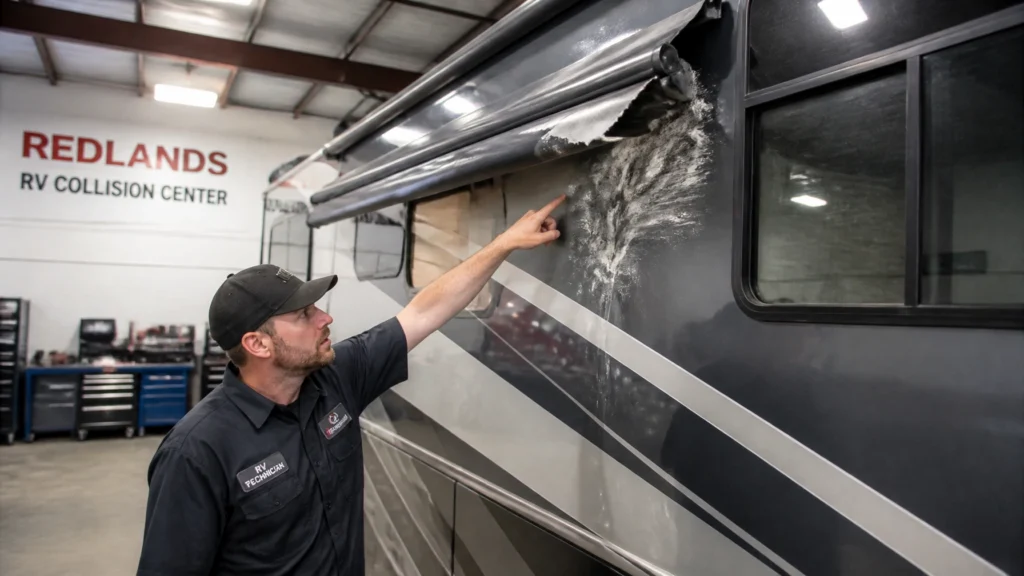
Operating as a family-owned collision, paint, and mechanical repair center with 21 years of dedicated service and RVDA-certified technicians, RVCCR in Redlands handles complex motorhome and travel trailer restorations daily. When an RV is involved in a collision: whether a sideswipe on Interstate 10, a misjudged turn at a campground, or a low-branch impact: the structural damage is rarely confined to the primary sheet metal or fiberglass sidewall. Exterior accessories and mounted hardware take a severe brunt of the force. From heavy-duty motorized patio awnings and roof-mounted air conditioning shrouds to delicate slide-out toppers, entry steps, and antenna assemblies, these components represent thousands of dollars in replacement and labor costs. Navigating the insurance claims process for these specialized parts requires a precise understanding of policy definitions, coverage classifications, and strict documentation protocols…
The Anatomy of an RV Exterior Collision: Beyond the Main Sidewall
When a recreational vehicle suffers an impact, the physics of the collision dictate that protruding exterior fixtures are often the first to absorb kinetic energy. Unlike passenger automobiles with smooth, aerodynamic contours, motorhomes, fifth wheels, and travel trailers feature numerous overhangs, brackets, tracks, and housings secured directly to the sidewall studs or roof framing.
Understanding the structural integration of these components is essential for both repair execution and insurance negotiation. For a comprehensive overview of how structural integrity differs across trailer types, review our detailed guide on fifth wheel vs. travel trailer collision repair.
When an insurance adjuster evaluates a claim, they look at the vehicle as an assembly of distinct risk categories. However, professional rv collision repair requires looking at how a single impact event transmits stress across multiple attached sub-assemblies. A glancing blow that compresses the upper roof radius rail will simultaneously twist the awning rail, fracture the drip molding, shear the fasteners of the upper bracket, and distort the internal torque arm of a motorized lateral-arm awning. If the adjuster writes the estimate solely for the fiberglass panel replacement while ignoring the structural torsion transferred to the awning mounting extrusion, the repair will ultimately fail, leading to water intrusion, wind noise, or mechanical binding down the road.

Classification of Exterior Components: Collision vs. Comprehensive vs. Appliance Claim
One of the most frequent friction points between RV owners, repair shops, and insurance adjusters is how different exterior items are classified under standard motorhome insurance policies. Insurers do not treat all damage equally, and the distinction between collision, comprehensive, and property endorsement coverage dictates whether your deductible applies and whether the claim is approved.
1. Collision Coverage (Direct Impact)
Collision coverage applies when your RV strikes another vehicle or stationary object (such as a guardrail, low-hanging bridge, tree trunk, or building pillar), or if the vehicle rolls over.
- Covered Items: Direct impact damage to patio awnings, window awnings, slide-out toppers, exterior ladders, grab handles, porch lights, storage compartment doors, and permanent exterior entertainment centers resulting directly from the collision event.
- Deductible Application: Subject to your standard collision deductible (e.g., $500 or $1,000).
2. Comprehensive Coverage (Non-Collision Perils)
Comprehensive coverage handles physical damage resulting from events outside of a vehicle-to-object collision.
- Common Scenarios: Falling tree branches during a storm that crush an AC shroud and tear off an awning, severe wind gusts that catch an extended patio awning and rip it off the roof rail, vandalism, or fire.
- Crucial Distinction: If wind catches an awning while you are parked at a campground, insurers generally classify this under comprehensive. However, if wind catches an awning while driving down the highway, or if the awning deploys due to a mechanical failure caused by a previous impact, the classification can become disputed territory requiring expert diagnostic documentation from a certified motorhome collision repair facility.
3. Endorsements and Specialized Property Coverage
Many standard auto policies or basic RV policies limit coverage for "attached accessories" or "permanent fixtures" to a nominal amount (often $1,000 to $2,000) unless a specific endorsement (such as Optional Equipment Coverage or Personal Effects/Awnings endorsement) is purchased.
- High-end electric lateral-arm awnings with integrated LED lighting systems, automated wind sensors, and heavy-duty extruded aluminum cases frequently exceed standard accessory caps.
- Without proper schedule listing or specialized RV endorsements, an owner may face out-of-pocket expenses for the difference between actual cash value (ACV) and replacement cost. For guidance on how repair expenses are itemized and analyzed, consult our breakdown on how to read a collision repair estimate.

Detailed Breakdown of Vulnerable Exterior Components
To ensure nothing is overlooked during an insurance appraisal, let's examine the specific exterior components most frequently damaged in collisions and how professional shops restore them to factory specifications.
Patio Awnings (Manual vs. Motorized Lateral-Arm)
Awnings are among the most expensive exterior accessories on a modern motorhome or travel trailer.
- Manual Spring-Loaded Awnings: Consist of a fabric roll tube, torsion springs, support arms, and top/bottom mounting brackets. In a collision, the arms easily bend or twist, putting uneven tension on the roller tube. Repairing these requires safely unwinding the high-tension torsion springs: a procedure requiring specialized winding tools to prevent severe personal injury.
- Motorized Lateral-Arm Awnings: Feature 12-volt tubular motors, articulated folding arms, electronic control boards, and often pitch-adjustment sensors. A side-impact collision can distort the extruded aluminum mounting channel, sheer the internal gears of the motor head, or crack the control box. Replacing these requires precise alignment along the sidewall studs to prevent binding during extension and retraction. Furthermore, matching OEM fabric colors and patterns (such as Acrylic Sunbrella materials) is critical to preserving the coach’s visual value.
Roof Vents, MaxxAir Covers, and Air Conditioning Shrouds
The upper roof profile of an RV is exceptionally vulnerable to low-clearance impacts, overhead tree limbs, and rollover events.
- AC Shrouds: Molded ABS or polycarbonate covers protect delicate condenser coils and compressor wiring. A minor branch scrape can shatter these shrouds. Insurance adjusters sometimes write these off as minor cosmetic items, but a cracked shroud allows rainwater to infiltrate the condenser unit, frying the electronic control board.
- Roof Vents and Skylights: Multi-layered polycarbonate skylights over showers and main living areas shatter instantly upon impact. Because these are sealed with specialized self-leveling lap sealants (such as Dicor) and butyl tape, replacement involves meticulous scraping of old sealants, structural substrate inspection, and flawless re-sealing to prevent catastrophic interior water damage.
Slide-Out Toppers (Awning Covers)
Slide-out awnings protect the roof of extended room extensions from debris, pine needles, and rain.
- When a collision impacts the side of an RV, the slide-out box itself may shift within its rough opening, twisting the slide-out topper roller and tearing the vinyl or acrylic fabric.
- Adjusters frequently miss the fact that a tweaked slide-out topper rail indicates frame shifting or wall racking, necessitating a thorough laser measurement of the wall opening rather than just a simple fabric swap.
Entry Steps (Manual vs. Electric Triple/Quad Steps)
Electric or manual folding steps mounted beneath the entry door take heavy abuse during side-swipes or when backing into low bollards.
- Electric Steps: Equipped with 12V gear motors, linkage arms, and magnetic door switches. A physical impact bends the heavy steel linkage arms, burning out the electric motor as it attempts to cycle past the mechanical obstruction.
- Replacement requires checking the chassis outrigger mounting brackets welded to the main frame rails. If the frame outrigger is bent, simply bolting on a new step assembly will result in misaligned deployment and door interference.
Exterior TV Antennas, Satellite Domes, and Ladders
- Antennas and Domes: Winegard crank-up antennas, King-Quest portable domes, and roof-mounted automatic satellite dishes (like Trav'ler systems) are precision electronics mounted on elevated risers. Collision impact shears coaxial cables, cracks waterproof roof glands, and destroys motorized elevation gears.
- Ladder Assemblies and Grab Handles: Tubular aluminum or steel ladders secured to the rear cap provide access to the walkable roof. A rear-end collision or backing incident pushes the ladder standoffs directly into the fiberglass or aluminum rear cap, starring the gelcoat and introducing structural moisture pathways.

Documentation and Proving Collision Causation
Insurance adjusters operate on evidence. When submitting a claim that includes exterior awnings, accessories, and specialized hardware, the burden of proof rests on demonstrating a direct causal link between the collision event and the damage claimed.
To prevent claim denials or partial payments, professional rv paint and body shop operations follow a rigorous documentation protocol:
- High-Resolution Multi-Angle Photography: Capturing wide shots showing the primary impact zone (e.g., the front-left corner cap) alongside medium and close-up macro shots tracing the transfer of energy along the beltline molding to the patio awning rail.
- Debris and Scratch Vector Analysis: Documenting paint transfer, fresh aluminum scuffs, and fiberglass shear patterns that prove the force traveled upward and rearward into the accessory mount.
- Component Disassembly and Inspection Notes: Removing warped cover plates and shrouds to expose hidden internal fractures in gearboxes, mounting brackets, and underlying wall studs.
- OEM Service Manual References: Citing manufacturer installation specifications that prove a bent awning arm cannot be safely straightened and must be replaced as a complete assembly per factory safety standards.
For insights into how current supply chain dynamics affect repair timelines once parts are ordered and approved, review our analysis on RV parts lead times.
Common Insurance Denial Reasons and How to Appeal Them
Even with thorough documentation, insurance companies occasionally push back on exterior component claims. Recognizing common denial tactics and knowing how to counter them with factual, technical arguments ensures you receive the full coverage you pay for.
Denial Reason 1: "Pre-Existing Wear and Tear"
- The Adjuster's Claim: The adjuster inspects a torn awning fabric or faded arm and claims it shows prior weathering, sun degradation, or age-related brittleness, refusing full replacement.
- The Counter-Argument: While UV degradation weakens fabric over time, a sudden collision imparts high-energy tensile and shear stress that tears material along impact vectors rather than weathering seams. A certified technician can demonstrate fresh stress whitening in the aluminum casting and clean tears in the fabric fibers that coincide exactly with the collision date.
Denial Reason 2: "Accessory Limit Exceeded"
- The Adjuster's Claim: The total cost of the custom electric awning, slide toppers, and roof satellite dish exceeds the policy's standard $1,500 "custom equipment" cap.
- The Counter-Argument: Many awnings and roof components (such as standard equipment patio awnings installed at the factory during primary production) are classified as standard equipment rather than custom aftermarket accessories. Reviewing the original window sticker (build sheet) proves whether the item was factory-installed original equipment, shifting it into the primary physical damage coverage category rather than the restricted accessory endorsement pool.
Denial Reason 3: "Unrelated Mechanical Failure"
- The Adjuster's Claim: An electric step or motorized awning fails to operate after an accident, but the adjuster claims it is an electrical motor failure unrelated to the physical impact.
- The Counter-Argument: Comprehensive diagnostic testing: including voltage drop checks, limit-switch inspection, and physical linkage resistance measurement: proves that the motor failure is a direct consequence of mechanical binding caused by frame and mounting bracket distortion from the crash.

Repair vs. Replacement Thresholds for Exterior Components
Not every damaged component requires outright replacement. Certified technicians evaluate each item against strict safety, structural, and aesthetic thresholds:
- Aluminum Awning Rails & Extrusions: If twisted more than 2 degrees per linear foot or if mounting screw holes are elongated, straightening is structurally impossible. Replacement is mandatory to maintain waterproof integrity against the sidewall.
- Tubular Awning Arms: Any bend, kink, or hairline crack in aluminum casting arms compromises the structural integrity under wind loads. They are non-repairable and must be replaced in matching pairs to ensure balanced tension.
- Fiberglass and Composite Sidewalls: Delamination behind awning mounting brackets requires injection epoxy bonding or complete panel replacement depending on the surface area affected. For professional evaluation, schedule an assessment through our main rv repair intake portal.
Navigating insurance claims for complex RV exterior damage doesn't have to be an uphill battle against adjusters and red tape. With two decades of hands-on expertise, factory certifications, and a commitment to restoring every motorhome to pristine factory specifications, our family-owned team handles the paperwork, negotiations, and meticulous craftsmanship from start to finish. Let us take the stress out of the repair process so you can focus on planning your next great adventure. Reach out to RVCCR today for your free, comprehensive collision estimate and experience true peace of mind on the open road!
Need a repair estimate?
Skip the wait — send us a few photos and our team will get back to you fast.
Start a Photo Estimate →