The EV High-Voltage Disconnect: Why Only Certified Shops Safely Handle a Damaged EV
RVCCR is a Tesla Approved Body Shop, Rivian 3P Certified, and Ford/Lincoln Certified collision facility serving Redlands and the Inland Empire. Updated August 17, 2026.
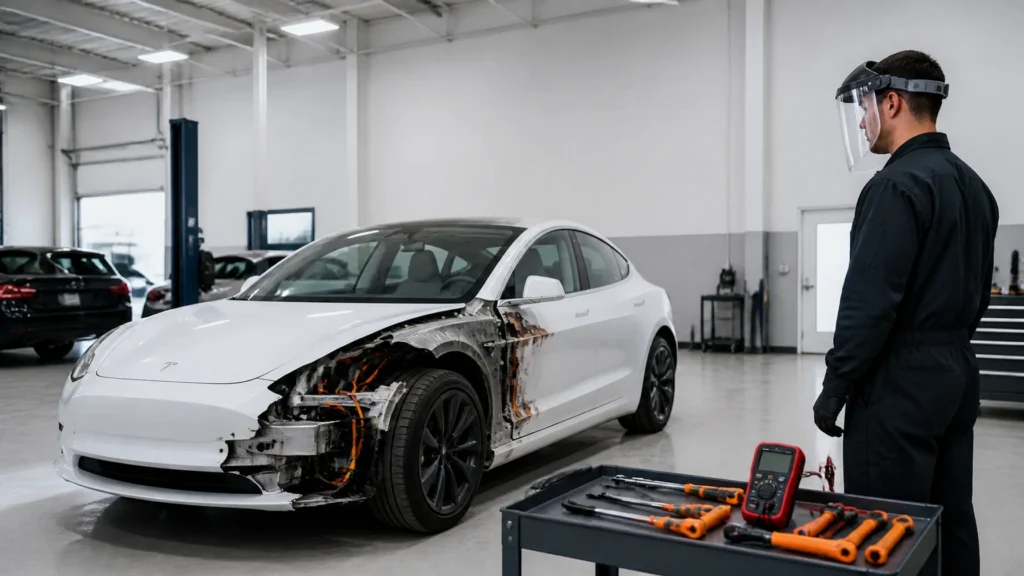
A damaged electric vehicle is not safe simply because its display is dark, its airbags have deployed, or its motor is no longer making noise. Beneath the bodywork may be a high-voltage battery pack, orange cables, inverters, contactors, power electronics, and stored electrical energy that require manufacturer-specific isolation before collision repairs begin…
For an EV owner searching for an ev repair shop near me, the important question is not only whether the facility can repair a dent or match the paint. It is whether the shop has the training, manufacturer information, insulated equipment, protective procedures, and documentation required to disable and verify the vehicle’s high-voltage system before technicians work near it.
That is why a tesla certified collision center, Rivian-certified facility, Ford-certified repairer, or other properly qualified EV collision shop is the appropriate choice after a crash. High-voltage safety is not a generic checklist that can be improvised from one vehicle to another. The correct process depends on the make, model, model year, battery configuration, collision severity, and manufacturer’s service information.
What the EV high-voltage system contains
An electric vehicle’s propulsion system is built around several connected components:
- The high-voltage battery pack, usually mounted beneath the passenger compartment or within the vehicle floor structure
- Orange high-voltage cables that carry electrical energy between the battery and other high-voltage components
- Inverters, which convert battery power into the form required by electric drive motors
- Onboard chargers and DC-to-DC converters
- High-voltage junctions, connectors, busbars, and contactors
- Battery-management and safety-monitoring systems
- Low-voltage systems that control contactors and other vehicle functions
The orange cable color is an important visual warning, but it is not a permission to handle the cable. Manufacturer emergency guides consistently warn responders to avoid cutting, touching, crushing, or allowing tools to contact orange high-voltage wiring until the vehicle has been disabled through the correct procedure.
The battery pack can also remain hazardous even after the vehicle’s high-voltage output has been disconnected. A service disconnect or cut loop may open the circuit that supplies the vehicle’s propulsion components, but it does not automatically make every internal battery component safe to touch. Ford’s F-150 Lightning emergency guide specifically warns that depowering the high-voltage system does not dissipate voltage inside the battery pack.
That distinction is central to collision repair: disconnecting the vehicle is not the same as proving the vehicle is electrically safe for the specific repair operation.
Why a crashed EV can remain dangerous when it looks off
Several conditions can make a damaged EV hazardous even when it appears to be powered down.
The display and READY light are not proof of zero voltage
A dark screen only tells a technician that the vehicle is not visibly operating in its normal user interface. It does not prove that the battery, high-voltage cables, inverter, or other components contain no electrical energy.
Ford’s emergency documentation warns that a vehicle’s high-voltage system may still be energized even when the READY light is not illuminated. Rivian likewise instructs responders to assume the vehicle is energized until the high-voltage system has been disabled.
The correct approach is to follow the vehicle-specific procedure and verify the result with approved test equipment.
Contactors may not open correctly
High-voltage contactors are electrically controlled switches that connect or isolate portions of the battery system. In a normal shutdown, the vehicle’s control systems command the contactors to open. After a crash, however, wiring, control systems, battery components, and contactors may be affected.
A contactor that is damaged, welded, or seized may not behave as expected. Tesla’s Model 3 high-voltage disablement procedure includes voltage measurements that can identify a possible contactor problem. If the measured voltage does not meet the procedure’s criteria, the technician must stop and follow the manufacturer’s escalation path rather than continue with repair work.
That is one reason simply disconnecting the 12-volt battery is not enough. The low-voltage system controls many high-voltage functions, but the shop still has to complete the manufacturer’s isolation and verification steps.
Airbag deployment does not make the battery safe
Airbag deployment confirms that a crash event occurred. It does not prove that the high-voltage battery is discharged or that all restraint-system energy has been released.
The supplementary restraint system and high-voltage system are related to the vehicle’s crash response, but they are not the same system. Manufacturer procedures specify waiting periods and separate verification requirements. Rivian’s emergency guide, for example, instructs responders to wait after cutting the cut loop so remaining restraint-system energy can discharge. Tesla’s service procedure requires testing at specified high-voltage points.
A technician should never infer electrical safety from the fact that airbags have already deployed.
The battery may be physically damaged
A battery enclosure can be dented, punctured, shifted, or otherwise compromised by an impact. Damage may involve the enclosure, mounting points, cooling system, internal modules, cell groups, or insulation between the high-voltage system and the vehicle body.
Some battery damage is visible. Some is not.
Warning signs can include:
- Smoke or vapor
- Unusual heat
- Sparks or arcing
- Hissing, popping, bubbling, or gurgling sounds
- Chemical odor
- Leaking fluid
- New battery or isolation warnings
- An impact directly beneath the battery pack
- A damaged underbody or battery enclosure
If those symptoms are present, the vehicle should not be treated as an ordinary collision repair intake. Emergency services and manufacturer-specific guidance may be required.

The high-voltage disconnect is a controlled safety process
A proper HV disconnect is not one universal switch. It is a controlled sequence designed to:
- Identify the exact vehicle and configuration
- Stabilize the vehicle against movement
- Remove the vehicle from charging equipment, if connected
- Power down the vehicle according to the OEM procedure
- Isolate low-voltage or mid-voltage control power as specified
- Open the manufacturer-designated HV disconnect, service disconnect, or cut loop
- Wait the prescribed time for stored energy to dissipate
- Use appropriate PPE and insulated equipment
- Test the specified points for absence of hazardous voltage
- Document the result before intrusive repair begins
The order matters. The tools matter. The measurement points matter. The waiting period matters. The technician’s qualification matters.
OSHA’s electrical safety rule, 29 CFR 1910.333, requires exposed live parts to be deenergized before employees work on or near them unless a documented exception applies. It also requires the deenergized condition to be verified with test equipment. OSHA further states in 29 CFR 1910.335 that appropriate electrical protective equipment and insulated tools must be used where electrical hazards exist.
Those general workplace requirements do not replace the vehicle manufacturer’s procedure. They reinforce why the procedure has to be followed.
Tesla’s manufacturer-specific disablement procedure
Tesla’s current Model 3 Service Manual includes a Vehicle HV Disablement Procedure and states that only technicians who have completed the required certification courses, or equivalent training, should perform it.
The Tesla procedure is more detailed than simply turning the vehicle off. At a high level, it requires the technician to:
- Disconnect 12-volt or low-voltage power according to the applicable service procedure
- Verify that the meter is functioning correctly
- Remove metal jewelry and conductive objects from pockets
- Inspect high-voltage insulating gloves
- Wear HV insulating gloves, leather outer gloves, and safety glasses when required
- Access the designated HV probe area
- Measure voltage at specified battery contactor and HV locations
- Interpret the readings using Tesla’s model-specific criteria
- Return to the repair procedure only after the vehicle meets the required isolation condition
For the Model 3 procedure reviewed for this article, Tesla uses a measurement table involving B+, B-, and ground points. Measurements below 10 volts are identified as passing for the listed tests; readings of 10 volts or more require further action, including a possible contactor-seize check.
That threshold should not be copied as a universal rule for every EV. Different Tesla models, battery configurations, and repair operations can have different access points, testing requirements, and tools. The technician must use the current procedure for that specific vehicle.
Tesla also warns that high voltage should be assumed present until proven otherwise, that indicators can fail, and that technicians should use a properly rated high-voltage meter or voltage-absence tester where required by local rules. If a repair instruction is unclear, the technician is expected to escalate rather than guess.
Read the Tesla Model 3 Vehicle HV Disablement Procedure for the manufacturer’s current technical requirements.
Rivian’s cut-loop and isolation guidance
Rivian’s Emergency Response Guide for the R1T provides a different high-voltage disablement approach for emergency response. Rivian states that the vehicle is designed to disable high voltage in a crash, but responders must always assume the vehicle remains energized.
At a high level, the R1T guide directs responders to:
- Chock the wheels
- Place the vehicle in Park
- Stabilize the vehicle
- Access the cut loop under the hood
- Locate the identified loop and cut it at the designated points
- Remove a section so the cut ends cannot reconnect
- Wait for the restraint and related systems to discharge
Rivian warns responders not to attempt this operation when the loop is inaccessible, when the vehicle is on fire, when it is submerged, or when there are signs such as sparks, smoke, increased temperature, hissing, bubbling, or leaking fluid.
The cut-loop procedure in an emergency guide is not a substitute for the complete shop service procedure. A collision repair facility must use the applicable Rivian service information for the vehicle being repaired. Rivian’s shop-level high-voltage service instructions are model- and procedure-specific, and collision work may require additional testing, inspection, battery evaluation, and documentation beyond the initial emergency disablement.
Rivian’s guide also warns against contact with orange cables and exposed high-voltage components. That warning remains relevant after the vehicle arrives at a repair facility.
Read Rivian’s official emergency response resources before making assumptions about any specific model.
Ford’s high-voltage disablement options
Ford’s emergency response guidance for the F-150 Lightning distinguishes between urgent and non-urgent disablement situations.
For urgent situations, the guide describes isolating the low-voltage service disconnect and disconnecting the negative battery cable, with the cut or disconnected wiring isolated to prevent reconnection.
For non-urgent situations, the guide describes a controlled procedure that includes:
- Confirming Park
- Confirming the READY light is off
- Deactivating the Pro Power Onboard system when equipped
- Opening the low-voltage service disconnect
- Preventing the connector from closing again
- Waiting at least five minutes
- Continuing with the applicable low-voltage and high-voltage safety steps
Ford also warns that high-voltage depowering does not remove voltage from inside the battery pack. The pack remains dangerous, particularly if it is damaged or opened.
The F-150 Lightning guide further instructs that a severely damaged vehicle should not be stored inside a structure or within 50 feet of a structure or another vehicle. It calls for ongoing inspection for smoke, heat, leaking fluids, sparks, and unusual sounds.
The specific Ford model and repair operation determine which service procedure applies. A Mustang Mach-E, F-150 Lightning, hybrid, or other Ford electrified vehicle may use different access points and steps.
Ford’s First Responder resources provide model-specific emergency information.
PPE, insulated tools, and meter verification
High-voltage safety equipment is not decorative shop equipment. It is part of the control system that protects technicians when electrical hazards cannot be eliminated immediately.
Depending on the vehicle and task, the safety setup may include:
- Voltage-rated rubber insulating gloves
- Leather protector gloves
- Safety glasses or face protection
- Arc-rated clothing where the hazard assessment requires it
- Insulated hand tools
- Properly rated test probes and meters
- Insulating mats or barriers
- Electrical safety hooks
- Warning signs and barricades
- Lockout/tagout materials
- Nonconductive footwear or other protective equipment as specified
Gloves must be inspected before use and maintained according to applicable requirements. Outer gloves protect insulating rubber from mechanical damage. Tools must be designed and rated for the task; ordinary tools with plastic handles are not automatically high-voltage insulated tools.
The meter must also be verified. Tesla’s procedure explains that the test instrument must be capable of handling the required DC voltage and warns that local regulations may require a voltage-absence tester instead of a multimeter.
The basic safety principle is often summarized as test before touch. In professional EV repair, it is more precise:
- Follow the OEM isolation procedure.
- Use the required PPE.
- Use the required test equipment.
- Test the manufacturer-designated points.
- Interpret the result using the manufacturer’s criteria.
- Stop if the result is outside the expected range.
A disconnected cable, dark dashboard, or absent warning light is not a substitute for that sequence.
Why arc flash and fire risks matter
An EV collision creates more than an electric shock hazard. It can also create arc, burn, fire, chemical, and thermal hazards.
An arc can occur when electrical energy jumps across an unintended gap or travels through a conductive tool or damaged component. The result can include intense heat, burns, flying material, equipment damage, or ignition of nearby combustible material. OSHA requires eye and face protection where electric arcs or flashes may create an injury risk and requires insulated tools near exposed energized conductors.
Battery damage creates another concern: delayed thermal events. A lithium-ion battery can develop internal damage that is not immediately obvious during intake. That is why a qualified facility may isolate a damaged EV, use thermal monitoring, control access, and follow the OEM’s storage recommendations before moving the vehicle into the main repair workflow.
For customers, the most reassuring safety process may look uneventful. A vehicle parked away from the main building, marked with warning signs, monitored for heat, and held until its condition is understood is not being ignored. It is being managed.
If there is active smoke, unusual heat, fire, hissing, leaking fluid, or other evidence of a battery event, customers and unqualified personnel should not attempt to inspect or repair the battery. Call emergency services and follow the manufacturer’s emergency response guidance.

What “DSR candidate cells” should mean to a customer
The phrase “DSR candidate cells” deserves careful explanation because it is not a standardized term defined in the Tesla, Rivian, or Ford primary documents reviewed for this article.
A report may use organization-specific terminology such as DSR, diagnostic service report, detailed service report, or another internal abbreviation. “Candidate cells” may refer generally to battery cell groups or modules that a diagnostic system has flagged for additional evaluation. However, the phrase alone does not establish that a cell is damaged, that a cell-level repair is approved, or that a full battery replacement is necessary.
If a shop or insurer uses this wording, ask:
- What does DSR mean in this report?
- Which manufacturer or diagnostic system generated the result?
- Is the finding related to voltage, temperature, isolation resistance, crash data, or another parameter?
- Is the battery enclosure physically damaged?
- Does the OEM permit cell-level or module-level repair for this vehicle?
- What additional tests are required before a repair decision?
- Who is qualified to perform the inspection?
A qualified shop should be able to explain the result in plain English and connect it to the manufacturer’s repair information. No collision facility should invent a battery diagnosis from an unexplained abbreviation.
Battery-management data can be useful, but it does not replace physical inspection, HV isolation, manufacturer procedures, or a qualified battery assessment. In some vehicles, the approved remedy may involve a module or complete pack rather than individual cell work. The correct decision depends on the vehicle and the OEM-approved repair pathway.
Why a non-certified shop may miss critical safety steps
A non-certified facility may be highly capable with conventional collision work and still lack the resources required for a particular EV. The problem is not necessarily carelessness or bad intent. It is often a process gap.
A shop that does not regularly perform EV collision repairs may lack:
- Current manufacturer service information
- Model-specific HV training
- Qualified technicians
- High-voltage meters and test probes
- Insulated tools
- Tested protective gloves
- Dedicated isolation procedures
- Battery storage or monitoring controls
- Manufacturer diagnostic access
- EV-specific repair documentation
- A process for post-repair re-energization
That can lead to shortcuts such as relying on the dashboard, disconnecting only the 12-volt battery, cutting an orange cable without verifying the system, using ordinary tools, skipping meter verification, or returning a vehicle to service without documenting the HV condition.
A certified facility is not automatically perfect, and certification should not be treated as a substitute for asking questions. It does, however, show that the shop has made a formal investment in manufacturer-specific equipment, training, information, and procedures.
When searching for certified auto collision repair, ask the facility:
- Which EV manufacturers currently certify your shop?
- Who performs the high-voltage disablement?
- How do you verify absence of voltage?
- What happens if the meter shows unexpected voltage?
- How do you isolate a vehicle with possible battery damage?
- What scans and calibrations are completed after repair?
- How is the disconnect and reconnect documented?
Specific answers are more meaningful than a generic statement that the shop “works on electric cars.”
Post-repair re-energization is part of the repair
High-voltage safety does not end when the body panels are installed. Re-energizing the vehicle is also a controlled process.
Before restoring power, a qualified technician should follow the manufacturer’s reconnect procedure and confirm that:
- The repair area is complete
- High-voltage connectors are correctly installed
- Required seals, fasteners, covers, and shielding are restored
- No tools, jumpers, loose hardware, or test leads remain
- All employees are clear of the hazard area
- The battery enclosure and cables are properly routed and protected
- The vehicle is ready for controlled power-up
- Required scans and system checks can be performed safely
OSHA’s electrical safety rule requires visual inspection and testing before equipment is reenergized and requires employees who could be exposed to be warned to stay clear. The vehicle manufacturer’s procedure then controls the specific reconnect and startup sequence.
After re-energization, the repair may require:
- A complete diagnostic scan
- Clearing or resolving fault codes
- Verification of battery-management status
- High-voltage isolation checks
- Charging-system verification when authorized
- Cooling-system checks
- Restraint-system inspection
- ADAS calibration
- Road testing under the manufacturer’s requirements
- Final quality-control inspection
A car that starts and drives is not automatically a completed repair. The high-voltage system, restraint system, electrical controls, sensors, and structural repairs all need to be evaluated in relation to the original collision.
Documentation protects the customer and the repair team
A professional EV repair file should document the safety-critical parts of the job. Depending on the vehicle and repair, that can include:
- Vehicle identification and battery configuration
- Initial damage photographs
- Pre-repair scan results
- HV warning or isolation codes
- Manufacturer procedure references
- Date and time of HV disablement
- Technician qualification or authorization
- PPE and equipment checks
- Voltage measurements and test points
- Battery enclosure and cable inspection
- Isolation-area observations
- Parts replaced and repair methods used
- Post-repair scan results
- Re-energization steps
- Calibration records
- Final quality-control inspection
Documentation is useful when communicating with the customer, insurer, manufacturer, and future repair professionals. It also prevents the shop from relying on memory when a repair involves multiple stages.
At RVCCR, our Tesla and EV repair facility combines manufacturer-aligned collision, paint, mechanical, diagnostic, and calibration work. Our OEM certification information explains the manufacturer programs that support our repair capabilities, while our certified auto collision repair process covers the broader path from estimate through final delivery.
What EV owners should do after a collision
If your EV has been involved in a collision:
- Move away from the vehicle if you see smoke, fire, leaking fluid, unusual heat, or hear hissing, popping, or bubbling.
- Call emergency services if there are signs of an active battery or fire hazard.
- Do not touch orange cables or exposed electrical components.
- Do not attempt to open the battery pack.
- Do not assume that airbags, a dark screen, or a disconnected 12-volt battery make the vehicle safe.
- Tell the tow operator that the vehicle is an EV and may have high-voltage damage.
- Use a facility with the appropriate manufacturer certification or qualified EV high-voltage capability.
- Ask how the shop will disable, verify, monitor, repair, re-energize, and document the vehicle.
- Keep copies of scans, repair records, and calibration documentation.
- Do not authorize a repair method that the shop cannot connect to current OEM information.
Choosing the right facility early can prevent unnecessary movement, unsafe storage, incomplete estimates, and avoidable delays.
Why RVCCR is prepared for EV collision repair in Redlands
RVCCR is a family-owned collision, paint, and mechanical repair facility serving Redlands and the Inland Empire. Our manufacturer credentials include Tesla Approved Body Shop, Rivian 3P Certified, and Ford/Lincoln Certified repair capability, along with Honda/Acura, Mazda, and Subaru certifications.
That investment matters because EV collision repair requires more than a body technician and a paint booth. It requires a coordinated process for:
- High-voltage safety
- Manufacturer-specific disablement
- Battery and enclosure inspection
- Structural repair
- Aluminum and mixed-material work
- OEM parts and repair procedures
- Pre- and post-repair scans
- Sensor and ADAS calibration
- Mechanical inspection
- Insurance communication
- Final quality control
We coordinate with major insurance carriers, offer free estimates, and back our collision work with a written lifetime warranty through the Fix Auto network. Most importantly, we explain what the vehicle needs and why before the repair moves forward.
If you are searching for an ev repair shop near me after a Tesla, Rivian, Ford, or other EV collision, choose a facility that treats high voltage as a serious engineering and safety responsibility: not as another line item on an estimate.
The road back to your next adventure
Your EV was built to move your life forward, whether that means commuting through the Inland Empire, carrying your family across Southern California, or leaving Redlands for your next weekend destination. After a crash, the goal is not merely to make the vehicle look repaired. The goal is to restore its structure, electrical systems, safety technology, and confidence on the road.
RVCCR follows the manufacturer-centered process that modern EVs demand. We isolate the risk, verify the system, repair the damage, document the work, validate the vehicle, and help you move forward.
Bring your EV to a certified team that protects the technology beneath the bodywork and gets your next drive back on track.
Request a free estimate from RVCCR
Sources and manufacturer references
- Tesla Model 3 Vehicle HV Disablement Procedure
- Rivian Official Emergency Response Resources
- Rivian R1T Emergency Response Guide
- Ford First Responder Resources
- Ford F-150 Lightning Emergency Response Guide
- OSHA 29 CFR 1910.333: Selection and Use of Work Practices
- OSHA 29 CFR 1910.335: Safeguards for Personnel Protection
Need a repair estimate?
Skip the wait — send us a few photos and our team will get back to you fast.
Start a Photo Estimate →