Towing a Tesla After a Collision: Why Flatbed-Only Rules Protect the Battery and Drive Unit
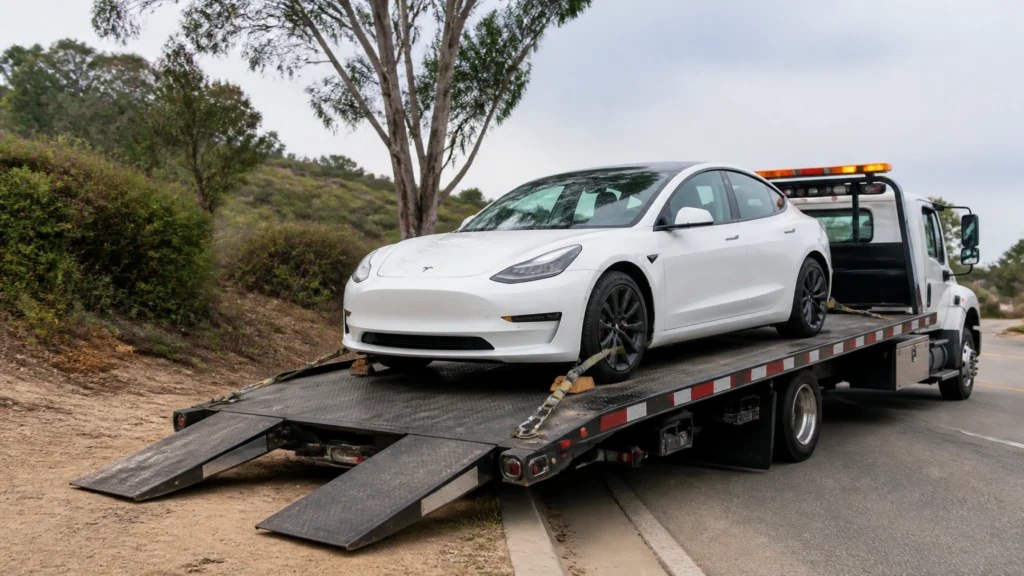
Published August 27, 2026 · RVCCR Tesla Approved Collision Center · Serving Redlands and the Inland Empire
Tesla vehicles require a different towing plan after a collision because the battery pack, drive units, suspension, body structure, and electronic safety systems all remain connected to the vehicle’s transport requirements. RVCCR is a Tesla Approved Body Shop with certified repair capabilities for Tesla models, and our recommendation for a collision-damaged Tesla is straightforward: request a flatbed tow truck with all four wheels off the ground, avoid conventional wheel-lift towing, and do not allow the vehicle to be dragged with any drive wheel rolling on the pavement…
The reason is not simply that a Tesla is expensive. It is that towing equipment can create additional loads through components that may already be damaged or difficult to inspect at the roadside. A tow that appears successful can still leave questions about the battery enclosure, underbody panels, drive unit, suspension, alignment, or high-voltage safety system. Knowing what Tesla’s published towing instructions say: and what to do before and after transport: helps protect the vehicle and preserve useful evidence for your insurance claim.
The short answer: use a flatbed after a Tesla collision
Tesla’s owner manuals direct owners and transporters to move the vehicle onto a flatbed and keep all four tires off the ground. Tesla describes Tow Mode as a way to disengage the parking brake while the vehicle is carefully rolled or winched onto a flatbed. The vehicle is not intended to be pulled down the road with its powered wheels turning.
For a collision-damaged Tesla, a flatbed is the safest and clearest transport choice because it:
- Keeps the tires from rolling on the road during transport.
- Avoids driving or rotating a potentially damaged drive unit.
- Reduces the chance of additional suspension or alignment loads.
- Keeps the vehicle’s underbody from scraping across uneven pavement.
- Makes it easier to document the car’s condition before loading and after unloading.
- Gives the receiving Tesla-certified collision center a more reliable starting point for inspection.
Tesla’s official guidance does describe a limited non-flatbed procedure for some models: a wheel lift may be used with dollies only when all four wheels remain off the ground, subject to the specific owner’s manual’s distance, speed, and equipment restrictions. That is not the same as a conventional wheel-lift tow. After a collision, RVCCR recommends requesting a flatbed rather than relying on a conditional alternative that may be difficult to apply safely at the scene.
A wheel-lift tow with two wheels on the ground is not an acceptable substitute for a flatbed. Dollies that leave any wheel rolling on the pavement also do not meet the basic all-four-wheels-off-the-ground principle in Tesla’s transport instructions.
Why a Tesla’s battery and drive unit need special towing protection
A Tesla’s high-voltage battery pack is located beneath the passenger compartment. The pack is protected by the vehicle’s structure and underbody components, but that does not make the underside immune to collision or loading damage. A vehicle that has struck an object, run over debris, contacted a curb, or suffered lower-body impact needs careful inspection before it is moved.
The drive units also require consideration. Depending on the model and configuration, the vehicle may have one or more electric drive units connected to the powered wheels. If a tow operator allows powered wheels to rotate on the road, the vehicle may experience movement through the drivetrain that Tesla’s transport procedures are designed to avoid.
That does not mean every improperly towed Tesla will automatically suffer battery or drive-unit damage. It means the method introduces avoidable risk and makes it harder to determine whether a later problem came from the collision, the tow, or an unrelated fault. A flatbed removes much of that uncertainty.
Potential areas of concern after improper towing include:
- Battery enclosure and underbody protection: Scraping, impact, deformation, or fastener damage may affect panels and protective components beneath the vehicle.
- High-voltage components: Collision damage can affect cables, connectors, and related systems. These components should be evaluated by trained personnel rather than handled at the roadside.
- Drive unit: A conventional tow with powered wheels on the ground can create unwanted drivetrain movement.
- Suspension and steering: Bent links, damaged wheels, altered ride height, or alignment changes may worsen if the vehicle is dragged or loaded at the wrong angle.
- Tires and wheels: A locked, damaged, or misaligned wheel can resist loading and cause additional damage to the tire, wheel, hub, or suspension.
- Low front or rear clearance: A damaged bumper, undertray, rocker panel, or suspension component can scrape on steep loading ramps.
The correct response is not to guess whether the car is safe to roll. The correct response is to secure it, follow the applicable Tesla manual, and use suitable loading equipment.
Tesla’s published towing instructions: Tow Mode is not ordinary Neutral
One of the most common misunderstandings after a collision is the assumption that selecting Neutral is enough. Tesla’s published owner manuals describe Tow Mode: or a similarly named towing or transport control: as the method for keeping the parking brake disengaged while the vehicle is winched onto a flatbed.
The exact menu path can vary by model, model year, software version, and regional manual. Tesla’s manuals commonly describe a sequence that includes:
- Place the vehicle in Park.
- Make sure the vehicle is on level ground when possible.
- Chock the tires or otherwise secure the vehicle.
- Press and hold the brake pedal.
- Open the applicable towing or service controls on the touchscreen.
- Select Enter Tow Mode or the corresponding transport control.
- Confirm that the screen indicates the mode is active.
- Roll or winch the vehicle slowly onto the flatbed.
- Exit Tow Mode after the vehicle is secured for transport, following the applicable instructions.
Tesla describes the vehicle as free-rolling in Tow Mode. That is why the wheels must be chocked before the parking brake is released. The vehicle should not be left unsecured on a slope, near traffic, or on a loading surface where it could move unexpectedly.
Tow Mode is designed for controlled, short-distance movement such as loading. It is not permission to tow the Tesla behind another vehicle with its wheels on the road.
What if the touchscreen does not work?
A collision may disable the touchscreen, the low-voltage electrical system, the vehicle’s ability to shift, or other functions required to enter Tow Mode. Flooding, severe impact, a depleted low-voltage battery, or damage around the front or rear of the vehicle can also complicate loading.
In that situation, the tow operator should not improvise by dragging the vehicle or attaching equipment to an unsuitable structural or suspension point. Tesla provides model-specific transport procedures, and the operator may need specialized loading equipment to move the vehicle without causing additional damage.
If the Tesla cannot enter Tow Mode, tell the tow company before arrival. Provide the exact model, location, collision conditions, whether the vehicle powers on, and whether the wheels appear straight and mobile. If there is visible underbody damage, smoke, unusual heat, fluid leakage, or a warning related to the high-voltage system, report that information immediately.

Why a conventional wheel-lift tow is a problem
A conventional wheel-lift truck raises one axle and leaves the other axle’s tires on the road. That method may be suitable for some conventional vehicles under the correct conditions, but it is not the default transport method for a Tesla after a collision.
If two wheels remain on the road, the vehicle can roll through the powered axle while being pulled. That can create drivetrain movement and expose damaged components to additional loading. A collision can also leave a wheel locked, turned, bent, or unsupported. Pulling the vehicle in that condition may worsen damage before the shop has completed its inspection.
There are other practical concerns:
- A damaged wheel may not track correctly behind the tow truck.
- A low bumper or underbody panel may scrape as the vehicle is pulled.
- A damaged suspension may collapse or shift during loading.
- A deployed airbag or disabled restraint system can make the vehicle unsafe to operate.
- A tow operator may not know whether the battery pack or high-voltage system has been compromised.
- A wheel-lift attachment can place loads on tires or suspension components that were not designed to carry them in the damaged condition.
Tesla manuals for certain vehicles provide a tightly limited wheel-lift-and-dolly alternative in which all four wheels are elevated and the transport distance and speed remain within specified limits. Owners should understand the distinction: a wheel lift with two tires on the ground is not that procedure. Even the dolly exception should be treated carefully after a collision, especially when the vehicle has visible lower-body, wheel, suspension, or battery-area damage.
For these reasons, a flatbed-only request is a simple instruction that removes confusion at a stressful time.
Low ride height makes loading technique important
A flatbed is the right type of truck, but the operator still needs to load the Tesla carefully. The vehicle’s approach angle, departure angle, tire condition, ride height, and collision damage all affect clearance.
A Tesla with a damaged front fascia may sit lower than normal. A damaged suspension component may alter the vehicle’s stance. A loose undertray or rocker panel may hang below its normal position. Even a Tesla that looks drivable can scrape when the flatbed ramps meet the deck.
The tow operator should assess:
- Whether the vehicle can roll freely.
- Whether the steering wheels can track straight.
- Whether the tires are inflated and intact.
- Whether the suspension appears stable.
- Whether the front or rear fascia is hanging low.
- Whether the underbody shows impact, leakage, or deformation.
- Whether the flatbed’s loading angle provides adequate clearance.
- Whether the winch line can be attached to an approved location.
- Whether soft straps and suitable restraints can secure the vehicle without contacting damaged areas.
Do not direct a tow operator to pull from a bumper cover, suspension arm, battery enclosure, or another component simply because it is convenient. Tesla’s model-specific transport instructions and the tow operator’s equipment procedures should determine the loading points.
If the car cannot clear the ramps, the operator should use equipment and methods appropriate for low-clearance loading rather than forcing the vehicle over the edge. Skates, controlled winching, ramp adjustments, or other equipment may be necessary, but the tow company must select those methods based on the vehicle’s condition and its procedures.
What Tesla owners should do before the tow arrives
The minutes before transport are important. Your priorities are personal safety, evidence preservation, accurate information, and preventing avoidable movement.
1. Move away from immediate traffic hazards
If the collision occurred on a freeway or active roadway, follow law-enforcement and emergency personnel instructions. Do not stand near traffic to photograph the underside of the car. Do not touch damaged high-voltage components, exposed wiring, leaking fluids, or parts that are hot, smoking, or sparking.
If there is smoke, unusual heat, a strong chemical odor, or a warning suggesting battery damage, tell emergency responders and the tow operator. Do not attempt to restart or drive the vehicle merely to make loading easier.
2. Photograph the vehicle before loading
When it is safe, photograph the Tesla from multiple angles before the tow truck moves it. Capture:
- Front, rear, and both sides.
- Each damaged wheel and tire.
- The lower bumper and rocker areas.
- Visible underbody damage.
- Dashboard warnings and the vehicle’s odometer.
- The tow truck, equipment, straps, and loading position.
- Any parts that appear loose or displaced.
- The vehicle’s location before loading.
These photographs do not determine liability by themselves, but they create a useful record of condition and can help separate collision damage from transport damage.
3. Save Dashcam footage
Tesla’s owner manuals state that Dashcam can automatically save footage when the vehicle detects a safety-critical event, such as a collision or airbag deployment, when the required USB drive and settings are in place. Routine footage can be overwritten, so do not assume that a clip will remain available indefinitely.
If the vehicle is operational and it is safe to do so, save relevant footage using the vehicle controls. You may also need to preserve the USB drive rather than continuing to use it. Do not format the drive, delete clips, or replace files before making a secure copy.
Dashcam behavior varies by setting and vehicle configuration. If Dashcam was not enabled, the USB drive was missing, or the event was not saved, footage may not be available. Avoid stating that Tesla footage definitely exists unless you have confirmed it.
4. Turn Sentry Mode off before transport when possible
Sentry Mode is designed to monitor a parked Tesla and record security events when the required conditions are met. Towing and loading can create movement and impacts that are unrelated to a security event. Turning Sentry Mode off before transport can prevent unnecessary alerts and recordings while the vehicle is being loaded or carried.
Tesla’s manuals explain how to disable Sentry Mode through the touchscreen or mobile app, depending on the vehicle and software. Confirm that the Sentry indicator is no longer active. If the vehicle cannot power on or the app cannot connect, tell the tow operator that Sentry Mode may remain active.
Disabling Sentry Mode before a tow is a practical transport precaution. It is not a substitute for Tesla’s model-specific towing instructions, and it should never delay emergency response or safe vehicle recovery.
5. Provide the correct vehicle information
Give the tow company:
- Tesla model and model year, if known.
- Whether the vehicle is rear-wheel drive, all-wheel drive, or dual-motor.
- The exact location.
- Whether the car powers on.
- Whether it can shift into Neutral or Tow Mode.
- Whether any wheel is locked or visibly damaged.
- Whether there is underbody or battery-area impact.
- The destination shop’s name and address.
- Your insurance claim number, if available.
Tell the dispatcher clearly: “This is a Tesla involved in a collision. I need a flatbed with all four wheels off the ground.”

Who pays if a tow truck damages the Tesla?
Responsibility depends on the facts, the insurance policy, who arranged the tow, and whether the damage resulted from negligence or from the original collision. This is an insurance and liability question, not something a repair shop should promise in advance.
In California, the Department of Insurance explains that reasonable towing expenses may be covered in an accident claim under circumstances described in its consumer guidance. The California Department of Insurance also advises consumers about documenting accident-related expenses and communicating with the insurer.
If a tow operator causes additional damage through improper loading, improper securing, dropping the vehicle, striking an object, or using an unsuitable towing method, the towing company may be responsible under its applicable commercial insurance and liability rules. Your own insurer may also handle the damage under your physical-damage coverage and then seek recovery from the responsible party. That process is commonly called subrogation, but whether it applies depends on the claim and policy.
Take these steps if you believe the tow caused new damage:
- Do not authorize repairs to the suspected tow damage before documenting it.
- Photograph the new or changed damage as soon as the vehicle arrives.
- Compare arrival photographs with the pre-loading photographs.
- Keep the tow invoice, dispatch record, payment receipt, and driver information.
- Ask the tow company for its legal business name and claim contact.
- Notify your insurer that you are reporting possible additional transport damage.
- Ask the receiving shop to document the condition before teardown.
- Avoid making a final statement about fault until the evidence is reviewed.
The original collision may already have damaged a wheel, suspension part, underbody panel, or battery enclosure. A careful inspection is necessary before assigning responsibility. A qualified shop can document what is visible, preserve photographs, and explain which findings require further disassembly or diagnostic testing.
What to check when the Tesla arrives at a certified collision center
The receiving inspection should begin before the vehicle is moved into the repair area. At RVCCR, the goal is to establish a clear condition record, identify safety concerns, and build an accurate repair plan rather than relying only on the original tow description.
A Tesla-certified collision facility should review the following areas.
Exterior condition
The shop should photograph the body from all sides and compare the arrival condition with the available pre-tow documentation. This includes checking panels, glass, lights, wheels, tires, trim, door operation, charging-port area, and visible gaps.
Underbody and battery-area condition
The lower body and protective panels should be evaluated for impact, scraping, deformation, missing fasteners, or other signs of contact. The battery pack and high-voltage system require appropriate safety procedures. Owners should not expect a general visual inspection to answer every question about battery condition. Additional testing or manufacturer-guided procedures may be necessary.
Suspension, steering, and alignment
The shop should assess the wheels, tires, steering components, suspension links, hubs, subframes, ride height, and alignment-related damage. If the Tesla was loaded with a locked or damaged wheel, this area deserves particular attention.
Diagnostic information
Collision repair may require pre-repair and post-repair scans, depending on the vehicle, damage, and applicable repair procedures. Diagnostic results can help identify restraint-system, sensor, communication, or high-voltage-related faults that are not visible from the outside.
Charging and thermal-management components
The repair team should consider damage to charging components, cooling lines, connectors, and related systems when the impact location or underbody condition makes those areas relevant. The exact inspection path depends on the Tesla model and the collision.
ADAS and camera systems
A repair involving the windshield, bumpers, mirrors, body panels, suspension, or other sensor-related areas may require calibration or validation. Tesla safety systems should not be assumed to be correct simply because the vehicle starts and drives.
Repair documentation
Ask the shop to explain:
- What damage was visible at arrival.
- Which findings may relate to the original collision.
- Whether any new transport damage is suspected.
- What Tesla procedures apply.
- Whether supplements are likely after teardown.
- Which parts require replacement.
- What scans, calibrations, or inspections are planned.
- Which items depend on insurer approval or parts availability.
For more detail about selecting a qualified facility, read RVCCR’s article on choosing a Tesla certified collision center. You can also review our Tesla Approved Body Shop and certification information and our Tesla and EV collision repair services.

Questions to ask the tow company
Before the truck arrives, ask these practical questions:
- Is the truck a true flatbed that can carry all four wheels off the ground?
- Will the vehicle be winched onto the deck rather than dragged?
- Can the operator accommodate low clearance?
- Will the vehicle be secured with equipment that avoids damaged body, suspension, and underbody components?
- Does the driver know this is a collision-damaged Tesla?
- If the touchscreen does not work, what loading procedure will be used?
- Will the driver photograph the vehicle before loading?
- Where will the vehicle be taken, and who authorized that destination?
- Will I receive a written invoice and condition record?
- What should I do if I see new damage when the vehicle arrives?
If the dispatcher says a standard wheel-lift truck is available but a flatbed is not, explain that you need all four wheels off the ground. If the operator proposes leaving two wheels on the road, contact your insurer or Tesla Roadside Assistance for guidance before authorizing transport, unless emergency responders are directing immediate removal for safety reasons.
Protecting your Tesla warranty and insurance claim
A collision itself is generally treated separately from a manufacturer defect claim. The important practical step is to use a repair process that follows the vehicle manufacturer’s applicable procedures and documents the condition carefully.
RVCCR’s guidance on Tesla warranty considerations after a collision explains why repair documentation, correct parts, certified technicians, and proper post-repair checks matter. A tow record is part of that larger file.
Keep copies of:
- The initial accident photographs.
- Dashcam or Sentry footage.
- The tow dispatch and invoice.
- Pre-loading and arrival photographs.
- Insurance claim information.
- The repair estimate and supplements.
- Diagnostic and calibration documentation.
- Parts information.
- Final repair paperwork and warranty terms.
The insurance carrier may have its own claim procedures and preferred providers, but you should still ask how the proposed repair will address Tesla-specific structural, electrical, battery, and calibration requirements. A certified facility can communicate with the insurer while explaining the repair plan in terms you can understand.
How RVCCR helps Inland Empire Tesla owners after a collision
For owners searching for an ev repair shop near me, a tesla certified collision center, or a tesla body shop inland empire drivers can reach in Redlands, the first step is safe transport. Do not drive a Tesla that may have high-voltage, suspension, steering, restraint, or underbody damage simply to reach a repair facility.
RVCCR combines collision repair, refinishing, and mechanical services under one roof. Our Tesla Approved Body Shop designation reflects Tesla-specific equipment, training, repair information, and processes. We work with major insurance carriers, provide free estimates, and back our completed repairs with a written lifetime warranty, subject to the applicable warranty terms.
When the Tesla arrives, our team can document its condition, inspect visible collision and transport damage, coordinate with the insurer, and determine which additional diagnostic or structural evaluations are needed. The exact repair timeline depends on the model, damage, parts availability, teardown findings, approvals, and required procedures. We will explain those variables rather than promise a timeline before the vehicle has been properly inspected.
Final takeaway: flatbed transport protects the next adventure
A Tesla after a collision is not just a damaged exterior waiting for a tow. It is a high-voltage vehicle with integrated battery, drive, suspension, structural, and safety systems that need controlled handling from the roadside to the repair bay.
Choose a flatbed. Keep all four wheels off the ground. Use Tesla’s applicable Tow Mode or transport procedure for loading. Chock the wheels before releasing the parking brake. Preserve Dashcam evidence, disable Sentry Mode when possible, photograph the vehicle, and document its condition when it reaches the shop. If a tow may have caused additional damage, notify both the towing company and your insurer promptly.
These steps protect more than the vehicle. They protect the evidence, the repair process, and your ability to return confidently to the routines and adventures that made the Tesla worth owning in the first place. Contact RVCCR for a free estimate, send photos through our online estimate request, and let a Tesla Approved collision repair team help move your vehicle from a stressful roadside stop toward a documented, factory-spec restoration.
Tier 1 sources
Need a repair estimate?
Skip the wait — send us a few photos and our team will get back to you fast.
Start a Photo Estimate →