Tesla Suspension and Alignment After a Collision: Why a Quick Alignment Isn’t a Structural Repair
Published August 28, 2026
RVCCR is a Tesla Approved collision repair facility serving Redlands and the Inland Empire, with certified collision, paint, and mechanical repair performed under one roof. Our team works from current manufacturer repair information, uses OEM-directed procedures and parts where required, and supports repairs with trained technicians, appropriate equipment, insurance coordination, and a written lifetime warranty.
After a Tesla collision, a computerized alignment reading can identify an important problem: but it cannot, by itself, prove that the suspension or structure is safe. A wheel may be pointing incorrectly because of a bent control arm, damaged steering knuckle, shifted subframe, deformed strut tower, damaged wheel, or movement at a suspension mounting point. Some of those conditions may not be obvious during a quick visual inspection…
The essential distinction is simple: an alignment is a measurement and adjustment procedure; it is not a substitute for inspecting and repairing the parts that control the vehicle’s geometry.
Why alignment can change when visible damage looks minor
Suspension geometry depends on the relationship between multiple components. The wheel, tire, hub, knuckle, control arms, links, tie rod, strut or damper, subframe, and body mounting points must all remain in their intended positions.
A collision does not need to leave a dramatic crease in the hood or a visibly crushed suspension component to change that relationship. Force can travel through the wheel and tire into the hub and knuckle. It can move a control arm or deform a mounting point. A side impact can shift a subframe slightly relative to the body. A front-corner impact can affect the strut tower or the structure surrounding it.
The outside of the vehicle may still look repairable while the suspension geometry is no longer within the manufacturer’s specifications.
Common post-collision causes of changed alignment include:
- A bent upper or lower control arm
- A deformed compliance link, fore link, aft link, or toe link
- A damaged steering tie rod or steering rack mounting point
- A bent steering knuckle or hub assembly
- A wheel that is bent or cracked from direct impact
- A tire with impact damage or internal separation
- A shifted front or rear subframe
- A damaged subframe mounting point
- A deformed strut tower or surrounding body structure
- A damaged spring, damper, or suspension mount
- Movement in a structural area that locates the suspension
The important point is that alignment angles are symptoms of geometry. They are not always the source of the problem.
What a basic four-wheel alignment does
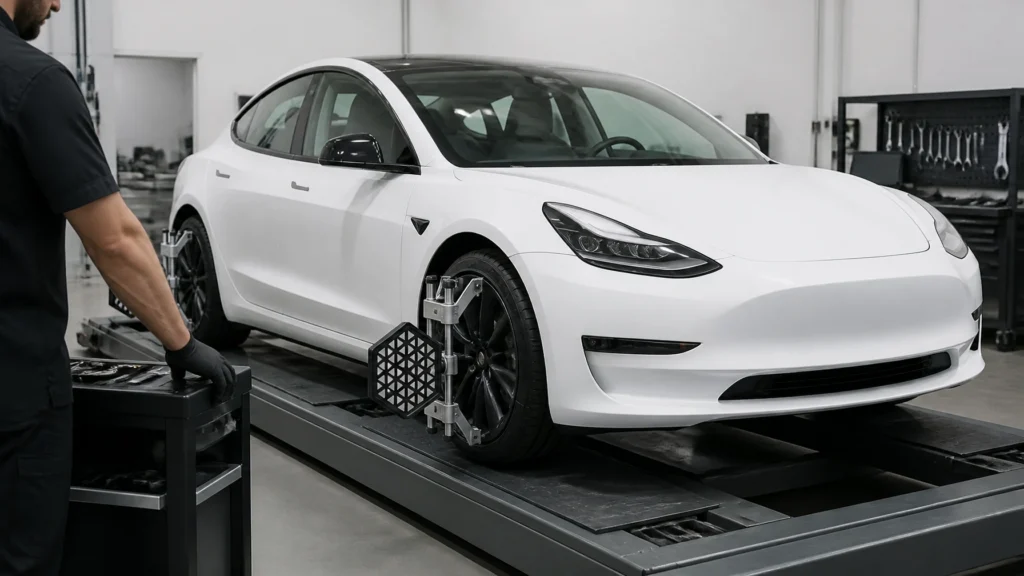
A four-wheel alignment places the vehicle on an alignment rack and measures wheel-angle relationships using sensors or targets attached to the wheels. Depending on the equipment and vehicle, the technician may review measurements such as:
- Toe: The direction each wheel points when viewed from above
- Camber: The inward or outward tilt of the wheel when viewed from the front
- Caster: The steering-axis angle viewed from the side
- Thrust angle: The direction in which the rear axle or rear wheel path points relative to the vehicle centerline
- Steering wheel center: Whether the steering wheel and front wheels are correctly related
- Setback and track relationships: Whether one wheel or axle sits differently from its opposite side
The alignment system compares measured values with the manufacturer’s specifications for the vehicle. If the geometry can be corrected through approved adjustments, the technician makes those adjustments and prints a final report.
That process is valuable. It can identify a problem that the driver cannot see. It can also confirm that the wheel angles are within the applicable factory range after suspension or structural work.
But an alignment rack does not straighten a bent control arm. It does not restore a shifted subframe to its correct position. It does not repair a deformed strut tower. It does not make a damaged wheel safe. It does not replace a cracked knuckle.
An alignment machine can only measure and adjust the geometry that the vehicle’s components allow it to adjust.
Why alignment alone cannot repair structural suspension damage
Many suspension systems include adjustment points designed for normal service. These may allow a technician to bring a wheel angle back within specification after a component is replaced or a permitted adjustment is made.
A collision may create a different condition: the adjustment range may be consumed while the underlying component remains bent or displaced.
For example, a technician might adjust toe until the computer shows an acceptable number. If a control arm or subframe is still damaged, the vehicle may have an acceptable toe reading while other geometry remains incorrect. The steering wheel may not stay centered. The vehicle may pull under braking. Tire wear may develop. The readings may change after the vehicle is driven or after damaged components are replaced.
A shop should not respond to an out-of-specification reading by adjusting whatever angle is easiest without first asking why the angle changed.
A proper diagnostic sequence considers whether:
- The wheel and tire are correct and undamaged.
- The hub and bearing are properly seated and free from collision damage.
- The steering and suspension components are straight and secure.
- The subframe is correctly positioned.
- The suspension mounting points remain dimensionally correct.
- The ride height is appropriate for the measurement procedure.
- Fasteners are installed, tightened, and verified according to the applicable procedure.
- The alignment rack and targets are set up correctly.
- The final readings remain within the vehicle-specific factory specifications.
If the equipment cannot bring the vehicle into specification through approved adjustments, that is not an invitation to force the readings into the green range. It is a reason to investigate the underlying geometry.
Tesla’s own documentation separates alignment checks from collision damage inspection
Tesla’s Service Manual includes model-specific instructions for determining when a suspension service requires an EPAS alignment check, a four-wheel alignment check, or no alignment procedure. The Tesla Alignment Requirement – Suspension document uses three categories:
- EC: An EPAS alignment check is required. If the vehicle fails that check, a four-wheel alignment check is performed.
- AC: A four-wheel alignment check is required to determine whether adjustment is necessary.
- NA: No alignment is required or the operation is not applicable.
The matrix is component-specific. In the Model S Palladium example, Tesla identifies different requirements for components such as control arms, links, tie-rod ends, the steering rack, and subframes. The exact requirements depend on what was removed, replaced, loosened, or disturbed.
Tesla also includes an important warning in that document: EPAS should not be used to check for potential suspension component damage resulting from a collision.
That distinction matters. An electronic power-assisted steering check may be required after certain service operations, but it is not a physical inspection of a bent control arm, damaged knuckle, shifted subframe, or deformed body mounting location.
The matrix is also not a universal substitute for the procedure that applies to a particular Tesla. Model, year, configuration, and the exact repair operation matter. A shop should use the current service information for the specific vehicle rather than applying a procedure from another Tesla model.
What a Tesla-certified suspension inspection should include
A thorough post-collision suspension inspection is broader than placing the vehicle on an alignment rack. The inspection should connect the physical condition of the vehicle with the measured geometry.
1. Vehicle identification and repair-information review
The shop should identify the Tesla by VIN and confirm the model, year, and configuration. The technician or repair planner should then review the current Tesla service and collision repair information applicable to the damaged area.
This step is important because suspension requirements can vary by model and procedure. The shop should know whether a component is repairable, replacement-only, or subject to additional inspection after an impact.
2. Initial visual inspection
The vehicle should be examined before alignment adjustments are attempted. Depending on the collision, the inspection may include:
- Wheel and tire condition
- Wheel offset and correct application
- Tire sidewall and tread damage
- Hub and bearing area
- Control arms and links
- Ball-joint or joint areas where applicable
- Steering tie rods
- Steering rack and mounting points
- Knuckles
- Springs and dampers
- Strut bodies and mounts
- Subframe attachment points
- Underbody structure
- Brake components affected by the impact
- Wiring, harnesses, and sensor brackets near the damaged area
A visual inspection does not prove that a component is straight, but it can identify cracks, bends, scraped surfaces, displaced hardware, torn bushings, damaged boots, leaking dampers, and impact marks.

3. Wheel and tire evaluation
The wheel is the first component to receive force in many collisions. A wheel can have a bent inner lip or crack that is not apparent from the outside. A tire can have sidewall damage or an internal condition that makes it unsuitable for continued use.
The technician should verify that the wheel and tire are appropriate for the vehicle and that the contact surfaces are clean and correctly seated. If the wheel is damaged, an alignment reading may not represent a reliable completed repair.
A new alignment cannot correct a wheel that has been distorted by a curb, pothole, or collision.
4. Suspension and steering-component inspection
The technician should look for evidence that suspension or steering parts have been bent, cracked, displaced, or loaded beyond their normal position.
A control arm may show a visible bend, but damage can also appear as an altered relationship between mounting points. A tie rod may be bent while the steering rack appears normal. A knuckle may be damaged at a mounting location that is difficult to see without removing adjacent components.
The inspection should also consider whether the component was removed and reinstalled during the collision repair. A part may be undamaged but incorrectly positioned, missing specified hardware, or not tightened according to the applicable procedure.
5. Subframe and mounting-point measurement
The subframe helps locate suspension and steering components. If it shifts, the wheels may no longer sit correctly relative to the vehicle body even when individual suspension parts appear straight.
A subframe inspection may require more than looking for a bent edge. The technician may need to check reference points, mounting positions, contact surfaces, fastener locations, and the relationship of the subframe to the body.
Where collision damage involves suspension mounting locations or surrounding structure, a proper frame measuring system and suitable rack or bench provide a controlled reference for determining whether the vehicle’s geometry has moved.
6. Ride-height verification
Ride height affects suspension geometry and the conditions under which alignment readings are taken. The vehicle must be evaluated according to the model-specific procedure, including the applicable suspension mode, loading condition, or preparation requirements.
A vehicle that is sitting unevenly may have:
- A damaged spring or damper
- A displaced suspension component
- A body or subframe mounting issue
- A tire or wheel problem
- An incorrect setup condition
- A component that was not fully seated or secured
Ride-height checks do not diagnose every possible problem, but they can identify an important difference between a correctly prepared vehicle and one that should not yet receive a final alignment.
7. Torque and fastener verification
Suspension and subframe fasteners are part of the repair, not an afterthought. The correct torque value, tightening sequence, ride-height condition, and fastener replacement requirement depend on the Tesla procedure and the component involved.
A technician should not rely on a generic torque chart for a safety-critical repair. The current vehicle-specific service information controls.
Torque verification may be especially important when a collision repair involved removal or replacement of control arms, links, tie rods, steering components, dampers, subframes, or related mounting hardware. The repair file should identify the operations performed and the required final checks.
8. Pre-repair and post-repair measurements
If structural or suspension damage is suspected, measurements should be captured before and after corrective work where applicable.
Pre-repair measurements can document the condition discovered during teardown. Post-repair measurements can show whether the relevant points returned to the required relationship.
These records do not replace the manufacturer’s procedures, but they make the repair easier to understand. They can also help explain why a part was replaced, why a subframe was repositioned, or why additional structural work was necessary.
The tools that matter
The quality of a suspension and alignment inspection depends on both technician judgment and equipment capability.
A proper four-wheel alignment rack
The rack must support the vehicle correctly and allow the alignment system to read all relevant wheels. The equipment should be maintained and calibrated according to the equipment manufacturer’s requirements.
The shop should also follow the Tesla procedure for preparation. Depending on the model and suspension type, that may involve steering-wheel locking, turn-plate and slip-plate preparation, ride-height settings, and other setup requirements.
A computer printout is useful only when the vehicle and equipment were prepared correctly.
A frame measuring system
A frame measuring system allows technicians to compare vehicle reference points with the manufacturer’s dimensions or the measurement data used by the repair facility. The system may be integrated with a frame bench or rack, depending on the equipment and repair operation.
Tesla’s Approved Collision Center Operating Standards state that structural repairs require a frame bench or rack system with specific measuring and/or dedicated fixtures, except for structural repairs specifically described in Tesla repair documentation.
The purpose is not to “pull until the numbers look right.” Tesla’s Model Y Structural Repair Guidelines state that Tesla does not support pulling or pushing components with frame-straightening equipment, except for operations described in the applicable repair documentation. The same guidelines explain that pulling or pushing can damage the integrity of a component or the joint between structural components.
Measurement and controlled fixturing are therefore different from unapproved force-based straightening.
Manufacturer diagnostic access
Tesla service information may require Service Mode, Toolbox, or other manufacturer-specific diagnostic processes. The applicable procedure determines what checks or resets are necessary.
For example, Tesla’s alignment information describes EPAS-related checks and angle-offset procedures for certain operations. Those electronic checks are part of the manufacturer’s process, but they do not replace physical inspection of collision-damaged suspension or structure.
Torque tools and vehicle-specific repair information
A shop needs properly maintained torque tools and current procedures. The technician must know whether a fastener is reusable, whether a new fastener is required, and whether tightening must occur at a specified ride height or position.
Scanning and calibration equipment
A collision can affect steering, suspension, wheel-speed sensing, cameras, ultrasonic systems, and other vehicle functions. The repair plan should identify whether scans, calibration, initialization, or road testing are required for the specific vehicle and damage.
The exact requirements vary by model and repair. The shop should not promise that every Tesla receives the same calibration sequence.
Why the order of operations matters
The order of a post-collision repair affects the reliability of the final alignment.
A responsible sequence generally looks like this:
- Document the initial condition.
- Identify the vehicle and review current Tesla repair information.
- Teardown enough of the vehicle to expose relevant damage.
- Inspect the wheels, tires, suspension, steering, subframe, mounting points, and surrounding structure.
- Measure structural reference points when the damage path indicates that measurement is needed.
- Replace or repair damaged parts using the approved procedure.
- Verify fasteners, torque, routing, and component seating.
- Confirm ride height and vehicle preparation.
- Perform the required four-wheel alignment check or other manufacturer-specified alignment procedure.
- Make only approved adjustments.
- Capture the final alignment printout.
- Complete scans, calibrations, road testing, and functional checks that apply to the repair.
- Review the repair file before delivery.
If alignment is performed too early, the readings can change after a bent part, shifted subframe, or damaged mounting point is corrected. Alignment should verify the repaired geometry, not conceal an unresolved structural condition.
Our article on Tesla frame sectioning and OEM cut lines explains the same principle from the body-structure side: the manufacturer’s repair boundaries and methods determine whether a structural operation is acceptable.
What owners should request from the repair shop
Tesla owners should not have to guess whether the shop completed more than a quick alignment. Ask for a repair explanation and documentation that addresses the actual collision.
Pre-repair documentation
Request:
- Photos of the damaged wheel, tire, bumper, fender, or quarter-panel area
- Photos after teardown if hidden damage was found
- The initial diagnostic scan, when applicable
- Notes identifying damaged suspension or steering components
- Pre-repair alignment readings, when an alignment check was performed
- Structural measurement records when structural or mounting-point damage was suspected
The pre-repair alignment report can be useful even if the vehicle was not safe to drive. It establishes the geometry that the shop observed before repairs.
Repair-procedure information
Ask which current Tesla procedure governed the work. The answer should identify the relevant vehicle and component, not merely say that the shop follows “factory standards.”
Ask whether the repair involved:
- Control arms or suspension links
- A steering knuckle
- A tie rod or steering rack
- A subframe
- A strut, damper, or mount
- A wheel or tire
- Structural mounting points
- Body structure near the suspension
The shop should be able to explain what was replaced, what was measured, and why.
Post-repair measurement records
Request:
- Post-repair structural measurements when applicable
- Final four-wheel alignment printout
- Ride-height verification when relevant
- Confirmation of torque and fastener procedures
- Scan and calibration records that apply to the repair
- Final road-test and quality-control documentation
Tesla’s operating standards require an Approved Collision Center to have the ability to complete and verify four-wheel alignment through a computer printout, either with an in-house alignment system or a qualified same-day sublet service. Owners should ask to see that final printout.
A written warranty
Ask who provides the workmanship warranty and what it covers. RVCCR backs collision work with a written lifetime warranty. Warranty language should be reviewed before authorization, especially when the repair involves structural, suspension, mechanical, electrical, or calibration operations.
Warning signs after a collision
After a Tesla is returned, contact the repair facility promptly if you notice:
- The steering wheel is not centered while driving straight
- The vehicle pulls consistently to one side
- The vehicle pulls during braking
- The steering feels loose, heavy, or uneven
- A wheel or tire vibrates at road speed
- New tire noise or rapid wear appears
- The vehicle sits lower or higher on one corner
- A warning message appears
- The suspension makes a new clunk, pop, or grinding sound
- The vehicle drifts or feels unstable on a normal road
- The alignment report was not provided when requested
- The shop cannot explain what was measured or replaced
These symptoms do not identify one specific failed part. They are reasons to request a documented reinspection rather than simply accepting another quick adjustment.

Choosing a Tesla-certified collision facility
Searching for an ev repair shop near me is a practical first step after a collision, but distance should not be the only factor. The facility should have the capability to inspect and repair the vehicle’s body, suspension, structure, electrical systems, and safety technology as the damage requires.
When comparing shops, ask:
- Is the facility currently approved or certified for Tesla collision work?
- Can it perform structural and suspension repairs in-house?
- Does it have access to current Tesla repair information?
- Does it use a suitable alignment rack?
- Can it measure structural reference points?
- Can it provide pre- and post-repair documentation?
- Does it use OEM parts and approved repair methods where required?
- Does it coordinate with your insurance carrier?
- What written warranty supports the repair?
- Who will explain the final measurements and test results?
The term tesla certified collision center should represent a real capability, not simply familiarity with the brand. Tesla’s Approved Collision Center Operating Standards address current repair procedures, training, equipment, structural repair methods, four-wheel alignment verification, suspension work, diagnostic tools, and written warranty requirements.
Certification does not eliminate the need to ask questions. It gives the owner a meaningful starting point for evaluating whether the facility has invested in the required systems.
For broader guidance, our article on certified auto collision repair in Redlands explains what to review before selecting a shop and beginning an insurance claim.
How EV safety fits into suspension repair
Suspension repairs may take place near battery enclosures, high-voltage cables, power electronics, and electrical connections. The exact hazards depend on the vehicle, the collision, and the operation.
A shop should determine whether high-voltage isolation procedures are required before work begins. Tesla’s collision operating standards identify high-voltage components and certain structural components as restricted parts requiring appropriate training, tools, and procedures.
OSHA’s electrical safety rules also establish general workplace protections. Under 29 CFR 1910.333, exposed live parts should be deenergized before employees work on or near them unless a documented exception applies, and a qualified person must use test equipment to verify the deenergized condition. 29 CFR 1910.335 addresses electrical protective equipment, insulated tools, shields, barriers, and warning methods.
Owners do not need to perform these procedures. They should choose a facility that understands that a Tesla collision repair may combine structural, mechanical, electrical, and diagnostic work.
Our article on EV high-voltage disconnect procedures explains why a dark display or disconnected low-voltage battery is not, by itself, proof that an EV is safe to work on.
A quick alignment can be useful: but it cannot tell the whole story
A four-wheel alignment is an important final verification. It can reveal a changed thrust angle, incorrect toe, unequal camber, steering offset, or another geometry concern. It can confirm that the repaired vehicle meets the applicable factory specifications when the inspection and repair have been completed correctly.
It cannot answer every structural question by itself.
The better question is not, “Did the alignment pass?” The better questions are:
- What caused the alignment to be out of specification?
- Were the wheels and tires checked?
- Were the suspension and steering parts inspected?
- Was the subframe checked?
- Were the mounting points measured when appropriate?
- Was ride height verified?
- Were fasteners and torque requirements confirmed?
- Were the repairs completed before the final alignment?
- Do the pre- and post-repair records support the result?
- Were required scans, calibrations, and road tests completed?
A green alignment printout is a useful document. It is not a structural certificate.
Get back to the road with documented confidence
A Tesla collision repair should restore more than appearance. It should address the geometry beneath the vehicle, the components that hold each wheel in position, the structure that supports the suspension, the systems that monitor the vehicle, and the manufacturer’s requirements for final verification.
At RVCCR, our certified team inspects the complete damage path, coordinates with major insurance carriers, uses current manufacturer information, performs collision and mechanical work under one roof, and explains the documentation behind the repair. We focus on the result: not merely the alignment number: a Tesla that is properly repaired, correctly measured, carefully tested, and ready for the miles ahead.
If your Tesla was involved in a collision in Redlands or the Inland Empire, do not settle for a quick alignment when the impact may have changed the structure beneath it. Request a free estimate from RVCCR and provide your VIN, vehicle photos, and collision details.
Let the right team inspect the geometry, correct the damage, verify the measurements, and restore your confidence for the next commute, family trip, or Southern California adventure.
Need a repair estimate?
Skip the wait — send us a few photos and our team will get back to you fast.
Start a Photo Estimate →