Fifth Wheel vs. Travel Trailer Collision Repair: Why the Coupling System, Pin Box, and Frame Geometry Are Completely Different
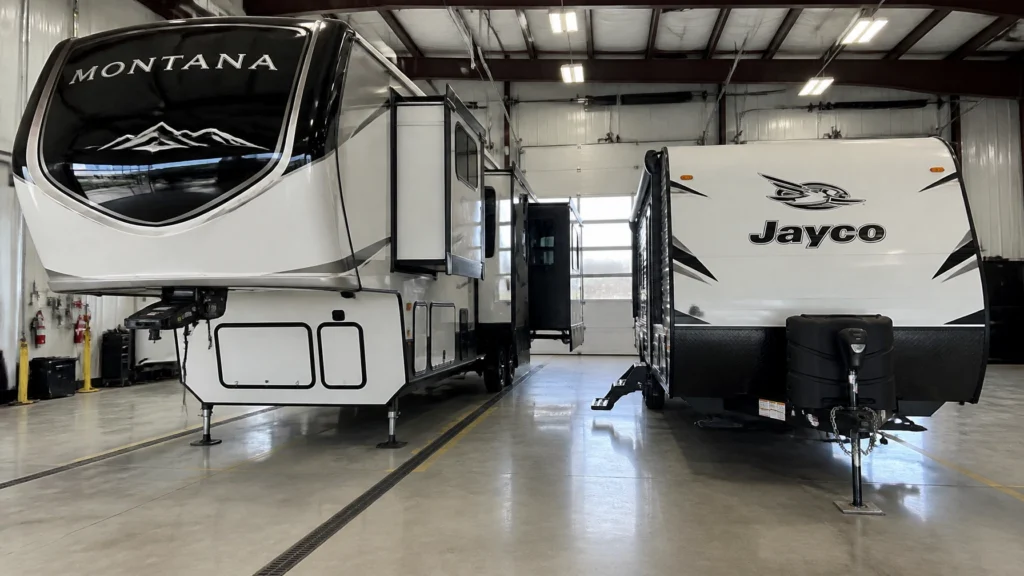
When an RV is involved in a collision, the path to a safe and factory-standard restoration is dictated almost entirely by the physics of its connection to the tow vehicle. As an RVDA-certified facility with over 21 years of experience in Redlands and the Inland Empire, RVCCR has seen firsthand how a single impact can ripple through a chassis in two fundamentally different ways depending on whether you are towing a fifth wheel or a travel trailer. While both categories are technically "towables," the engineering behind their frames and coupling systems is worlds apart.
Understanding these differences is not just a matter of technical curiosity: it is essential for ensuring that your vehicle is returned to its original structural integrity. A travel trailer repair near me involves assessing a cantilevered A-frame tongue that bears the brunt of the lever-arm force, whereas a fifth wheel repair focuses on an integrated upper deck and a specialized pin box that transfers loads directly over the truck's rear axle. The implications for frame straightening, weld inspection, and sway control are profound…
The Anatomy of the Coupling: Pin Box vs. Ball Coupler
The most visible difference between these two RV types is the coupling system itself. This is the "handshake" between the trailer and the tow vehicle, and in a collision, it is the primary point of force entry.
The Fifth Wheel Pin Box
A fifth wheel connects via a heavy-duty pin box that houses the kingpin. This kingpin locks into a plate hitch mounted inside the bed of the truck, typically centered directly over or slightly ahead of the rear axle. Structurally, the pin box is a massive steel weldment bolted or welded into an "upper deck" that overhangs the truck bed.
In a collision, the pin box acts as a rigid conduit. Because the fifth wheel carries roughly 20% to 25% of its total weight as "pin weight," the structure must be exceptionally robust. When a rear-end collision occurs, the force is driven upward and forward through the kingpin. This often results in "buckling" of the pin box housing or, more critically, the transfer of energy into the upper deck crossmembers.
The Travel Trailer Ball Coupler
Conversely, a travel trailer uses a ball coupler mounted at the tip of an A-frame tongue. This connects to a receiver hitch at the rear bumper of the tow vehicle. The geometry here is a "bumper pull" configuration. In this setup, the hitch point is several feet behind the rear axle of the truck, creating a significant lever arm.
During an impact, this lever arm amplifies the force. Instead of the force being absorbed directly over the truck's axle, it pulls or pushes on the very end of the truck's frame, often resulting in a "jackknife" where the A-frame tongue is bent laterally. The coupler itself is often a sacrificial component; it may deform or shear to prevent even more catastrophic frame damage, but the bending moment it applies to the trailer's front chassis rails is immense.

Frame Geometry: Integrated Upper Deck vs. Cantilevered A-Frame
The way an RV’s frame is built determines how it handles the "trauma" of a collision. Most modern RVs utilize steel I-beams or boxed tube frames, but the way they terminate at the front of the vehicle is where the engineering diverges.
The Fifth Wheel "Drop-Frame" and Upper Deck
Fifth wheel frames are typically more complex and heavier-duty. They feature a "drop-frame" design where the main chassis rails (usually 10-inch to 12-inch I-beams) transition into a raised front section that sits above the truck bed. This transition point is a critical area for rv collision repair.
Because the upper deck is integrated into the main structure, a front-end impact on a fifth wheel doesn't just damage the hitch; it can "rack" the entire front of the trailer. At RVCCR, our inspection process for fifth wheels involves stripping back the fiberglass front cap or the under-chassis "coroplast" to inspect the transition welds. If the upper deck has shifted even a fraction of an inch, the kingpin will not track straight, leading to accelerated tire wear and dangerous handling.
The Travel Trailer A-Frame Tongue
Travel trailers utilize a simpler but more vulnerable geometry. The two main longitudinal frame rails converge at the front to form a triangle: the A-frame. This tongue is essentially a cantilevered beam.
When you search for a rv paint and body shop after a travel trailer accident, the first thing the technicians should look at is the "junction" where the A-frame meets the first crossmember of the main box. Because the tongue projects forward, any vertical or lateral impact acts like a giant wrench, twisting the main frame rails. It is very common to see "kinked" C-channel frames on travel trailers after a relatively minor jackknife incident.
Collision Force Dynamics: How Impacts Travel Through the Chassis
Physics dictates that energy must go somewhere. In a collision, the "load path" is the route that the impact energy takes as it moves from the point of contact through the vehicle.
Fifth Wheel: The Vertical Load Path
In a fifth wheel, the load path is largely vertical and longitudinal. Because the weight is over the truck's axle, the truck and trailer tend to move more in unison. In a hard braking event or a front-end collision, the energy is driven into the "overhang."
This can lead to hidden damage such as:
- Sidewall Cracking: The stress on the upper deck can cause the fiberglass sidewalls near the front bedroom slide-outs to crack or "spider-web."
- Pin Box Plate Deformation: The horizontal plate where the pin box mounts can become "bowed," making it difficult to hitch or unhitch.
- Internal Cabinetry Shifting: Because the front deck is high up, the "whiplash" effect on the front of the trailer is amplified, often dislodging interior furniture or cabinets.
Travel Trailer: The Lateral and Torsional Load Path
Travel trailers are much more susceptible to lateral (side-to-side) forces. Because the pivot point is so far behind the truck's axle, any sway or side-impact creates a massive amount of torque.
If a travel trailer is hit from the side or undergoes a severe sway event that leads to a crash, the A-frame tongue often acts as a "pivot." We frequently see trailers where the A-frame is bent 5 to 10 degrees out of alignment with the rest of the body. This requires specialized frame straightening equipment to pull the steel back into a "true" center line. Without this, the trailer will "dog-track" down the highway, meaning it will sit crooked behind the tow vehicle even when driving straight.

Repair Protocols: Welding, Alignment, and Material Science
At RVCCR, we treat every repair as a structural reconstruction. The materials used in RV frames: typically ASTM A36 structural steel or high-strength low-alloy (HSLA) steel: require specific welding and cooling protocols to maintain their strength.
Repairing the Fifth Wheel Pin Box Area
If a pin box or its mounting brackets are damaged, "patching" is never an option. We follow OEM (Original Equipment Manufacturer) guidelines, which often require the complete replacement of the pin box weldment.
- Laser Alignment: We use laser leveling tools to ensure the kingpin is perfectly perpendicular to the main axles.
- GMAW Welding: We utilize Gas Metal Arc Welding (MIG) with specific wire-feed speeds to ensure deep penetration into the heavy I-beams.
- Gusset Reinforcement: In cases where the upper deck has been compromised, we may install engineered steel gussets to reinforce the transition zone, ensuring it is stronger than it was pre-accident.
Repairing the Travel Trailer A-Frame
For travel trailers, the repair often involves the A-frame itself. If the steel is "kinked" (meaning the metal has folded or stretched beyond its elastic limit), that section must be cut out and replaced.
- Symmetry Checks: We measure from the center of the coupler to identical points on the left and right axles. If these measurements are not identical to within 1/16th of an inch, the trailer will not tow safely.
- Coupler Replacement: We always recommend replacing the ball coupler after a significant impact. Micro-fractures in the cast or stamped steel of a coupler are invisible to the naked eye but can lead to a catastrophic "uncoupling" on the highway later.
- Weight Distribution Mounts: We carefully inspect the points where weight distribution (WD) brackets were mounted. These brackets put immense localized stress on the frame, and a collision can "tear" the steel at these mounting points.
Sway Control and Weight Distribution Implications After Repair
One of the most overlooked aspects of RV collision repair is the restoration of the vehicle’s handling characteristics. A trailer that looks "repaired" but handles poorly is a safety liability.
Fifth Wheel Stability
Fifth wheels are inherently more stable because the hitch is over the axle, which virtually eliminates the "lever effect" that causes sway. However, if the frame is not perfectly aligned during repair, the trailer can develop a "lean." This lean shifts the center of gravity, which can cause one side of the suspension to wear out prematurely or cause the trailer to "hunt" (weave) at highway speeds. Our post-repair protocol includes a detailed suspension geometry check to ensure the leaf springs or torsion axles are sharing the load equally.
Travel Trailer Sway and WD Hitches
For travel trailers, the relationship between the frame and the weight distribution hitch is symbiotic. Many owners use sway control bars or WD hitches to manage the "bumper pull" physics. If the A-frame tongue is even slightly twisted during a collision, your WD hitch will no longer distribute weight evenly across the truck’s axles.
During our free estimate process, we ask owners to bring in their hitch head and bars. We need to ensure that the frame's new alignment matches the hitch's geometry. If the frame has been straightened, the "L-brackets" for the sway bars may need to be repositioned to ensure they are applying equal tension. Failure to do this can lead to "induced sway," where the hitch itself causes the trailer to oscillate.

Insurance Classification: How Total Loss Math Differs
When dealing with insurance claims, the structural differences between these two types of RVs often dictate whether a vehicle is repaired or "totaled."
Fifth Wheel Valuation
Fifth wheels generally have a higher MSRP and hold their value longer than travel trailers. Because the frame is a more substantial component of the vehicle's overall cost, insurance companies are often more willing to pay for complex upper-deck repairs. However, the labor hours required to "de-skin" the front of a fifth wheel to access the frame can be high. We work closely with major insurance carriers to provide the technical data they need to justify these high-quality repairs.
Travel Trailer Totalling Risks
Travel trailers, especially entry-level "stick and tin" models, have a much lower "total loss" threshold. Because the frame is often a lighter, single-piece weldment, a bent frame can quickly exceed 70% of the vehicle's actual cash value (ACV). At RVCCR, we specialize in providing accurate, line-itemed collision estimates that help owners and adjusters understand the difference between a simple "tongue swap" and a total frame failure.
The Inspection Checklist: What Every Owner Should Demand
If you have been in an accident, do not settle for a "visual" inspection. Demand a structural teardown that covers these points:
| Inspection Point | Fifth Wheel Priority | Travel Trailer Priority |
|---|---|---|
| Hitch Interface | Kingpin straightness and "mushrooming" check. | Coupler latch mechanism and ball-socket wear. |
| Main Frame | I-beam flange buckling at the "drop" transition. | A-frame tube "kinking" or twisting. |
| Welds | Inspection of the pin box support brackets. | Inspection of the tongue-to-main-rail junction. |
| Sidewalls | Flex-frame cracks near the front bedroom/slide. | Delamination checks near the front window/cap. |
| Suspension | Hanger bracket alignment and "crabbing" check. | Axle tube straightness (often bent in side impacts). |
Restoring Your Peace of Mind for the Next Adventure
A collision is a traumatic interruption to your lifestyle, but it doesn't have to be the end of your RV's story. Whether you are towing a 40-foot luxury fifth wheel or a weekend-warrior travel trailer, the structural integrity of your frame is the only thing standing between a safe trip and a highway disaster.
At RVCCR, we don't just "fix" trailers; we restore the engineering standards set by the manufacturer. As a family-owned business for over two decades, we stand behind our work with a written lifetime warranty. We coordinate directly with your insurance, provide comprehensive digital photo documentation of every weld, and ensure that your vehicle's "load path" is as strong as the day it left the factory.
Don't let hidden frame damage compromise your family's safety. Contact our team today for a professional evaluation and let us handle the technical complexities so you can get back to what matters: the open road and the adventures that await.
Restore your RV to factory specs. Secure your frame. Reclaim your journey.
Need a repair estimate?
Skip the wait — send us a few photos and our team will get back to you fast.
Start a Photo Estimate →