Frame Damage on Unibody vs. Body-on-Frame Vehicles: Why Repair Standards Differ for Your Car, Truck, RV, or EV
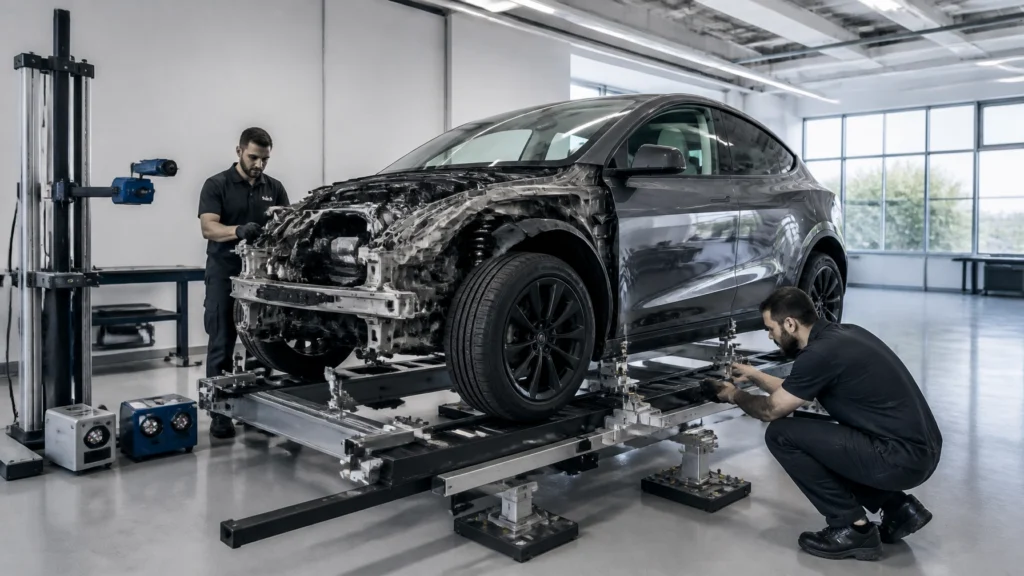
When a vehicle sustains a collision, the underlying structural framework absorbs and distributes the impact energy. How that framework is constructed fundamentally dictates every step of the repair process. Whether you drive a modern passenger sedan, an all-electric Tesla, a heavy-duty pickup truck, or a motorhome, understanding the structural differences between unibody and body-on-frame architecture is essential for ensuring your vehicle is restored safely. At RVCCR, with over 21 years of family-owned experience serving Redlands and the Inland Empire, our technicians approach structural alignment with rigorous adherence to OEM (Original Equipment Manufacturer) specifications.
Navigating structural damage requires moving past generalized assumptions about "frame straightening." Modern vehicles: particularly with the proliferation of ultra-high-strength steels (UHSS), aluminum alloys, and integrated EV battery packs: operate under strict engineering thresholds. When a collision compromises structural integrity, the repair protocol depends entirely on whether the vehicle relies on an integrated unibody monocoque shell or a separate, independent chassis frame…
Structural Architecture: Unibody vs. Body-on-Frame
To understand why repair standards differ so drastically, we must examine how these two distinct manufacturing architectures manage load and impact energy.
Unibody Construction (Monocoque)
In a unibody vehicle: which includes the vast majority of modern passenger cars, crossovers, and electric vehicles such as Teslas: the body and frame are built as a single, integrated welded structure. There is no separate steel chassis underneath. Instead, the floor pan, pillars, roof rails, and rocker panels work in unison to support mechanical loads and protect occupants during a collision.
Modern unibodies make extensive use of Advanced High-Strength Steel (AHSS) and Ultra-High-Strength Steel (UHSS) in strategic crash zones. These materials are engineered to maintain a rigid safety cell around passengers while intentionally deforming in specific crush zones to absorb kinetic energy. Because the entire structure is interconnected, a severe impact to a front rail or quarter panel does not stay isolated. The force transmits through the entire monocoque shell, often requiring specialized 3D measuring systems and computerized anchoring equipment to return the vehicle to factory tolerances.
Body-on-Frame Construction
Conversely, body-on-frame construction: traditionally found on full-size pickup trucks, large SUVs, and many motorized RV chassis: features a distinct separation between the vehicle's structural backbone and its passenger compartment. A rigid, heavy-gauge steel ladder frame carries the powertrain, suspension, and drivetrain, while the body shell is bolted directly to this chassis with rubber or polyurethane body mounts.
Because the frame bears all structural loads independently, minor to moderate impacts can often be addressed by servicing or straightening the frame rails without immediately compromising the body shell above it. Many traditional frames utilize mild or conventional high-strength steel rather than extreme grades of UHSS, granting technicians broader latitude in mechanical straightening, provided the steel's grain structure and tensile integrity remain uncompromised.
Repair Thresholds and Procedures: Unibody Realities
When a unibody vehicle suffers rail or pillar damage, repair standards are governed strictly by the OEM Body Repair Manual (BRM). Unlike older vehicles where technicians could heat and pull metal freely, modern unibody repair leaves no room for guesswork.

The UHSS and Heat Constraint
Ultra-high-strength steels derive their exceptional tensile strength through precise thermal processing and alloying during manufacturing. When a collision bends a UHSS component, the steel undergoes localized work-hardening.
- Cold-Repair Limits: Most OEMs strictly limit cold-straightening on UHSS components to minor, elastic deformations. If a rail or pillar is severely buckled or folded, straightening is prohibited.
- The Heat Ban: Applying an open flame or excessive torch heat to alter UHSS changes the metallurgical structure, drastically reducing its yield strength and destroying its crash-energy management capabilities. Therefore, unauthorized heating during unibody repair is an extreme safety hazard.
Sectioning Protocols
When a unibody rail or pillar cannot be straightened, repair facilities utilize OEM-approved sectioning. Sectioning involves cutting out the damaged portion of a structural member and splicing in a factory-authorized replacement segment using specific joint designs (such as sleeve reinforcements, overlapping joints, or rosette welds).
However, sectioning is never a universal procedure. OEMs designate exact cut locations: often near factory seams or reinforcement overlaps: where structural integrity can be safely restored. If a BRM states "no sectioning" for a specific A-pillar or rocker reinforcement, the entire assembly must be replaced from factory seams. Furthermore, incorrect joining techniques (such as substituting standard MIG welding for resistance spot welding or MIG brazing where specified) can reduce joint strength by 30 to 40 percent. For vehicle owners seeking professional guidance on evaluating structural estimates, our guide on how to read a collision repair estimate outlines what to look for regarding OEM structural line items.
Repair Thresholds and Procedures: Body-on-Frame Dynamics
Body-on-frame vehicles, including trucks and larger commercial chassis, operate under different physical parameters during a restoration.

Hydraulic Straightening and Cold Pulling
Because truck frames are built from thick, heavy-gauge steel channels or boxed sections, they are frequently restored using powerful hydraulic frame-pulling machines and anchoring towers.
- Cold Pulling vs. Controlled Heat: Depending on the steel grade specified by the truck manufacturer, localized controlled heat may be permitted under strict OEM guidelines to relieve stress during a pull, though many late-model trucks incorporating high-strength steel alloys now prohibit torch heating altogether.
- Dimensional Verification: Laser and electronic measuring systems map frame diamond, sag, twist, and side-sway down to the millimeter, ensuring the steering axis and suspension mounting points align perfectly with factory blueprints.
Rail Replacement and Boxing
When a frame rail is kinked beyond its elastic limit or exhibits metal tearing, straightening is insufficient. Technicians must either section the rail using engineered fishplates and MIG welding at approved splice locations or replace the complete frame assembly. For commercial trucks and heavy-duty haulers, maintaining factory welding specifications and maintaining correct chassis geometry is vital for safe towing and highway stability. For more details on heavy chassis and recreational vehicle frameworks, review our insights on travel trailer collision repair and structural standards.
Special Considerations for Electric Vehicles (EVs) and Teslas
The evolution toward electrification has transformed unibody engineering. Modern EVs and Tesla models integrate structural battery packs directly into the floor pan as a primary load-bearing element of the unibody architecture.

The Integrated Battery Chassis
In a Tesla or certified EV, the battery enclosure acts as a rigid structural member that ties the front and rear crash management structures together.
- Strict Inspection Protocols: Following a side impact or undercarriage scrape, technicians must perform rigorous diagnostic sweeps and physical inspections to verify that the battery housing flange, cooling jackets, and internal module integrity remain undamaged.
- Aluminum and Mixed-Metal Joining: EVs frequently combine steel safety cages with cast aluminum shock towers and extruded aluminum crash rails. Aluminum cannot be straightened like steel; it work-hardens rapidly and will crack under improper bending loads. Damaged aluminum structural nodes require cold mechanical joining, rivet bonding, or complete part replacement.
For EV owners in the Inland Empire, utilizing a Tesla certified collision center ensures that technicians have access to proprietary diagnostic software, high-voltage disable procedures, and specialized structural benches required to restore EV safety cages to original factory specifications.
Restoring Safety and Peace of Mind
Recognizing the distinction between unibody and body-on-frame repair is more than an academic exercise: it is the difference between a vehicle that merely looks repaired on the surface and one that will protect your family in a subsequent collision. Whether your vehicle requires delicate unibody sectioning with ultra-high-strength steel or heavy-duty chassis alignment, partnering with a certified shop guarantees that every repair adheres strictly to engineering science rather than guesswork.
At RVCCR, our certified technicians combine decades of hands-on experience with factory-grade diagnostic and measuring equipment to restore your car, truck, RV, or EV to pristine condition. We coordinate seamlessly with major insurance providers, offer free transparent estimates, and back our craftsmanship with a written lifetime warranty.
Do not leave your vehicle's structural safety to chance. Contact RVCCR today to schedule your professional collision assessment and experience true factory-certified craftsmanship.
Need a repair estimate?
Skip the wait — send us a few photos and our team will get back to you fast.
Start a Photo Estimate →