Motorhome Frame Straightening: Why Standard Auto Body Shops Can’t Fix the Chassis of a 40-Foot Coach
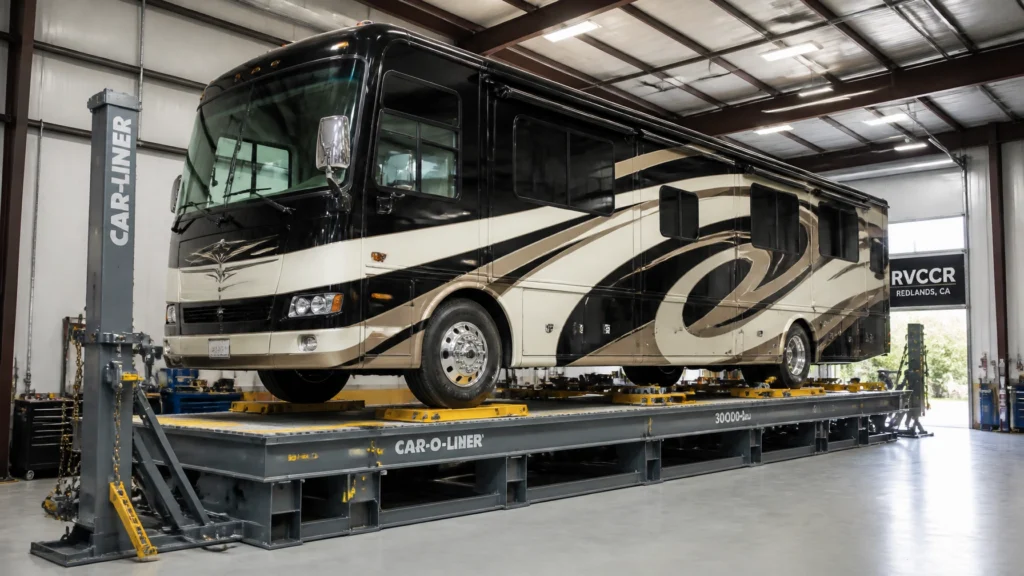
At RVCCR, we understand that a motorhome is not simply a large car; it is a complex intersection of a heavy-duty commercial truck chassis and a sophisticated residential structure. For over 21 years, our family-owned facility in Redlands has served as a specialized hub for rv collision repair, maintaining RVDA certifications and deep technical expertise in structural restoration. When a 40-foot coach sustains an impact, the forces involved are exponentially greater than those seen in standard automotive accidents. The restoration of a tweaked or diamonded frame requires specialized equipment, extreme precision, and a deep understanding of heavy-duty metallurgy that most general repair shops simply are not equipped to handle.
The integrity of your motorhome’s foundation: its chassis: is the single most critical factor in determining whether the vehicle can ever truly return to the road in a safe, predictable condition. A frame that is out of alignment by even a fraction of an inch can lead to catastrophic tire wear, compromised emergency braking, and structural failures in the coach body itself. Navigating the repair of such a massive asset requires more than just a standard estimate; it requires a specialized technical approach that accounts for the unique physics of a multi-ton RV…
The Engineering Gap: Unibody vs. Ladder Frame Construction
To understand why your local auto body shop isn't the right choice for frame work, you first have to understand what they are used to fixing. Modern passenger cars: and even most SUVs: utilize "unibody" construction. In a unibody vehicle, the chassis and the body are one single, integrated structure. The sheet metal of the floor, the roof, and the pillars all work together to provide structural rigidity. When a unibody car is hit, the energy is designed to dissipate through "crumple zones" that fold like an accordion to protect the passengers.
In contrast, a Class A or Class C motorhome is built on a "ladder frame" chassis. This is a massive, rigid foundation consisting of two long, parallel steel rails connected by several crossmembers: looking very much like a ladder. The house (the motorhome body) is then bolted or welded on top of this steel spine.

The difference in material thickness is staggering. A unibody car uses thin-gauge sheet steel, while a motorhome chassis uses thick, heat-treated high-strength steel (HSS) C-channels or I-beams. Straightening these rails requires massive, controlled force that would literally rip a standard car rack out of the floor. Because the motorhome body is separate from the frame, a "tweaked" frame might not be immediately visible from the outside, yet it can put immense stress on the fiberglass walls and slide-out mechanisms above it. Choosing a specialized rv paint and body shop means working with a team that knows how to isolate frame damage from coach damage.
Equipment Scale: The 30,000 lb Requirement
The most significant barrier for standard shops is the physical equipment. A typical auto body frame rack is rated for 10,000 lbs of pulling force: perfect for a 4,000 lb sedan or a 6,000 lb pickup truck. However, a 40-foot coach can weigh anywhere from 25,000 to 45,000 lbs.
At RVCCR, we utilize heavy-duty frame racks rated for 30,000+ lbs of pulling force per tower. These industrial-grade machines are anchored deep into reinforced concrete floors. The towers on these racks are taller and more robust, allowing us to reach the higher mounting points on a coach chassis.
If a shop attempts to pull a motorhome frame on a standard car rack, two things usually happen:
- The Rack Flexes: Instead of the frame straightening, the rack itself bends or the anchors fail, leading to an inaccurate and potentially dangerous "repair."
- Insufficient Force: The hydraulic pumps on a car rack often lack the pressure needed to move a 1/2-inch thick steel rail.
Furthermore, we employ "cold straightening" techniques. Many uncertified shops will use heat (a torch) to soften the steel and make it easier to pull. This is a critical error. Most modern motorhome frames (like those from Freightliner, Spartan, or Ford) are made of heat-treated steel. Applying heat destroys the temper of the metal, making it brittle or soft, which can lead to a catastrophic frame failure under the weight of the coach later on. We follow OEM procedures that mandate room-temperature pulls to maintain the original metallurgical integrity of the steel.
The Science of Measurement: The 1/8 Inch Rule
In the world of motorhome collision repair, "close enough" is never enough. A 40-foot coach has a massive wheelbase; if the front wheels are just 1/4 of an inch out of square with the rear wheels, that error is magnified over the length of the vehicle. This results in "dog-tracking," where the RV moves down the highway at a slight angle, causing the tires to scrub and wear out in as little as 2,000 miles.

We use 3D laser measuring systems to establish a "datum line" (a theoretical flat plane) and a "centerline" for the chassis. Every point on the frame is measured against the manufacturer’s original CAD data.
- Diagonal Tolerance: Diagonals across the frame must typically be within 1/8 inch (3mm) of each other.
- Centerline Tolerance: The distance from the center of the frame to the rails must not vary by more than 1/8 inch at any control point.
- Suspension Mounting: Per OEM specs, suspension mounting points must be precisely aligned to ensure that the Advanced Driver Assistance Systems (ADAS): like lane-keep assist and collision avoidance: function correctly. If the frame is crooked, the cameras and radar sensors will be pointing in the wrong direction, rendering your safety systems useless.
Common Damage Patterns in Motorhome Impacts
RV frame damage isn't always the result of a high-speed crash; sometimes, a minor "thump" in a tight parking lot can translate enough energy to shift a rail.
Front Cap Impacts (The Diamonded Frame)
When a motorhome hits an object with one front corner, it often results in a "diamond" condition. This is where one rail is pushed further back than the other, shifting the entire rectangle of the frame into a parallelogram shape. This is particularly common in Class A coaches where the front cap has very little structural "give" before the energy reaches the frame.
Side Impacts and Slide-Out Alignment
A side impact often doesn't just damage the fiberglass; it can "sway" the frame rails to one side. Because slide-out rooms are built to incredibly tight tolerances within the coach walls, a frame that is swayed by even 1/4 inch can cause a slide-out to bind, leak, or fail to retract. We often find that "mysterious" slide-out issues are actually caused by underlying frame misalignment that was missed by a shop that only looked at the "cosmetic" fiberglass.
Rear Impacts and Hitch Squareness
Rear-end collisions often crush the hitch receiver area. While the hitch might look replaceable, the crossmember it attaches to is often part of the structural rear of the frame.

If the rear of the frame is not perfectly square, towing a vehicle (a "toad") or a trailer becomes dangerous. The trailer will not track straight, putting uneven loads on the hitch and potentially causing a sway-induced accident. We ensure the hitch receiver is square to the frame within factory tolerances before any body work begins.
Why Standard Shops Fail the Certification Test
Most insurance companies want to send vehicles to their "preferred" shops. While those shops might be excellent at fixing a Toyota Camry, they often lack the specialized knowledge for RVs.
- Vertical Clearance: Most standard shops have 10-foot or 12-foot ceilings. A Class A motorhome needs at least 14 feet of clearance just to get in the door, and more if it’s going to be lifted on a rack.
- Technician Training: RV frame repair is a specific trade. Our technicians are trained in the specific nuances of RV construction, including how to protect the interior cabinetry, plumbing, and electrical systems during a heavy-duty frame pull.
- Parts Sourcing: Finding the correct crossmembers or frame extensions for a 10-year-old Spartan chassis is vastly different from ordering parts for a Ford F-150. We understand the nuances of motorhome collision repair and the importance of using certified components.
The Safety and Longevity Implications
Driving a motorhome with a compromised frame is a high-stakes gamble. Because RVs have a high center of gravity, any instability in the chassis is magnified. A crooked frame affects the "return-to-center" of the steering, making the coach feel nervous or twitchy on the highway. In an emergency maneuver, a misaligned frame can lead to unpredictable weight transfer, increasing the risk of a rollover.
Moreover, we stand behind our work with a lifetime warranty as part of the Fix Auto Network. This warranty covers the structural integrity of the repairs we perform. If you take your coach to a shop that doesn't have the right equipment, you aren't just getting a subpar repair: you are losing the long-term protection of a written guarantee that travels with you.
When choosing an rv paint and body shop, you must look beyond the initial price quote and ask about their measurement systems, their rack capacity, and their policy on heat-straightening.
Trust the Specialized Expertise at RVCCR
A damaged frame does not have to mean the end of your motorhome's life. With the right technology and the right team, even a significant structural shift can be corrected to factory specifications. We believe in doing the job once and doing it right, ensuring that your foundation is as strong as the day it left the assembly line.
If you suspect your coach has structural damage, or if you've been involved in a collision in the Inland Empire, don't settle for a shop that "thinks" they can fix it. Bring your vehicle to the experts who have the heavy-duty equipment and the certified training to prove it.
Contact RVCCR today for a comprehensive structural evaluation. Let’s get your coach back on the level so you can resume your journey with total confidence. Schedule your estimate now and let our family take care of yours, ensuring every mile of your next adventure is supported by a perfectly aligned foundation.
Need a repair estimate?
Skip the wait — send us a few photos and our team will get back to you fast.
Start a Photo Estimate →