RV Collision Repair in the Inland Empire: What Motorhome Owners Get Wrong About Post-Accident Restoration
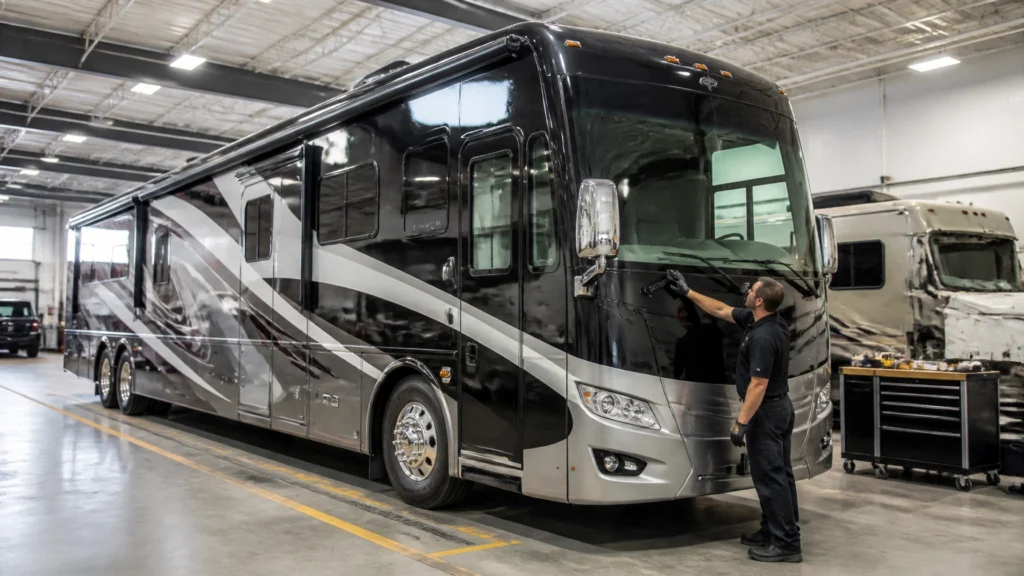
Operating a motorhome is a unique blend of automotive responsibility and homeownership, a duality that becomes starkly apparent the moment a collision occurs on the I-10 or I-215. While a travel trailer or fifth wheel is essentially a "house on wheels" that relies on a tow vehicle for its mechanical soul, a motorhome is a singular, integrated machine. This integration creates a complex web of structural, mechanical, and safety systems that most owners: and many general auto body shops: fail to fully account for after an accident.
Restoring a Class A diesel pusher or a Class C gas motorhome to factory specifications involves far more than just "straightening the bumper" or "patching the fiberglass." Because the living quarters (the "house") are built directly onto the chassis, the kinetic energy of a collision travels through the entire structure in ways that a travel trailer simply doesn't experience. From frame rail tolerances measured in millimeters to the delicate alignment of multi-ton slide-out rooms, the margin for error is non-existent…
The Core Difference: Why Motorhomes Aren't Just Large Trailers
To understand the complexity of rv collision repair, one must first understand the physics of the "house-chassis" bond. In a travel trailer, the frame is a relatively simple ladder structure designed to support weight and tension. In a motorhome, the chassis must handle the torque of a high-output engine, the weight of the house, and the safety requirements of a passenger vehicle.
When a motorhome sustains a front-end impact, the force isn't just absorbed by the bumper and the engine bay. That energy radiates into the floor joists, the wall studs, and the roof-to-wall seals. We often see motorhomes where the front cap is cracked, but the real "hidden" damage is at the rear of the coach, where the force caused a slide-out to jump its track or a plumbing line to snap.
Furthermore, motorhomes are subject to different Department of Transportation (DOT) safety standards than towables. Because people are sitting in the cockpit while the vehicle is in motion, the structural integrity of the front "cage" (on Class A units) or the cutaway cab (on Class C units) is a life-safety issue. This is why choosing a shop with certified auto collision repair in Redlands is critical; you aren't just repairing a vehicle; you are restoring a safety cell.
Diesel Pusher vs. Gas Chassis: Collision Physics
The location of the engine and the type of suspension fundamentally change how a motorhome responds to a collision. In the Inland Empire, we see a mix of both, and the repair paths are rarely identical.
The Diesel Pusher (Rear-Engine)
A Class A diesel pusher, built on a Freightliner or Spartan chassis, is a heavy-duty machine. The engine is at the rear, which means a front-end collision is less likely to destroy the drivetrain but more likely to compromise the steering column and front suspension geometry. However, rear-end collisions in a diesel pusher are often catastrophic. The radiator, charge-air cooler, and complex exhaust aftertreatment systems are all located right behind the rear cap. A "minor" rear-end tap can lead to a $40,000 mechanical repair bill before a single piece of fiberglass is touched.
The Gas Chassis (Front-Engine)
Most gas motorhomes are built on a Ford F-53 stripped chassis or a Chevy Workhorse. The engine is at the front. In a head-on collision, the engine often acts as a crumple zone, but this creates immense heat and vibration that can damage the "house" structure immediately above the cockpit. Because gas chassis use leaf-spring or liquid-spring suspensions rather than the air-ride systems of diesel pushers, the shock of an impact is more "rigid," often leading to more widespread cracking in the fiberglass body panels.

The "House" Systems: Hidden Damage from Collision Force
One of the most common mistakes motorhome owners make is assuming that if the RV still drives and the lights turn on, the "house" side is fine. At RVCCR, our motorhome collision repair process includes a rigorous inspection of the secondary systems that are often jolted during an accident.
- The Generator: Most Class A units have a generator mounted in the front or middle. The vibration of a crash can shear the mounting bolts or crack the exhaust manifold of the generator, leading to carbon monoxide risks later.
- HVAC and Propane: The copper or flexible propane lines running beneath the coach are susceptible to "pinching" when the frame flexes during an impact. A line that looks fine externally may have a microscopic fracture that only reveals itself when the system is pressurized.
- Appliance Mountings: Residential-style refrigerators and convection microwaves are heavy. The inertia of a 60mph-to-0mph stop can strain the cabinetry mounts. If these aren't inspected and reinforced, they can become projectiles in a subsequent hard braking event.
Using OEM parts vs. aftermarket is particularly important for these house systems. Aftermarket brackets or "universal" seals often lack the specific tolerances required to keep these heavy components secure within a fiberglass shell.
Fiberglass Cap Replacement: Front and Rear Dynamics
Motorhomes typically feature large, molded fiberglass "caps" on the front and rear. Unlike a car fender, which is a bolt-on steel or aluminum part, an RV cap is a massive, structural component that must be bonded to the roof and sidewalls.
When a cap is damaged beyond repair, the replacement process is an exercise in precision. The old cap must be de-bonded: a process that involves removing the awning rails, clearance lights, and the critical front-to-roof transition seal. If the shop doesn't understand the chemistry of modern sealants, you will end up with water intrusion. We always emphasize that rv roof replacement and sealing is a required conversation during any cap replacement. If the seal where the cap meets the roof isn't perfect, your collision repair will turn into a mold and rot problem within six months.

Slide-Out Realignment: The Millimeter Margin
Slide-outs are perhaps the most complex part of a motorhome's "body." They rely on a precise relationship between the floor, the sidewall, and the electric or hydraulic motor system. When a motorhome is involved in a collision, the entire "box" of the RV can slightly twist: a phenomenon called "racking."
If the coach is racked even by half an inch, the slide-out will no longer seat correctly against the seals. You might notice:
- The slide-out moves slower than usual.
- The "popping" or "grinding" sounds of gears struggling to mesh.
- Visible gaps at the top or bottom corners when the slide is retracted.
At an rv paint and body shop like RVCCR, we don't just fix the dent on the outside of the slide; we perform a full cycle test and realignment. We check the "square" of the opening and the health of the Schwintek or hydraulic rams. A slide-out that is forced into a warped opening will eventually burn out its motors or, worse, fail to retract while you're at a campsite in the middle of the Mojave.

Frame Rail Straightening vs. Replacement Thresholds
The question we are most frequently asked after a major accident is: "Can the frame be saved?"
For motorhomes, the answer depends on the location and type of the bend.
- The "Crumple" Zone: Modern motorhome chassis have specific areas designed to absorb impact. If the damage is confined to these front or rear "extensions," they can often be cut out and replaced with OEM components.
- The Main Rails: If the bend occurs between the axles (the "mid-ship" area), the structural integrity of the entire vehicle is compromised. Because motorhomes carry such immense weight, a heat-straightened frame rail may not have the same load-bearing capacity as the original steel.
At RVCCR, we use 3D laser measuring to compare your chassis against the manufacturer's original blueprints. If the frame is out of spec by more than the allowed tolerance (often as little as 3mm), we will advocate for a full frame replacement or, in some cases, advise that the vehicle is a total loss for safety reasons. This level of honesty is what separates a factory-certified shop from a general repair facility that might "eyeball" the alignment.
Insurance and Total Loss Dynamics in the Inland Empire
The insurance process for motorhome collision repair is vastly different from that of travel trailer collision repair. Because a Class A motorhome can easily cost $300,000 to $800,000, insurance adjusters are much more thorough: and much more hesitant: to authorize high-dollar repairs.
In California, the "Total Loss" threshold is generally when the cost of repair plus the salvage value exceeds the Actual Cash Value (ACV) of the vehicle. However, with motorhomes, there is a "constructive total loss" component. If a specialized part (like a custom-molded front cap for a defunct manufacturer like Itasca or certain Winnebago models) is no longer available, the insurer may total the unit because it cannot be restored to "pre-loss condition."
We work directly with major carriers to provide the detailed, line-item documentation they require. We don't just say "the wall is broken." We provide photos of the internal framing, the damaged wire looms, and the 3D frame measurements. This transparency often helps our customers get the "Repair" vs "Total" decision that actually makes sense for their long-term investment.
Why Certified Experience Matters in Redlands
The Inland Empire is home to thousands of RV owners who enjoy the proximity to Big Bear, Joshua Tree, and the Colorado River. But when an accident happens, many owners make the mistake of taking their motorhome to a shop that primarily fixes passenger cars.
A standard auto body shop lacks the 60-foot paint booths, the heavy-duty frame racks, and the RVDA-certified technicians required to handle a motorhome. They might be able to paint a fender, but do they know how to properly seal a TPO roof to a fiberglass cap? Do they know how to bleed an HWH hydraulic leveling system?
RVCCR is a family-owned business that has spent 21 years specializing in this exact intersection of automotive and RV repair. We are certified by the manufacturers that build the vehicles you drive: Tesla, Ford, Honda, and more: and we bring that same factory-spec discipline to our RV work.
If your motorhome has been involved in an accident, don't settle for a "good enough" repair. Your safety, your investment, and your next adventure depend on a restoration that is documented, warranted, and done right the first time.
Contact RVCCR in Redlands today for a free estimate and let our certified team handle the insurance, the structural repairs, and the precision paint work your motorhome deserves.
Need a repair estimate?
Skip the wait — send us a few photos and our team will get back to you fast.
Start a Photo Estimate →