RV Delamination Repair After a Collision: Proving the Damage Is Crash-Related vs. Pre-Existing Moisture Intrusion
Operating a family-owned collision, paint, and mechanical repair shop for 21 years in Redlands and across the Inland Empire provides a front-row seat to the complex realities of RV ownership. When a motorhome, fifth wheel, travel trailer, or toy hauler suffers an impact on the highway or at a campsite, the immediate visible damage: crushed fiberglass, cracked corners, or bent aluminum framing: dominates the owner's attention. Yet, beneath the outer skin of modern recreational vehicles lies a multi-layer composite structure engineered under strict tension and vacuum-bonding specifications. When a collision occurs, the shockwave and kinetic forces ripple far beyond the point of direct contact, frequently severing the internal adhesive bond between the exterior fiberglass and the underlying wooden or composite backing core…
As RV owners navigate the stressful aftermath of an accident, an equally formidable battle often begins in the insurance adjusting bay: distinguishing between fresh, impact-induced sidewall delamination and pre-existing, weather-related moisture intrusion. Insurance carriers frequently attempt to categorize structural separation as long-term neglect, water rot, or general wear and tear, seeking to deny coverage for expensive panel restorations. For recreational vehicle owners in Southern California seeking an experienced rv collision repair facility, understanding the physics of delamination, the exact diagnostic protocols required to prove causation, and the distinction between localized epoxy injections and full structural panel replacement is essential for securing complete restoration.
The Anatomy of Modern RV Sidewalls and Vacuum-Bonded Lamination
To understand why a collision triggers sudden delamination, one must first examine how modern RV walls are constructed. Unlike traditional stick-built residential framing, contemporary motorhomes and travel trailers utilize advanced composite sandwich panels manufactured through high-pressure vacuum bonding.
A standard RV sidewall consists of several distinct layers compressed together under thousands of pounds of pressure:
- Exterior Skin: High-gloss or pebble-finish gel-coated fiberglass reinforced plastic (FRP), chosen for its weather resistance, flexibility, and light weight.
- Adhesive Layer: Industrial-grade contact adhesives, polyurethane glues, or reactive structural epoxies applied uniformly across the entire surface area.
- Backing Substrate: Typically thin luan plywood, Azdel composite panels, or specialized oriented strand board (OSB) that provides rigidity and screw-holding strength.
- Framing & Insulation: Aluminum or structural wood framing interspersed with block foam (expanded polystyrene or extruded polystyrene) or high-density fiberglass batt insulation.
- Interior Wallboard: Vinyl-covered interior paneling that finishes the living space.
During the manufacturing process, the exterior fiberglass and backing core are pressed into the adhesive while a vacuum pulls out all trapped air. This creates an unyielding, unified structural diaphragm where wind loads, torsional chassis flexing, and thermal expansion are distributed evenly across the entire wall.
However, this composite integrity relies entirely on an unbroken bond. When a vehicle sustains a collision: whether a sideswipe on Interstate 10, a low-hanging branch strike on a winding mountain road, or a jackknife incident with a tow vehicle: the instantaneous deceleration and localized shear forces act like a high-speed wedge, snapping the adhesive bond between the fiberglass skin and the luan backing core, even in areas where the outer skin appears completely unpunched.

Collision-Caused Delamination vs. Pre-Existing Weather Intrusion
The central friction point in many insurance claims involves proving whether wall separation was caused by the recent accident or by years of unchecked roof leaks, failing window seals, or unaddressed plumbing condensation. Insurance adjusters are trained to look for pre-existing conditions to limit payouts, making it vital to understand the distinct forensic markers that differentiate collision damage from weather degradation.
1. Boundary Characteristics and Edge Profiles
- Collision-Induced Delamination: Features sharp, well-defined boundaries that radiate outward directly from the point of impact or structural stress riser. The separation line often traces the exact contour of internal aluminum framing members that buckled during the crash, or mirrors the shockwave propagation pattern across the sidewall.
- Pre-Existing Moisture Intrusion: Exhibits gradual, feathering boundaries. Water-damaged wood swells, rots, and loses structural cohesion progressively over months or years. The transition from bonded to unbonded wall is soft, irregular, and typically concentrated near gravity-fed entry points such as roof radiuses, marker lights, unsealed window frames, or slide-out wiper gaskets.
2. Location Relative to Impact Zones
- Collision-Induced Delamination: Frequently occurs miles away from any source of water. A severe corner impact at the rear bumper can transmit torsional shock through the structural framing, causing the sidewall to delaminate near the front door or cab-over transition, entirely independent of any water leak path.
- Pre-Existing Moisture Intrusion: Strictly follows hydrological laws. Damage is almost exclusively clustered beneath roof seams, window corners, slide-out headers, and plumbing vent stacks, where gravity pulls moisture downward through the wall cavity.
3. Substrate Condition and Moisture Content
- Collision-Induced Delamination: Can occur in bone-dry wall cavities. If a collision happens during dry summer weather in the Inland Empire, the wood backing behind the separated fiberglass may register normal baseline moisture levels (below 15%) while remaining completely detached due to mechanical shear stress.
- Pre-Existing Moisture Intrusion: Is invariably accompanied by elevated moisture meter readings (exceeding 20% to 30%), mold spore colonization, fungal decay of the luan plywood, and a distinct musty odor inside the wall cavity.
For vehicle owners seeking a reputable rv paint and body shop, establishing this distinction with scientific precision is the cornerstone of a successful insurance claim approval.
Professional Diagnostic Methodology: How Experts Prove Causation
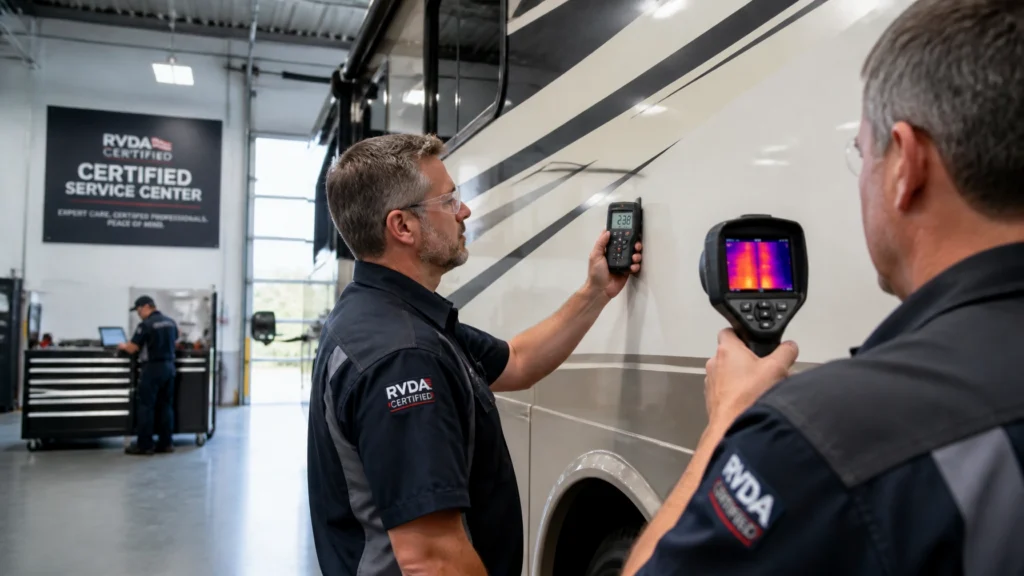
When an RV arrives at an RVDA certified facility for collision evaluation, technicians cannot rely on visual inspection alone. Proving that delamination is directly tied to a specific accident requires a rigorous, multi-point diagnostic protocol accepted by major insurance carriers and forensic adjusters.
The Tapping Test (Acoustic Resonance Analysis)
Using a lightweight diagnostic hammer or specialized coin-tapping technique across the entire sidewall, certified technicians listen for changes in acoustic resonance. A solidly bonded wall produces a crisp, high-pitched tap. A delaminated section: where air has formed a pocket between the fiberglass and the backing core: produces a dull, hollow thud. Technicians map these hollow zones on a grid, creating a visual blueprint of the separation area.
Pinless and Pin-Type Moisture Meter Scanning
To rule out or confirm pre-existing water intrusion, technicians deploy calibrated electromagnetic depth-penetrating moisture meters. Pinless meters scan up to an inch beneath the surface without damaging the fiberglass, measuring dielectric constant changes caused by moisture. If high moisture readings align exclusively with a roof seam far from the collision zone, pre-existing water damage is documented. Conversely, if moisture readings throughout the delaminated area are normal (indicating dry separation caused by impact shock), the collision causation is verified.
Thermal Imaging (Infrared Thermography)
Advanced collision centers utilize high-resolution thermal imaging cameras to inspect RV sidewalls under controlled temperature differentials. Because trapped air pockets and wet substrate materials exhibit different thermal mass and heat dissipation rates than solid, dry composite walls, infrared scans reveal precise internal delamination boundaries that are entirely invisible to the naked eye. This thermal map serves as irrefutable documentation for insurance adjusters and independent claims investigators.

Repair Methodologies: From Epoxy Injection to Full Panel Replacement
Once diagnostic testing establishes the exact extent and cause of the delamination, technicians determine the appropriate restoration protocol. Repair methods vary dramatically depending on the size of the affected area, the condition of the underlying substrate, and structural requirements.
1. Injectable Adhesive Repair (Localized Delamination)
For smaller, localized delamination zones (typically under 3 to 4 square feet) resulting directly from a localized impact where the underlying wood core remains structurally sound and dry:
- Access Drilling: Technicians drill a grid of precise, micro-diameter holes through the interior wallboard (or exterior fiberglass, depending on accessibility).
- Resin Formulation: A specialized, two-part structural epoxy or polyurethane adhesive formulated for composite bonding (maintaining a precise resin-to-hardener ratio) is injected into the void via pneumatic syringes.
- Precision Clamping: External vacuum fixtures and rigid exterior caul boards are applied across the sidewall to press the fiberglass skin flush against the backing core while the adhesive cures for 15 to 24 hours.
- Finishing: Injection ports are plugged, sealed, and refinished to match factory textures and paint codes.
- Cost Range: Generally ranges from $800 to $4,000, depending on accessibility and finish complexity.
2. Full Structural Sidewall Panel Replacement (Major Damage)
When collision forces cause extensive, multi-foot delamination, or when the underlying luan plywood has suffered structural shear and cannot hold an adhesive bond:
- Component Removal: Surrounding exterior trim, clearance lights, windows, slide-out mechanisms, and interior cabinetry are carefully unbolted and removed.
- Wall Extraction: The damaged composite sidewall is detached from the aluminum or steel framing skeleton.
- Substrate & Framing Restoration: Buckled aluminum studs are straightened or replaced to exact factory specifications. New marine-grade luan or composite backing boards are installed.
- Vacuum Bonding & Reassembly: A new OEM-spec composite sidewall panel is bonded and clamped to the framing, followed by professional color-matched painting and clear-coating in a certified paint booth.
- Cost Range: Comprehensive structural wall replacement typically ranges from $3,000 to $12,000+, depending on motorhome class and body length.
Whether executing a localized repair or a major structural overhaul, professional motorhome collision repair requires factory-grade equipment and meticulous attention to detail to restore structural integrity and weather resistance.
Navigating the Insurance Claim and Securing Full Compensation
Filing an insurance claim for collision-induced RV delamination presents unique hurdles. Because delamination can sometimes take weeks or months to become fully apparent: as thermal expansion and road vibration gradually work the unbonded fiberglass away from the core: adjusters often reflexively deny claims filed after initial post-accident inspections.
To successfully secure coverage for delamination repairs, vehicle owners must build an airtight documentation package with the assistance of their repair facility:
- Immediate Post-Collision Documentation: High-resolution photographs and video footage taken immediately after the accident, capturing not only direct impact points but surrounding sidewalls and corner caps.
- Comprehensive Maintenance Records: Proof of regular roof inspections, seal recoating, and preventative maintenance. This preempts insurer arguments regarding pre-existing neglect.
- Professional Diagnostic Report: A certified repair shop assessment featuring thermal imaging scans, moisture meter mapping logs, and acoustic tapping diagrams that establish the exact temporal and physical correlation between the impact and the delamination.
- OEM Repair Specifications: Documenting manufacturer guidelines that mandate structural panel replacement rather than temporary cosmetic fixes when composite integrity is compromised.
By partnering with an established, family-owned repair facility that coordinates directly with all major insurance providers, offers free estimates, and backs every restoration with a written lifetime warranty, RV owners remove the administrative friction from the claims process.

Restoring Your RV for the Open Road
Sidewall delamination following a collision is a serious structural issue that demands professional intervention, precise diagnostic testing, and uncompromising craftsmanship. Ignoring separated fiberglass invites progressive moisture intrusion, mold growth, and structural failure that threatens the safety and longevity of your recreational vehicle.
If your motorhome, travel trailer, or toy hauler has sustained impact damage and you are navigating the complexities of insurance claims and structural restoration, expert guidance makes all the difference. Schedule your free estimate with our certified technicians today, or explore our comprehensive collision repair and RV restoration services. Let us handle the technical precision and structural engineering behind the scenes, so you can refocus on what truly matters: planning your next unforgettable adventure across the open road.
Need a repair estimate?
Skip the wait — send us a few photos and our team will get back to you fast.
Start a Photo Estimate →