Tesla Giga-Casting Collision Repair: Why Single-Piece Castings Demand a Different Approach to Structural Restoration
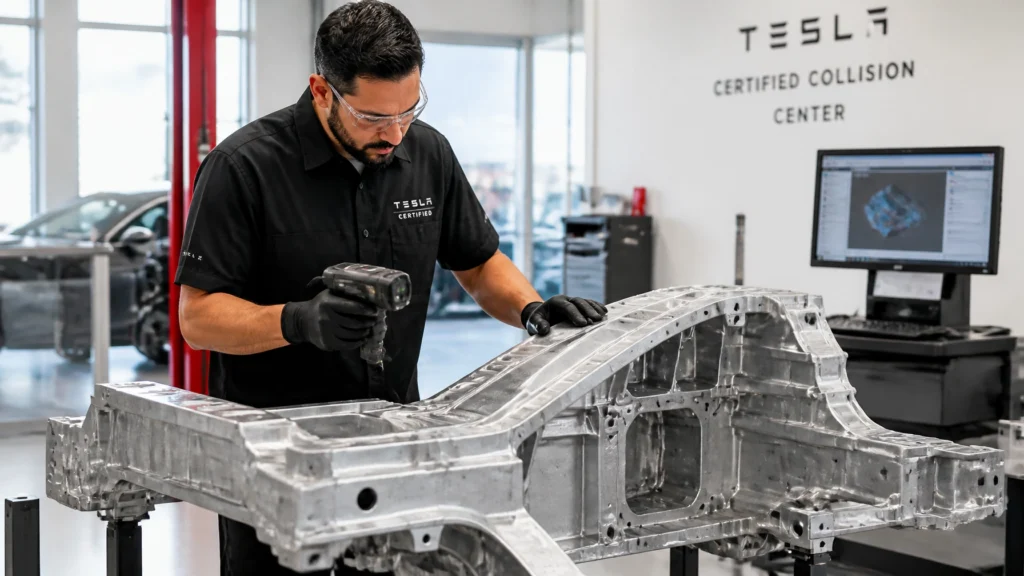
Operating a certified automotive repair facility in California's Inland Empire requires navigating profound technological shifts in modern vehicle construction. For over two decades, our family-owned shop has restored vehicles to factory specifications through rigorous training, OEM tooling adherence, and uncompromising craftsmanship. Today, no automotive engineering innovation has disrupted traditional collision repair methods quite as dramatically as Tesla’s introduction of massive single-piece aluminum Giga-Castings in vehicles like the Model Y and the Cybertruck.
When a modern electric vehicle featuring a structural rear or front underbody casting suffers a collision, the traditional playbook of frame machines, hydraulic pulls, and arbitrary heat-straightening becomes obsolete. Single-piece aluminum castings possess unique metallurgical properties, distinct energy-absorption characteristics, and strict manufacturer-mandated restoration parameters that separate specialized Tesla certified collision centers from general body shops. Understanding these complexities is essential for vehicle owners, insurance adjusters, and fleet managers navigating post-collision safety…
The Evolution of Automotive Architecture: From Multi-Piece Stampings to Giga-Castings
For nearly a century, automotive body construction relied on hundreds of individual steel and aluminum stampings welded, bonded, or riveted together. In a severe rear-end or front-end collision, conventional unibody vehicles absorb kinetic energy through the controlled crumpling of these multi-piece assemblies. When damaged, technicians could section individual rails, drill out spot welds, align bent members on a frame bench, and weld replacement stamped sections into place.
Tesla’s implementation of High-Pressure Die Casting (HPDC): commonly referred to as "Giga-Casting": fundamentally upends this paradigm. Instead of assembling a rear or front underbody structure from 70 separate stamped components, robotic Giga-presses inject molten aluminum alloy into colossal molds under immense pressure, casting an entire structural section as a single, homogenous monolithic component.
This manufacturing marvel yields significant advantages for production efficiency and vehicle rigidity:
- Massive Weight Reduction: Eliminating dozens of overlapping steel or aluminum panels, spot welds, and structural adhesives substantially lowers vehicle weight, extending battery range.
- Enhanced Torsional Rigidity: A single-piece aluminum casting provides superior structural stiffness, improving handling dynamics, cabin quietness, and crash energy distribution.
- Streamlined Manufacturing: Reducing assembly steps accelerates production velocity at Tesla Gigafactories across Fremont, Austin, Berlin, and Shanghai.
However, what represents a triumph of modern manufacturing introduces unprecedented challenges in the realm of collision repair. Because the underbody structure is no longer an assemblage of modular pieces, an impact that reaches the casting transmits forces instantly across a massive, unyielding surface area.
Metallurgical Reality: Why Cast Aluminum Cannot Be Straightened or Welded Arbitrarily
To appreciate why a generic repair facility cannot service a modern Tesla after a moderate impact, one must examine the metallurgy of high-pressure die-cast aluminum. Unlike wrought aluminum alloys: which exhibit ductility and can often be cold-formed, reshaped, or manipulated within strict manufacturer tolerances: cast aluminum has a crystalline microstructure that is inherently brittle under concentrated stress.
When a traditional vehicle frame is bent in a collision, body technicians attach hydraulic towers to pull the steel back into alignment. Attempting to apply hydraulic pulling force to a deformed Giga-casting will not restore its original geometry; instead, it will cause catastrophic cracking, fracturing, or micro-fissuring throughout the casting matrix.

Tesla’s engineering standards and official structural repair manuals enforce strict limitations:
- Zero Cold Straightening on Core Load Paths: Unlike mild steel rails, structural casting members cannot be mechanically pulled, hammered, or heat-straightened when deformed beyond factory tolerance.
- Zone-Based Repair Protocols: Tesla categorizes casting damage into strict visual and structural zones (typically mapped as green, yellow, orange, and red areas).
- In designated green zones, minor surface cracks up to specific thresholds (often under 30 mm to 50 mm) may be repairable via specialized TIG welding combined with backing reinforcement plates.
- In orange and red zones: which encompass suspension mounting points, battery enclosure interfaces, and primary crash impact paths: any crack, tear, or significant dimensional distortion mandates complete or partial casting replacement. No welding is permitted.
- The Absolute Prohibition of Unauthorized Welding: Standard automotive repair welding techniques introduce excessive heat, altering the grain structure of the specialized aluminum alloy and severely compromising its tensile strength. Only technicians trained and certified specifically in Tesla EV repair procedures are authorized to execute structural bonding and approved sectioning methods.
The Precision of Partial Sectioning and Structural Replacement
When a Giga-casting sustains localized damage exceeding minor surface thresholds, replacing the entire vehicle underbody is rarely the first resort unless the impact was catastrophic. Instead, Tesla engineers developed sophisticated sectioning procedures that allow certified facilities to replace only the compromised portion of the casting.
As an elite tesla certified collision center, our technicians follow exact factory protocols to execute these complex structural cuts:
1. Locating Factory Reference Lines
Tesla designs structural castings with designated reference cut lines. These precision locations allow technicians to use specialized water-cooled pneumatic saws to cleanly excise the damaged section along pre-engineered geometric boundaries.
2. Surface Preparation and Chemical Cleaning
The cut edges of the remaining parent casting must be meticulously prepped. Technicians remove burrs, smooth surfaces with calibrated belt sanders, and treat the exposed aluminum with chemical cleansing agents (such as isopropyl alcohol) to ensure optimal adhesion.
3. Structural Adhesives and Rivet Bonding
The replacement casting section is fitted using aerospace-grade structural adhesives (crash-durable epoxies) combined with high-strength flow-drill screws and self-piercing rivets (SPRs). The adhesive provides continuous load distribution along the joint, while mechanical fasteners clamp the components together while the epoxy cures under controlled temperature conditions.
The Critical 8-Point Fixturing Requirement
Executing a structural casting replacement or sectioning procedure requires an environment far removed from a traditional body shop floor. Because single-piece castings dictate the precise geometry of the vehicle's suspension geometry, battery pack mountings, and occupant safety cells, dimensional accuracy must be maintained down to fractions of a millimeter.
This is where the mandatory 8-point bench fixturing system comes into play.

When working on a Giga-cast structure, the vehicle must be mounted onto a dedicated, manufacturer-approved straightening and measuring bench. The setup utilizes at least eight primary factory reference and mounting points simultaneously.
- Dimensional Stability: The bench locks the undamaged portions of the vehicle in rigid spatial alignment, preventing any shifting or warping while sections of the casting are cut away.
- Laser Measurement Integration: Throughout the adhesive bonding and riveting process, active laser measuring systems monitor suspension mounting datums to verify that dimensional tolerances remain within strict OEM windows.
- Curing Rigidity: Once the new casting section is bonded and riveted, the vehicle must remain secured on the fixture for up to 24 hours while the structural epoxy cures to its maximum rated tensile strength. Removing the vehicle prematurely risks inducing permanent internal stresses that can ruin wheel alignments, compromise ADAS sensor calibration, and degrade crashworthiness.
Part Sourcing, Freight Logistics, and the Reality of Extended Turnaround Times
For vehicle owners searching for an ev repair shop near me after an accident, turnaround time is naturally a primary concern. However, repairing or replacing a Tesla Giga-casting introduces unique logistical hurdles that differentiate EV collision work from conventional automotive repairs.
The Challenge of Massive Replacement Castings
Unlike traditional fenders or bumper reinforcement bars that arrive in standard courier parcels, Giga-casting replacement sections are massive, fragile, and geometrically complex components. Shipping a structural rear underbody section requires specialized freight handling, custom crating, and dedicated transport logistics from Tesla’s distribution hubs to certified regional collision facilities.
Supply Chain and Inventory Realities
Because Giga-press technology is relatively new in automotive manufacturing, aftermarket equivalent castings do not exist: nor would they be legally or structurally permissible. Every replacement component must be a genuine OEM part sourced directly through official Tesla supply channels. Ensuring that the correct part revision (corresponding to minute engineering updates introduced during continuous vehicle manufacturing runs) arrives at the shop requires experienced parts coordinators who understand Tesla’s micro-part categorization.
Why Insurance Estimates Frequently Miss Giga-Casting Damage
One of the most stressful aspects for vehicle owners involved in an accident is the discrepancy between initial insurance adjuster estimates and the actual scope of repairs required by a certified shop.
When an insurance appraiser conducts an initial drive-by or photographic inspection of a Tesla Model Y or Cybertruck following a rear or side impact, they typically document superficial damage: cracked bumper fascias, dented tailgate skins, or displaced plastic trim. Because Giga-castings are hidden beneath interior trunk liners, battery shields, and sound-deadening insulation, hairline fractures or micro-deformation of the casting are virtually invisible during a preliminary survey.
When the vehicle arrives at our tesla body shop inland empire facility, our technicians perform a complete disassembly, remove protective shielding, and utilize non-destructive testing (such as dye penetrant inspection) to uncover hidden structural compromise. We then collaborate directly with insurance carriers to submit comprehensive supplemental estimates supported by Tesla’s official repair procedures, ensuring that hidden casting damage is fully documented and correctly covered.
Financial Realities: Understanding the Cost Spectrum ($8,000 – $25,000+)
Due to the specialized tooling, mandatory 8-point fixturing setups, structural bonding adhesives, high labor hours, and expensive OEM components involved, Giga-casting collision restoration represents a significant financial investment.
Based on documented real-world repairs across certified facilities, collision involving structural casting work typically spans distinct cost brackets:
- Localized Sectioning & Minor Structural Work: Repairs involving the replacement of a single rail section or localized aluminum reinforcement bonding generally start around $8,000 to $14,000, inclusive of labor, structural epoxies, rivets, and refinishing.
- Major Structural Replacement & Associated Assemblies: Extensive impacts requiring full sectional replacement of a rear or front Giga-casting, coupled with necessary suspension replacement, rear drive unit removal, high-voltage battery safety disconnects, and comprehensive ADAS sensor calibrations, frequently range from $15,000 to $25,000+.
While these figures reflect the advanced engineering embedded in modern electric vehicles, independent automotive engineering studies have noted that sectional casting repairs can actually be more cost-effective and structurally sound than repairing complex multi-piece stamped assemblies with dozens of overlapping weld joints.
Entrusting Your EV to Certified Specialists
Navigating the aftermath of a collision is challenging enough without worrying whether your vehicle’s structural integrity has been permanently compromised. Tesla’s revolutionary Giga-castings offer unmatched safety and rigidity, but they demand a standard of care that only factory-certified technicians can provide.
If your Tesla or electric vehicle has suffered structural impact, do not leave its restoration to chance. Contact our expert team today to schedule a comprehensive assessment or request free estimates from technicians who treat every vehicle with the uncompromising precision it deserves. Let us restore your vehicle to factory specifications so you can get back on the road with total confidence and peace of mind.
Need a repair estimate?
Skip the wait — send us a few photos and our team will get back to you fast.
Start a Photo Estimate →