EV Battery Safety Inspection After a Collision: What Every Tesla and EV Owner Should Demand
As a family-owned shop with 21 years of experience in Redlands and the Inland Empire, RVCCR has witnessed the rapid evolution of automotive technology. Today, a collision involves far more than straightening metal and matching paint. For owners of a Tesla, Rivian, or Ford Mustang Mach-E, the most critical component of a post-crash repair isn't the bumper or the fender: it is the high-voltage (HV) battery system.
A high-voltage battery is a massive, complex energy storage device. While the outer enclosure is designed to protect the lithium-ion cells from the rigors of the road, the forces involved in even a "minor" collision can cause internal damage that is invisible to the naked eye. Unlike a traditional internal combustion engine vehicle, a compromised EV battery may not show immediate symptoms, yet it poses a long-term risk of thermal runaway or electrical failure.
Establishing immediate trust through certified expertise is the only way to navigate these complexities. At RVCCR, we hold manufacturer certifications from Tesla, Rivian, and Ford, meaning our technicians are specifically trained in the delicate and dangerous art of HV battery safety inspections. When you are looking for an ev repair shop near me, you aren't just looking for a body shop; you are looking for a safety partner who understands that the structural integrity of your battery is non-negotiable…
The High-Voltage Disconnect: Why Safety Starts with Isolation
Before a technician even touches a wrench to your vehicle, the first and most vital step is the High-Voltage Service Disconnect (HVSD). This procedure is not merely a "battery pull." It is a strictly regulated safety protocol designed to isolate the high-voltage power: often exceeding 400 or 800 volts: from the rest of the vehicle.

At a tesla certified collision center, this process follows precise manufacturer instructions. The disconnect ensures that no stray current can energize the vehicle's chassis while technicians are performing repairs. This is particularly crucial if the vehicle has sustained structural damage. If the high-voltage system is not properly de-energized, the risk of arc flash or electrocution is a real threat to anyone working on the car.
But the disconnect serves a secondary purpose for the owner: it protects the vehicle's sensitive electronic components. By isolating the battery, we ensure that during the welding or structural pulling phases of a certified auto collision repair, no surges can damage the Battery Management System (BMS) or the drive units. Demand that your shop provides documentation that the HV system was de-energized and verified with a multi-meter before any work began.
Visual and Structural Inspection of the Battery Enclosure
The lithium-ion cells in your EV are housed within a reinforced metal enclosure. Depending on the model, this enclosure might be made of high-strength steel or lightweight aluminum. During a collision, especially one involving a side-impact or an underbody strike, this enclosure can suffer "non-structural" damage that leads to "structural" failure of the battery.
Our technicians divide the battery inspection into four specific zones:
- The Front Zone (Skid Plate Area): We inspect the front skid plate for tears, breaches, or dents. If an object has punctured the plate, it may have reached the coolant passthroughs or the HV cables.
- The Side Zones (Rocker Panels): EVs like the Rivian R1T and Tesla Model Y are particularly sensitive to side-impacts. We remove the rocker covers to inspect for pinched cables or deformations in the "skateboard" frame.
- The Center Zone (Center Ski): Any deformation in the center of the floorpan suggests the battery pack itself has been compressed.
- The Rear Zone: We check for distortion in the rear motor mounts and the HV harness interfaces.
Tesla’s technical bulletins, such as TN-22-16-001, are very specific: any hole, crack, or tear in the enclosure requires immediate battery replacement. There is no such thing as "patching" an EV battery. If your adjuster suggests a repair to the enclosure, you must insist on OEM parts and a full replacement, as any breach in the seal allows moisture to enter, leading to corrosion and eventual internal shorts.
Thermal Imaging: Seeing the Invisible Threat
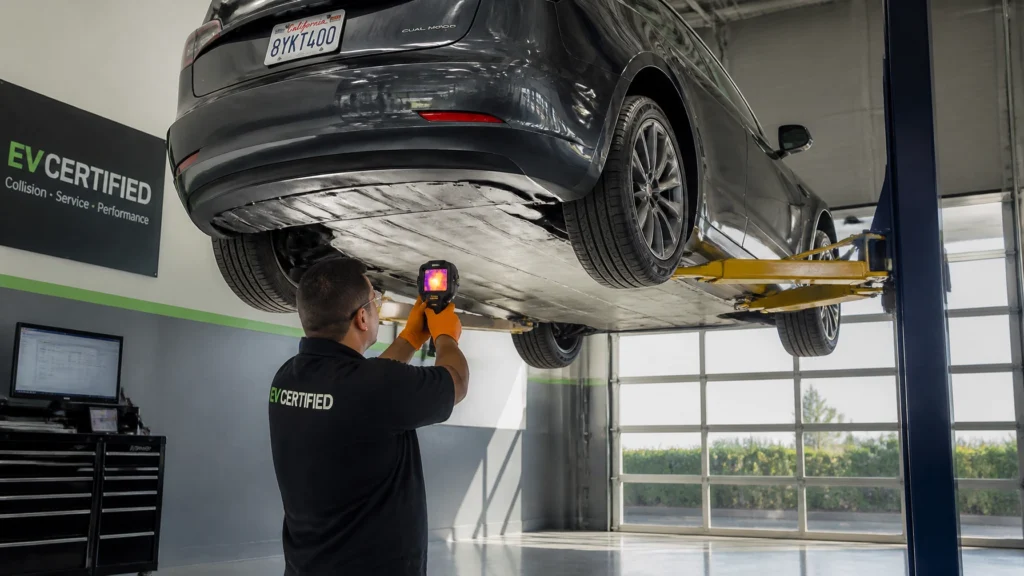
One of the most advanced tools we use at RVCCR is the non-contact infrared thermal imaging camera. A damaged battery cell can experience a "micro-short," which generates heat long before it sparks a fire.
Tesla's safety protocol for suspected critically damaged batteries includes a 16-point thermal measurement. To pass, every measurement on the pack must be below 40°C (104°F), and the difference (delta) between any two points must be less than 5°C. If one corner of your battery is significantly warmer than the rest, it is a sign of internal chemical instability.

For owners in the Inland Empire, where summer temperatures frequently exceed 100°F, this test is even more critical. Environmental heat can exacerbate internal cell damage. If your car was in a collision during a heatwave, a thermal scan is the only way to ensure the battery isn't currently undergoing a slow-motion failure that could culminate in a fire weeks later.
Dielectric Testing and Coolant System Integrity
EV batteries are liquid-cooled. A network of thin-walled tubes carries a glycol-based coolant between the cells to maintain an optimal operating temperature. In a crash, these tubes can crack.
The nightmare scenario is a "coolant-to-battery" leak. Because the coolant is conductive, if it leaks inside the sealed battery enclosure, it can create a path for electricity to jump between high-voltage components. This is why we perform a dielectric test (also known as an insulation resistance test).
Using a specialized Megger tester, we apply a controlled high-voltage load to the system to see if the electricity "leaks" where it shouldn't. If the resistance is low, it indicates that either coolant, moisture, or physical debris has compromised the electrical isolation of the pack. At our rivian certified collision center, this is a standard part of the post-repair verification.
The BMS Diagnostic Scan: Reading the Battery's History
Your vehicle’s Battery Management System (BMS) is essentially a black box for the battery. It monitors every cell's voltage, temperature, and health in real-time. After a collision, even if there are no warning lights on the dashboard, the BMS may have stored "fault codes" (DTCs) that indicate a problem.

We use OEM scan tools: not generic OBD-II readers: to interrogate the BMS. We look for:
- Isolation Faults: Indicating a high-voltage leak.
- Cell Imbalance: Showing that one or more cells are not holding a charge correctly due to impact damage.
- Contactor Welds: Where the high-voltage switches have stuck open or closed during the crash's emergency shutdown.
- Thermal Management Errors: Indicating the cooling pumps or sensors are malfunctioning.
A clean "BMS Vitall" printout is your ultimate proof of safety. It is the documentation you need to protect your vehicle’s resale value and your family's safety.
Manufacturer-Specific Requirements: Why Certification Matters
Every manufacturer has a different philosophy on battery safety. A generic shop simply cannot keep up with these evolving requirements.
Tesla’s Battery Inspection Protocol
Tesla requires a rigorous multi-point check that includes documenting the State of Charge (SOC). If a Tesla battery is suspected of being "critically damaged," it must be stored outdoors in a cordoned-off area, 50 feet away from other structures, until it can be safely discharged and inspected. If your shop is parking your damaged Tesla inside a crowded warehouse immediately after a crash, they are violating safety protocols.
Rivian’s Skateboard Inspection
The Rivian R1T and R1S utilize a "skateboard" platform where the battery is a structural member of the chassis. This means that frame damage often is battery damage. Our technicians are trained to measure the skateboard for millimetric deviations that could indicate the battery enclosure has been torqued or twisted, which can stress the internal cell connections.
Ford Mustang Mach-E and F-150 Lightning
Ford’s EV architecture relies on specific battery tray mounting specs. If the mounting bolts are stretched or the tray is misaligned by even a fraction of an inch, the high-voltage connectors may not seat correctly, leading to "arcing" over time.
Replacement vs. Repair: The Insurance Implications
The cost of an EV battery replacement can range from $12,000 to over $30,000. Because of this high cost, insurance companies are often quick to "total loss" an EV if there is even a hint of battery damage.
However, a certified shop can often provide the technical evidence needed to save a vehicle if the damage is truly cosmetic, or conversely, to demand a total loss if the battery is unsafe. We work directly with all major insurance carriers: including GEICO, State Farm, and AAA: to ensure that the "bottom line" never overrides your safety. We don't accept aftermarket parts for high-voltage systems because there is no such thing as a "safe" third-party EV battery.
The Actual Cost of EV Battery Replacement vs. Repair
This is the financial reality behind nearly every serious EV collision claim. When an adjuster hears the words "possible battery damage," they are not thinking about a small inspection charge. They are thinking about the possibility of a five-figure battery replacement that can push the vehicle beyond its actual cash value…
Here are the kinds of replacement figures that drive those decisions:
- Tesla Model 3 battery replacement: approximately $12,000 to $16,000
- Tesla Model S or Model X battery replacement: approximately $18,000 to $25,000
- Rivian R1T skateboard replacement: approximately $20,000 to $30,000
- Ford Mustang Mach-E battery replacement: approximately $12,000 to $18,000
Those numbers matter because they can change the direction of the claim almost immediately. If a vehicle already needs structural repairs, suspension work, calibrations, paint, and rental coverage, then adding a battery replacement can make the file move from "repairable" to "potential total loss" very quickly. That is why insurance carriers frequently take a cautious position when there is confirmed battery enclosure damage, a thermal event, or evidence of compromised high-voltage isolation.
But there is an equally important point that owners need to understand: suspected battery damage is not the same thing as confirmed battery failure. A proper inspection may show that the outer body damage looks severe while the battery pack remains structurally intact, electrically isolated, and thermally stable. When that happens, a certified inspection can save the vehicle from being totaled unnecessarily.
The math is straightforward. A full EV battery safety inspection generally costs about $300 to $800, depending on the manufacturer procedure, the level of disassembly required, and the diagnostic steps needed to document the pack's condition. That is a fraction of the cost of a replacement battery. In most collision claims, that inspection expense is typically written as part of the diagnostic fee because it is necessary to determine whether the vehicle can be repaired safely.
This is one of the biggest differences between a certified EV collision center and a general repair shop. A non-certified shop may treat the battery as an unknown and leave the adjuster with two bad options: guess that the battery is fine, or assume the worst. A certified shop can produce thermal data, scan results, inspection photos, and manufacturer-based repair logic that supports the correct outcome. Sometimes that means proving the battery is safe and preserving the vehicle. Sometimes it means documenting damage so clearly that a total-loss decision is the only responsible path.
For Tesla, Rivian, and Ford owners, that distinction can mean the difference between a manageable repair and the loss of a vehicle you expected to keep for years. The inspection is not an upsell. It is the small, necessary step that protects you from making a five-figure mistake.
The 50-Foot Quarantine: What Happens When a Battery Is Critically Damaged
Some post-collision EV procedures are inconvenient. This one is non-negotiable.
If a battery is suspected of being critically damaged, Tesla protocol requires the vehicle to be stored outdoors in a designated safety zone at least 50 feet from any structure, combustible material, or other vehicles. That distance is not arbitrary. It is intended to reduce the chance that a battery fire or thermal event will spread to the building, nearby customer cars, parts storage, or other ignition sources.
A battery may be treated as critically damaged if there has been impact to the battery enclosure, an observed thermal event, or airbag deployment in a collision severe enough to raise concerns about high-voltage system integrity. In that situation, the vehicle cannot simply be pushed into a regular storage line and forgotten until teardown begins.
The outdoor quarantine area must be clearly separated and cordoned off with warning tape so employees, customers, vendors, and tow operators do not enter the zone casually. If the battery shows any signs of thermal runaway risk, such as smoke, hissing, or discoloration, the fire department must be notified immediately. Those symptoms indicate the situation may be escalating beyond normal collision handling into an active battery hazard.
Once the vehicle is in quarantine, monitoring becomes part of the repair plan. The battery must be checked with a thermal camera every 4 hours until it is discharged or removed. That repeated monitoring matters because battery failures do not always happen at the moment of impact. Heat can build later. A pack that looks stable when it arrives can become unstable hours afterward, especially after ambient temperature changes or internal damage continues to develop.
This is exactly why certified EV facilities maintain designated outdoor storage areas and fire-safety procedures for damaged high-voltage vehicles. They understand that containment, separation, and monitoring are part of the repair process, not optional extras. A shop without that setup is not equipped for the risk profile of a damaged EV battery.
It also explains why owners should be cautious about where their vehicle is towed after a crash. A non-certified shop may park a damaged EV inside a standard production area, a normal parking lot, or even near a paint booth. If the battery is suspected of critical damage, that is not just poor process. It is a serious safety problem and can amount to a fire code issue. Paint materials, compressed gases, neighboring vehicles, and enclosed structures do not belong next to a quarantined EV.
From the customer's perspective, the quarantine period can feel like a delay. In reality, it is evidence that the shop is taking the vehicle's condition seriously. Responsible EV collision repair does not begin with cosmetic teardown. It begins with scene control, hazard separation, and documented battery safety management.
The Post-Repair Test Drive: What the Technician Checks
A battery inspection is not complete just because the scan tool shows no active fault at one moment in the bay. Post-repair validation has to confirm that the vehicle behaves correctly when the high-voltage system is loaded in real driving conditions…
After the battery inspection and collision repairs are complete, the technician runs the vehicle through a full charge cycle to verify that the Battery Management System (BMS) is communicating correctly. This step helps confirm that the pack, charging system, and control modules are working together the way the manufacturer intended. A battery that appears normal during static testing can still show communication or performance issues during charging.
During and after that process, the technician checks for warning messages on the instrument cluster and in the OEM diagnostic system. Even an intermittent high-voltage warning matters. If the system records a charging fault, isolation alert, battery management communication error, or thermal management issue, the repair cannot be treated as complete.
The road test itself serves several purposes. One major check is verifying that regenerative braking functions properly. Regen is not just a drivability feature. It is proof that the battery is able to accept charge during deceleration. If regenerative braking is limited, inconsistent, or disabled without a normal explanation such as state-of-charge or ambient-temperature restrictions, that can point to battery acceptance issues that require further diagnosis.
The technician also monitors battery temperature during the drive. If there is an abnormal temperature rise under normal operation, the pack may have an internal problem that was not obvious during visual inspection. A temperature spike above 104°F during the test drive is treated as a serious warning sign because it can indicate a failed cell that requires immediate service.
Range behavior matters too. The technician checks that the vehicle's range estimate is consistent with the pre-accident baseline. This is not about chasing an exact dashboard number down to the mile. It is about making sure the vehicle's predicted energy usage and available driving range remain in line with how the battery performed before the collision. A large unexplained drop in usable range can suggest hidden battery degradation, charging limitations, or BMS issues that still need attention.
In a certified environment, the post-repair test drive is one more documented checkpoint in a chain of evidence. First the battery is isolated. Then it is inspected visually and electronically. Then it is validated under charge and road load. That sequence protects the owner, the insurer, and the next technician who may service the vehicle later.
A shop that skips this process may still return a car that looks repaired. What it cannot return is confidence. For an EV owner, that confidence comes from knowing the vehicle was not only rebuilt to factory appearance, but also tested to confirm the battery system performs safely when you accelerate, brake, charge, and head back into daily life.
Why an Aftermarket Battery Is Not a Safe Option
When EV owners hear how expensive battery replacement can be, the next question is predictable: is there a less expensive aftermarket alternative?
For practical collision-repair purposes, the answer is no. There is no such thing as an aftermarket or remanufactured EV battery that meets OEM safety standards for Tesla, Rivian, or Ford collision restoration. These manufacturers do not treat the battery as a generic parts-bin component. The battery pack is an integrated safety, structural, thermal, and software-controlled system.
Tesla, Rivian, and Ford do not license their battery management software to third-party rebuilders. That matters because the Battery Management System is not a side issue. It is what monitors cell voltage, temperature, charging behavior, power delivery, and fault response across the entire pack. Without OEM control and calibration, a replacement battery may physically fit in the vehicle while still operating outside safe parameters.
A non-OEM or rebuilt battery may also introduce problems that are not visible at installation. Those can include:
- Mismatched cell chemistries
- Missing or inferior thermal management features
- Incorrect BMS calibration
- Unknown prior damage history
- Unverified module balancing or pack integrity
Any one of those issues can create a serious safety problem. A battery with incorrect chemistry matching or poor calibration can overheat, charge improperly, deliver inconsistent power, or trigger unpredictable warning conditions. In the worst case, a non-OEM battery can contribute to a fire or other catastrophic high-voltage failure.
There are ownership consequences as well. Installing a non-certified battery can void the vehicle's warranty and may make the vehicle ineligible for certified pre-owned resale programs later. That matters to owners who plan to preserve long-term value, trade the vehicle in, or document a clean and proper repair history after a collision.
Yes, a "rebuilt" battery may appear cheaper on paper. You may hear figures in the range of $5,000 to $8,000 instead of $12,000 to $25,000 or more for the proper OEM path. But those apparent savings ignore the actual risk. If the pack fails, creates a drivability issue, causes a thermal event, or leaves the car unsupported by the manufacturer, the original savings disappear quickly.
That is why certified collision shops do not present aftermarket high-voltage batteries as a legitimate safety solution. For cosmetic items, there can be debates about parts selection. For the battery system, the conversation is much narrower. Either the original pack passes inspection and remains in service, or the vehicle receives the correct OEM-certified replacement path. There is no responsible middle ground built on guesswork.
The Risk of Delayed Failure: The "Weeks Later" Syndrome
One of the most dangerous misconceptions about EV collisions is that "if it didn't catch fire at the scene, it's fine." Lithium-ion batteries can suffer from something called "dendrite formation" after an impact. A physical shock can cause microscopic fractures in the separators between the battery's anode and cathode. Over several charge and discharge cycles, lithium "fingers" (dendrites) can grow through these fractures.
When those dendrites eventually touch, they create an internal short-circuit. This leads to heat, which leads to more chemical breakdown, eventually resulting in a thermal runaway fire that can occur while the car is parked in your garage three weeks after the accident. A professional battery safety inspection is designed to find the precursors to this failure before they become a catastrophe.
What Every EV Owner Should Demand in Their Documentation
When you pick up your vehicle from a collision center, do not just look at the paint. Demand a "Safety Inspection Folder" that includes:
- HV Disconnect Verification: Proof that the system was safely de-energized.
- Thermal Scan Results: A printout showing the temperature delta across the pack.
- BMS Health Report: A full diagnostic scan showing zero active isolation or cell faults.
- Dielectric/Insulation Test Values: Hard data proving the pack is electrically isolated from the chassis.
- Alignment and Frame Data: If your EV is a structural-battery model (like Tesla or Rivian), proof that the "box" is still square.
At RVCCR, we provide this level of transparency because we believe your peace of mind is just as important as the repair itself.
Adventure Awaits in a Safe Vehicle
Dealing with a collision is stressful, especially when it involves the high-tech heart of your electric vehicle. But you don't have to navigate the insurance adjusters and technical jargon alone. By choosing a shop that prioritizes OEM-certified procedures and high-voltage safety, you ensure that your vehicle remains the high-performance, eco-friendly machine you fell in love with.
Our team at RVCCR is ready to restore your Tesla, Rivian, or Ford to factory specifications, backed by our written lifetime warranty. Whether you have a minor scrape or a major structural concern, we provide the expertise needed to get you back on the road with confidence.
Drive your EV with total peace of mind. Visit us today for a free estimate and let our certified technicians handle the technical details while you plan your next adventure.
Need a repair estimate?
Skip the wait — send us a few photos and our team will get back to you fast.
Start a Photo Estimate →