Auto Body Shop Redlands: How to Spot Certified Collision Repair Before You Authorize Work
Choosing an auto body shop in Redlands is no longer as simple as looking for the closest garage or the one recommended by your insurance company’s generic list. As vehicle technology has pivoted toward complex aluminum structures, high-voltage EV batteries, and intricate Advanced Driver Assistance Systems (ADAS), the "certified" label has become the baseline for safety and structural integrity. However, not all certifications are created equal, and simply having a logo on a website does not guarantee that your vehicle will be restored to original equipment manufacturer (OEM) specifications.
The complexity of modern vehicle repair: ranging from the high-voltage safety protocols of a Tesla or Rivian to the specialized structural requirements of a Ford, Honda, Mazda, or Subaru: requires a level of transparency that most shops are not prepared to offer. Before you sign an authorization to repair, you must understand how to verify the technical reality behind the "certified" claim. This involves inspecting the facility, scrutinizing the line items on your estimate, and ensuring that the technician's training matches the specific metallurgy and electronics of your vehicle…
The Reality of OEM Certifications in 2026
When you search for an auto body shop in Redlands, you are likely to see various badges for I-CAR Gold Class, Tesla Approved Collision Center, or Ford Pro Certified. It is essential to distinguish between a general industry certification and a direct manufacturer (OEM) certification.
General industry certifications like I-CAR provide a foundation for collision repair training, but OEM certifications are much more rigorous. An OEM certification means the shop has invested tens of thousands of dollars in brand-specific tools, annual training for technicians, and specialized facility upgrades required by that specific manufacturer. For instance, certified auto collision repair in Redlands for a Tesla involves structural repair procedures that are fundamentally different from those used on a traditional steel-frame vehicle.
Verifying the Certification Decal
Do not take a shop's word for it. Every major manufacturer maintains a public "Shop Locator" on their official website. Before authorizing work:
- Check the Official OEM Portal: Visit the Tesla, Rivian, or Ford owner support pages and use their locator tools. If the shop isn't listed there, they are not currently "certified," regardless of what their lobby signage says.
- Ask for the Training Certificate: Most OEM programs require technicians to be recertified every 1–3 years. Ask to see the most recent certificates for the specific technician who will be lead on your repair.
- Validate the "Network" Membership: Many shops belong to a network, like the Fix Auto Network, which mandates higher quality standards and helps facilitate OEM certification across multiple brands.
Technical Facility Standards: What a Certified Shop Looks Like
A certified shop is not just a building with tools; it is a controlled environment designed to prevent contamination and ensure precision. When you walk through a facility, there are three key areas you should look for to verify their capability.
1. The Aluminum Clean Room
If you drive a Tesla, Rivian, or many newer Ford and luxury models, your vehicle contains significant amounts of aluminum. Aluminum is highly sensitive to cross-contamination. If a technician uses a wire brush that was previously used on a steel frame, the microscopic steel particles can embed in the aluminum, causing galvanic corrosion: a process where the metal literally eats itself from the inside out.
A truly certified shop will have a dedicated aluminum repair station, often isolated by heavy-duty curtains or a separate room. This area should have its own set of dedicated tools (hammers, dollies, and vacuum systems) that never touch steel.

2. Pressurized Spray Booths with Baking Cycles
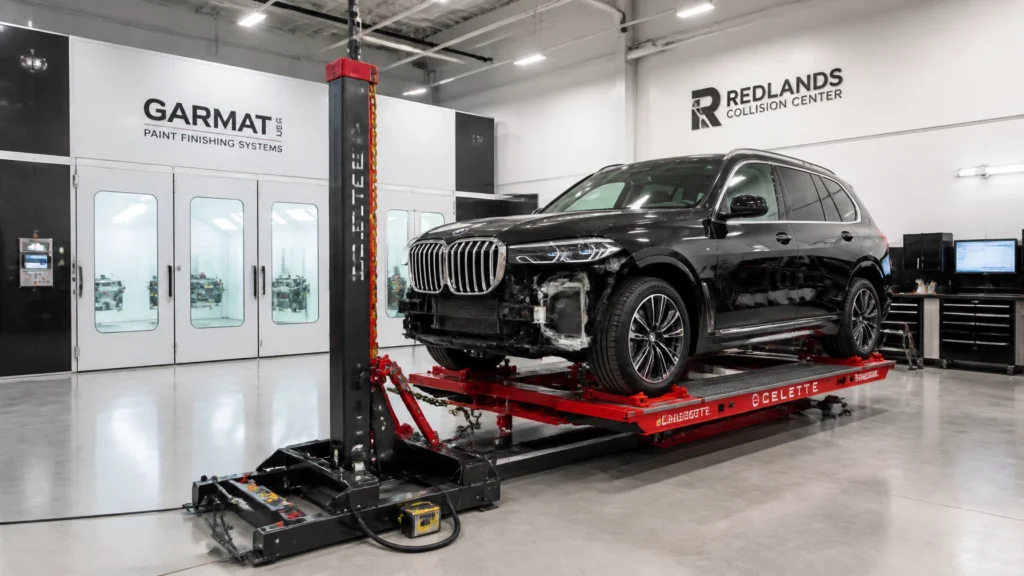
The paint on your car is more than just a color; it is a protective layer and a key component of your vehicle's resale value. Modern waterborne finishes require precise temperature and humidity control. A certified shop should use a pressurized, downdraft spray booth: such as those manufactured by Garmat. These booths pull air from the ceiling down to the floor, removing overspray and dust. More importantly, they feature a "bake" cycle that cures the paint at factory temperatures, ensuring the finish is as durable as the original.
3. Computerized Frame and Measuring Systems
Modern vehicles are built with tight tolerances: often down to a single millimeter. After a collision, the only way to ensure the safety sensors (ADAS) and suspension components will work correctly is to restore the frame or unibody to its exact factory dimensions. A certified shop will use a computerized measuring system (like Car-O-Liner) that provides a digital "before and after" printout of your vehicle's structural alignment.
Evaluating the Estimate: Red Flags and Missing Details
An estimate is more than just a price tag; it is a blueprint for the repair. A low-ball estimate is often the result of "guess-timating" rather than "blueprinting." When reviewing your estimate from an auto body shop in Redlands, look for these critical components.
The Missing "Teardown" or "Blueprint" Provision
In 2026, you cannot accurately estimate a modern vehicle's damage by looking at the exterior. A certified shop will include a line item for "Teardown" or "Blueprint for Repair." This involves removing the bumper covers and trim panels to inspect the energy-absorbing structures underneath. If a shop gives you a final-looking estimate in 15 minutes without taking anything apart, they are likely missing 30-50% of the actual damage.
Line-Item Gaps in ADAS Calibration
Almost every vehicle built in the last five years has cameras, radar, or ultrasonic sensors. If your estimate includes the replacement of a bumper, windshield, or side mirror, it must also include a line item for ADAS calibration.

Without this calibration, your automatic emergency braking, lane-keep assist, or blind-spot monitoring may fail when you need it most. Tesla certified collision repair is particularly strict about these calibrations; if they are not listed on the estimate, the shop is not following the required safety protocols.
Parts Sourcing: OEM vs. Aftermarket
Insurance companies often push for "Like Kind and Quality" (LKQ) or aftermarket parts to save money. However, for structural components and safety systems, aftermarket parts often lack the precise metallurgy and fit of original parts. A certified shop will prioritize OEM parts to ensure the "crush zones" of your vehicle perform exactly as the manufacturer intended during a secondary accident.
When discussing parts with your estimator, ask specifically about their policy on OEM parts vs aftermarket solutions. A reputable shop will fight for OEM parts, especially when it concerns the structural integrity or the high-voltage systems of an EV.
Brand-Specific Requirements: Tesla, Rivian, and Beyond
Each manufacturer has unique "deal-breakers" that determine whether a repair is safe. Understanding these helps you spot a shop that is simply "winging it."
- Tesla & Rivian: These vehicles require high-voltage (HV) safety protocols. A certified shop must have insulated tools, HV-rated gloves, and a designated "EV-safe" zone. If the shop doesn't ask about your battery state of charge or mention "Powering Down" the vehicle, they are not following the OEM service manual.
- Ford (especially F-150): As a pioneer in aluminum-intensive vehicles, Ford's certification requires specific squeeze-type resistance spot welders (STRSW). These welders replicate the factory welds exactly. Ask if they use an STRSW welder for your Ford.
- Subaru: Subaru's "Ring-Shaped Reinforcement Frame" is designed to protect the cabin by diverting energy. This structure uses ultra-high-strength steel that cannot be straightened if bent; it must be replaced according to strict Subaru guidelines.
How to Interpret a Written Lifetime Warranty
A "Lifetime Warranty" is common in the industry, but its value is entirely dependent on the shop's longevity and certification status.
- Workmanship vs. Parts: Most warranties cover workmanship (the labor and paint application) for as long as you own the vehicle. Parts warranties are typically dictated by the manufacturer (OEM) or the aftermarket supplier.
- The Insurance Caveat: If you use a "preferred" shop recommended by your insurance, the insurance company often backs the warranty. However, this often comes at the cost of the shop being forced to use cheaper parts.
- The Independent Shop Advantage: A family-owned, certified shop that offers a written lifetime warranty is often more motivated to get the repair right the first time because their reputation in the Redlands community: and their certification status: depends on it.
Questions to Ask Before You Authorize
Before signing the paperwork at any auto body shop in Redlands, ask these four direct questions:
- "Can you show me the OEM repair procedures you pulled for my specific VIN?" (They should be able to produce a printout from the manufacturer's portal).
- "Will you be performing a pre-repair and post-repair diagnostic scan?" (This is mandatory for modern vehicles to identify "hidden" electronic faults).
- "Is the lead technician on my car certified by the manufacturer (e.g., Tesla or Ford) or just I-CAR?"
- "Do you perform ADAS calibrations in-house or sublet them to a dealer?" (In-house often means faster turnaround and better quality control).
The complexity of today’s automotive landscape means that the "best" shop is no longer just the one with the most experience, but the one with the most up-to-date documentation and specialized equipment. Your vehicle is one of your most significant investments, and its structural integrity is the only thing protecting you in a subsequent collision.
By looking for dedicated aluminum rooms, verifying OEM-specific training, and demanding a thorough teardown/blueprint process, you ensure that your vehicle is returned to you in factory-spec condition…
We are ready to guide you through the complexities of certified restoration and help you navigate the nuances of your specific vehicle's needs. Our team specializes in the high-stakes world of certified collision repair, ensuring every weld, sensor, and paint stroke meets the rigorous standards of the world’s leading manufacturers.
Restore your vehicle’s safety and value today by scheduling your professional estimate.
Need a repair estimate?
Skip the wait — send us a few photos and our team will get back to you fast.
Start a Photo Estimate →