Tesla Cybertruck Collision Repair: Stainless Steel Exoskeleton Restoration and Specialized Bay Requirements
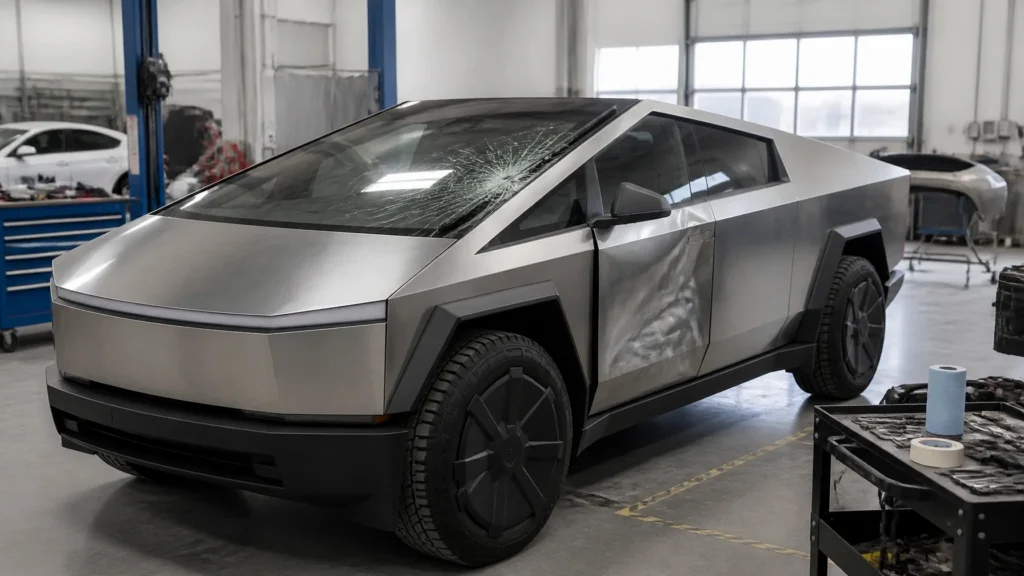
RVCCR is a Tesla-certified collision center serving Redlands and the Inland Empire, with certified technicians, OEM repair procedures, and collision, paint, and mechanical capabilities under one roof. Cybertruck collision repair requires a different approach from conventional steel bodywork because Tesla combines a 30X cold-rolled stainless-steel exoskeleton with structural body components, fixed glass, powered cargo-bed hardware, high-voltage systems, and steer-by-wire technology. A repair that looks acceptable from the outside may still be incomplete if the panel, glass, tonneau mechanism, or electronic systems have not been evaluated against Tesla’s procedures.
The repair path depends on the location and severity of the damage, the specific part involved, whether a safety component is nearby, and what Tesla’s current collision documentation allows. Some exterior damage may qualify for controlled cosmetic repair. Other damage requires panel or component replacement. The difference cannot be decided safely by appearance alone…
Why Cybertruck Collision Repair Is Different
Tesla designed the Cybertruck around a stainless-steel exterior commonly described by Tesla as a 30X cold-rolled stainless-steel exoskeleton. Tesla’s product information presents the exoskeleton as part of the vehicle’s distinctive construction, while the company’s collision documentation provides the actual repair limits, procedures, approved materials, fasteners, adhesives, and joining methods technicians must follow.
That distinction matters. Marketing descriptions explain the vehicle’s design intent. The official Tesla Cybertruck Collision Repair Procedures determine what a repair facility may do to a specific damaged component.
A conventional painted steel fender may tolerate repair methods that are not appropriate for Cybertruck stainless steel. A traditional shop may be accustomed to pulling a dent, applying filler, sanding the surface, and refinishing the entire panel. On an exposed stainless-steel Cybertruck panel, that approach can create problems involving:
- Surface appearance and directional grain
- Visible color or texture inconsistency
- Unapproved material removal
- Contamination from carbon-steel dust
- Damage to panel edges or attached components
- Improper treatment of structural areas
- Loss of the original exposed-metal finish
The Cybertruck’s exterior also cannot be evaluated in isolation. An impact may affect fixed glass, cameras, wiring, steering components, suspension, the powered tonneau cover, or high-voltage areas behind the visible panel. A qualified inspection therefore begins with documentation, scanning where appropriate, controlled disassembly, and procedure-based repair planning.
Stainless Steel Is Not Just Painted Body Metal
The Cybertruck’s exposed stainless finish changes the way damage is seen and repaired. On a painted vehicle, primer, basecoat, and clearcoat can conceal small variations in the repaired substrate. On exposed stainless steel, the panel itself remains the visible finish. Scratches, sanding marks, changes in surface direction, and inconsistent texture can remain noticeable after the repair.
Tesla’s collision information includes a dedicated Exterior Stainless Steel Panel Refinishing procedure. That procedure is important because it separates permitted cosmetic operations from methods that could permanently change the panel or create an inconsistent appearance.
A Cybertruck owner should be cautious when a repair estimate uses general language such as “body filler and paint” without explaining the actual stainless-steel process. The proper questions are more specific:
- Is the damage cosmetic or structural?
- Does Tesla permit repair of this particular panel and damage pattern?
- Is the panel allowed to be refinished, and if so, which plane or surface?
- Can the repair be completed without drilling unauthorized access holes?
- Does the panel contain or sit near a crash sensor, restraint component, or intrusion beam?
- Will the original exposed-metal appearance be restored consistently across the affected area?
- Does the procedure require replacement rather than repair?
These questions help distinguish a Cybertruck-specific repair plan from a conventional bodywork estimate.
Why Traditional Dent Pulling and Body Filler Are Not the Default Answer
The answer is not that every Cybertruck dent automatically requires a new panel. Tesla’s published repair information recognizes permitted cosmetic repairs in specified circumstances. The answer is that traditional dent pulling and body filler cannot be treated as universal solutions.
Pulling can change the panel
Tesla’s structural repair guidance states that pulling or pushing structural components with frame-straightening equipment is not supported. The concern is not limited to visible distortion. Pulling can affect the integrity of a component or the joint connecting it to other structural parts, including adhesive joints and mechanical fasteners.
That rule is especially important when an exterior panel is part of, attached to, or positioned over a structural assembly. A technician cannot assume that a hydraulic pull will simply return the metal to its original state. The shop must first identify the part, determine whether the damage is within Tesla’s permitted repair criteria, and confirm that the proposed operation will not compromise an adjoining joint or safety component.
Filler does not restore exposed stainless steel
Body filler is designed to level a prepared surface before refinishing. It does not restore the original metallurgy, surface character, or structural function of a stainless-steel panel. On an exposed-metal Cybertruck surface, a filler-based repair can also leave an area that looks different from the surrounding stainless steel because the repair depends on a coating or resurfacing step rather than restoration of the original panel surface.
For that reason, filler should not be presented as a substitute for a Tesla-approved stainless-steel repair procedure. If Tesla’s procedure does not permit the required operation, the correct answer is not to use more filler. It is to replace the panel or component.
Drilling for access may not be permitted
Tesla’s collision guidance for cosmetic repairs includes restrictions on drilling exterior panels for tooling access. That matters because some conventional dent-repair techniques depend on drilling small holes, inserting pulling devices, and filling the access points afterward. If the applicable Cybertruck procedure does not allow that operation, a repairer must not improvise it.
A permitted cosmetic repair may involve carefully controlled surface work or paintless dent repair in an allowed area, but the exact method depends on the current Tesla procedure and the damaged part. “Paintless” does not mean “anything goes.” The technician still has to protect the panel, avoid unauthorized holes, maintain the finish, and confirm that the damage is cosmetic rather than structural.
The Repair Decision: Cosmetic Repair, Structural Repair, or Replacement?
There is no single published millimeter threshold that determines whether every Cybertruck stainless panel must be repaired or replaced. Tesla’s decision criteria are procedure-specific. They depend on the part, its location, the damage type, nearby safety systems, and whether the affected surface can be restored without changing the component’s intended function or appearance.
A useful way to understand the decision is to divide the assessment into three categories.
1. Cosmetic surface damage
Light scratching or limited surface damage may qualify for the stainless-steel refinishing process if the panel and damage meet Tesla’s criteria. The procedure may distinguish between light and deep scratches and may specify the tools, abrasives, surface preparation, and refinishing boundaries.
The finish must be evaluated across the panel’s visible plane. A repair that creates a small polished or sanded patch can look inconsistent when viewed beside the untouched stainless surface. Tesla’s procedures address how the affected plane is treated so the result remains visually consistent.
2. Dent or deformation in an approved repair area
A dent may be repairable if the damage remains within Tesla’s approved cosmetic repair boundaries and the technician can restore the surface without drilling, pulling a structural section, overheating the metal, or affecting an adjoining component.
The inspection must also confirm that the dent has not altered panel mounting points, seams, reinforcements, crash-sensor locations, intrusion protection, or other safety-related areas. A dent that appears shallow may still require replacement if it sits near a prohibited repair zone.
3. Damage requiring replacement
Replacement becomes the appropriate path when the part is structurally compromised, located near a safety component, attached to a crash sensor, outside Tesla’s allowed repair area, or too severely damaged to restore through the published process.
Tesla’s material guidance is direct about several related principles:
- Parts with attached crash sensors cannot be repaired.
- Damaged components near airbags, seat belts, impact sensors, or intrusion beams may require replacement.
- Structural components cannot be pulled or pushed with frame-straightening equipment.
- Repairs involving welding are not permitted on stainless-steel components.
- Structural adhesives, fasteners, and welds may only be used as directed by the specific procedure.
The final decision should be documented in the estimate and repair file. A Tesla-certified collision center should be able to explain why a panel is repairable, why it must be replaced, or why additional teardown is needed before the decision can be made.
Why a Separate Stainless-Steel Repair Area Matters
Tesla’s published Cybertruck materials do not establish a universal rule using the exact phrase “every repair must occur in a dedicated stainless-steel bay.” However, a shop handling exposed stainless steel should use a controlled, separated work area and dedicated tools as a contamination-control practice.
The reason is straightforward: carbon-steel grinding, sanding, cutting, and welding can release ferrous particles, abrasive dust, and sparks. If those contaminants land on an exposed stainless-steel panel or enter the repair process, they can affect the surface appearance and create problems that may not be visible at delivery.
A responsible stainless-steel work area should address:
- Separation from carbon-steel grinding and welding
- Dedicated or thoroughly controlled hand tools
- Dust extraction and housekeeping
- Clean storage for stainless panels
- Protection from sparks and airborne debris
- Clean work surfaces for abrasives and finishing materials
- Controlled handling of panels before installation
- Inspection under appropriate lighting before reassembly

This is not about making the shop look impressive. It is about protecting the visible surface and maintaining process control. Stainless-steel repair is unforgiving because the finish is the metal. A contaminant that would disappear beneath primer and paint on a conventional vehicle can remain obvious on a Cybertruck.
Owners comparing a Tesla body shop in the Inland Empire should ask whether stainless-steel work is isolated from ordinary steel operations. A shop does not need to use a particular marketing label for the area, but it should be able to explain how it prevents cross-contamination.
Structural Exterior Skin Requires Procedure-Based Replacement
The word “exoskeleton” can lead owners to assume that every exterior panel is equally structural. That is too broad. The Cybertruck includes exterior stainless-steel panels and separate structural body components, and Tesla’s repair documentation identifies what operations are allowed for each material and part.
When structural damage is present, a repair may involve:
- Confirming the vehicle identity and applicable procedure
- Scanning and documenting the vehicle condition
- Measuring the affected area against approved reference data
- Removing exterior panels and trim as required
- Inspecting inner structures and attached components
- Determining whether the damaged component is repairable or replacement-only
- Mounting the vehicle correctly on approved equipment when the procedure requires it
- Removing the damaged component using the specified method
- Preparing mating surfaces
- Applying approved structural adhesive where directed
- Installing approved rivets, bolts, or welds where specified
- Torquing fasteners to the procedure
- Performing post-repair diagnostics and inspections
Tesla’s Cybertruck body-side procedures illustrate this controlled approach. Depending on the component, replacement can involve removing factory fasteners, preparing the new part, applying structural adhesive, installing approved rivets and bolts, and performing resistance spot welding in permitted locations. Tesla also warns that only technicians who have completed the required welding training should weld structural components, and the vehicle’s electrical systems must be properly isolated before welding.
That is very different from pulling a damaged rail into position and filling visible gaps. The goal is not merely to recover panel alignment. The goal is to restore the approved load paths, joints, fasteners, adhesives, and measurements that the vehicle was designed around.
Fixed Glass and “Armor Glass” Replacement
Tesla markets the Cybertruck’s glazing as Armor Glass, but collision technicians work from Tesla’s technical categories and procedures, including fixed glass, windshield, roof glass, and body-glass instructions. The marketing name does not mean the glass is unbreakable, and it does not replace the manufacturer’s replacement criteria.
After a collision, glass must be evaluated for more than visible cracks. The inspection should consider:
- Which glass component is damaged
- Whether the inner layer is affected
- Whether the damage is in a restricted viewing or sensor area
- Whether the glass is fixed or movable
- Whether the surrounding body opening is distorted
- Whether cameras, wiring, trim, or seals are affected
- Whether the glass can be repaired under Tesla’s current procedure
- Whether replacement adhesives and primers are approved
Tesla’s collision documentation includes a dedicated fixed-glass installation preparation procedure. Proper replacement requires the correct removal method, substrate preparation, approved adhesive and primer materials, bead application, positioning, curing, and water-leak inspection.
For windshield damage, Tesla’s procedure includes area-specific repair rules. In general terms, the most critical area may not be repairable, inner-layer damage can require replacement, and the procedure limits the total number of permitted repairs. Roof glass is treated more restrictively; Tesla’s published guidance indicates that roof-glass repairs are not allowed and damaged roof glass must be replaced.
The exact decision must be made against the current Cybertruck procedure, not against a generic windshield-repair chart from another vehicle. The same applies to glass that supports cameras or other systems. If the glass opening, bracket, or sensor alignment has changed, a glass replacement alone may not complete the repair.
Tonneau Cover and Motorized Rail Realignment
The Cybertruck’s powered tonneau cover adds another repair system that a conventional pickup estimate may overlook. Tesla’s Owner’s Manual describes the tonneau cover as motorized and provides warnings about operation, obstruction, locking, water intrusion, and calibration.
After a rear or side impact, technicians should inspect the complete tonneau system rather than only the visible cover surface. Collision damage can affect:
- Tonneau cover slats or panels
- Motorized rails and guides
- Bed-side mounting points
- Tailgate alignment
- End stops and closures
- Wiring and switches
- Obstruction detection
- Rear camera visibility
- Seals and water-management areas

Rail realignment is not a matter of forcing the cover into position until the gaps look even. The technician must determine whether the rail, mounting structure, motor, or cover has been bent or displaced and then follow Tesla’s applicable service information. If the system has been disturbed, calibration may be required after the mechanical work.
Tesla’s Owner’s Manual also explains that the cover can be operated through vehicle controls and that calibration is part of troubleshooting when it does not open or close as expected. After collision repair, the shop should verify:
- Full opening and closing
- Smooth travel through the rails
- Correct stopping points
- Obstacle response
- Switch and touchscreen operation
- Tailgate and cover interaction
- Camera operation with the cover closed
- Water-management performance
- Absence of binding, noise, or uneven movement
A Cybertruck should not be delivered with a tonneau cover that works only when manually assisted or stopped before the damaged area. Powered closure systems must operate consistently and safely.
High-Voltage Safety Before Collision Work
Cybertruck collision repair can involve work near high-voltage components, wiring, battery-adjacent structures, and electrical systems. The technician’s first responsibility is to establish whether the vehicle is safe to inspect and how it must be isolated before repair begins.
Tesla’s collision procedures direct technicians to review general collision safety documentation, wear the appropriate personal protective equipment, and follow the vehicle-specific electrical isolation procedure. Tesla specifically warns that welding on a vehicle with energized high- or low-voltage systems can damage vehicle components.
A high-voltage safety workflow may include:
- Identifying the vehicle and collision condition
- Checking for warning messages and visible electrical damage
- Evaluating whether the battery enclosure may have been impacted
- Following the Cybertruck Vehicle HV Disablement Procedure
- Establishing a controlled work area
- Using appropriate insulated equipment and PPE
- Confirming isolation before applicable repairs
- Monitoring the vehicle throughout the repair
- Restoring and validating the system after work is complete
This is not a do-it-yourself procedure. Owners should not attempt to disconnect orange cables, access battery components, or test a damaged Cybertruck outside the manufacturer’s safety instructions. After a collision, the safest next step is controlled transport to a qualified Tesla repair facility.
Steer-by-Wire Requires More Than a Road Test
The Cybertruck uses steer-by-wire technology. Tesla’s Owner’s Manual describes a system in which electronic sensors and actuators communicate between the steering controls and the road wheels rather than relying on a conventional mechanical steering shaft connection.
Tesla also describes redundant sensors and actuators and explains how the vehicle responds if it detects a steering-system issue. That architecture makes post-collision inspection especially important. A vehicle may appear to steer normally while still requiring system-specific diagnosis, calibration, or component replacement.
The collision repair process should evaluate:
- Steering gear and steering-related components
- Suspension attachment points
- Wheel and tire impact damage
- Alignment readings
- Steering operation and effort
- Electrical connectors and harnesses
- Stored faults and warnings
- Steering-angle and related calibration data
- Required post-repair tests
Tesla’s collision guidance includes a steering-gear replacement guideline. It identifies replacement conditions such as visible damage, changed steering operation, inability to align within specifications, or damage to related steering and suspension components. Where replacement is required, Tesla specifies genuine parts and a subsequent four-wheel alignment.
That is why “the steering wheel feels fine” is not a complete inspection. The vehicle must be checked against the applicable Tesla service and collision procedures, followed by alignment and electronic validation where required.

The Final Repair Is a System, Not a Panel
Cybertruck collision repair is complete only when the connected systems agree that the vehicle is ready to return to service. That final verification may include:
- Structural measurements
- Panel and closure fit
- Glass installation and leak inspection
- Tonneau operation and calibration
- Wheel alignment
- Steering-system checks
- Restraint-system inspection
- High-voltage system validation
- Diagnostic scans
- Camera or driver-assistance calibration when required
- Road testing under appropriate conditions
- Final quality-control inspection
This is why Tesla certification matters. It connects training, repair information, parts access, equipment, and process accountability. A general shop may be able to replace a bumper or refinish a conventional panel, but Cybertruck repair requires a facility prepared to manage stainless steel, fixed glass, powered closures, high voltage, steer-by-wire, and Tesla-specific documentation together.
RVCCR combines collision, paint, and mechanical repair in one facility. Our team coordinates with major insurance carriers, uses OEM parts where required, provides free estimates, and backs completed work with a written lifetime warranty. For additional information about the broader process, review our article on Tesla-certified collision repair and EV structural safety.
Questions to Ask Before Choosing a Cybertruck Repair Shop
Before authorizing repairs, ask the facility:
- Are you currently a Tesla-certified collision center?
- Do you have access to the current Cybertruck Collision Repair Procedures?
- How do you separate stainless-steel work from carbon-steel grinding and welding?
- Which Cybertruck panels can you repair, and which require replacement?
- How do you protect the exposed stainless finish from contamination?
- Do you follow Tesla’s fixed-glass installation procedures?
- How will you inspect the powered tonneau cover and rails after impact?
- What high-voltage isolation process applies to this repair?
- How will you verify steer-by-wire, alignment, and related electronic systems?
- Will you document supplements and procedure-based replacement decisions for the insurer?
A trustworthy shop should answer clearly. If the response is simply “we fix all makes and models,” ask for more detail. Cybertruck work is too specialized for assumptions.
If you are searching for an EV repair shop near me, proximity is useful, but capability matters more. The right facility should be able to explain the repair before asking you to authorize it.
Returning Your Cybertruck to the Road
A Cybertruck collision can interrupt work, family plans, commuting, and the trips you bought the vehicle to enjoy. The repair should do more than remove visible damage. It should restore the stainless-steel exterior, structural components, glass, tonneau system, high-voltage safety, steering function, and electronic systems according to Tesla’s current requirements.
At RVCCR, our certified team evaluates the complete repair rather than treating the damage as an isolated dent. We document the condition, coordinate with insurance, use OEM parts and approved procedures, and keep the process organized from estimate through final inspection.
If your Cybertruck has been involved in a collision, contact RVCCR for a free estimate in Redlands. We will inspect the damage, explain the repair path in straightforward terms, and help you move from a stressful accident back to the road: and back to the adventure your vehicle was built to support.
Official Tesla references
- Tesla Cybertruck Collision Repair Procedures
- Tesla Cybertruck Structural Repair Guidelines
- Tesla Cybertruck Service Manual
- Tesla Cybertruck Owner’s Manual
- Tesla Cybertruck product information
Need a repair estimate?
Start a Photo Estimate or contact RVCCR to discuss your Cybertruck collision repair.
Need a repair estimate?
Skip the wait — send us a few photos and our team will get back to you fast.
Start a Photo Estimate →