The Pre-Repair Diagnostic Scan: Why Your Tesla or EV Needs a Full Scan Before Body Work Starts
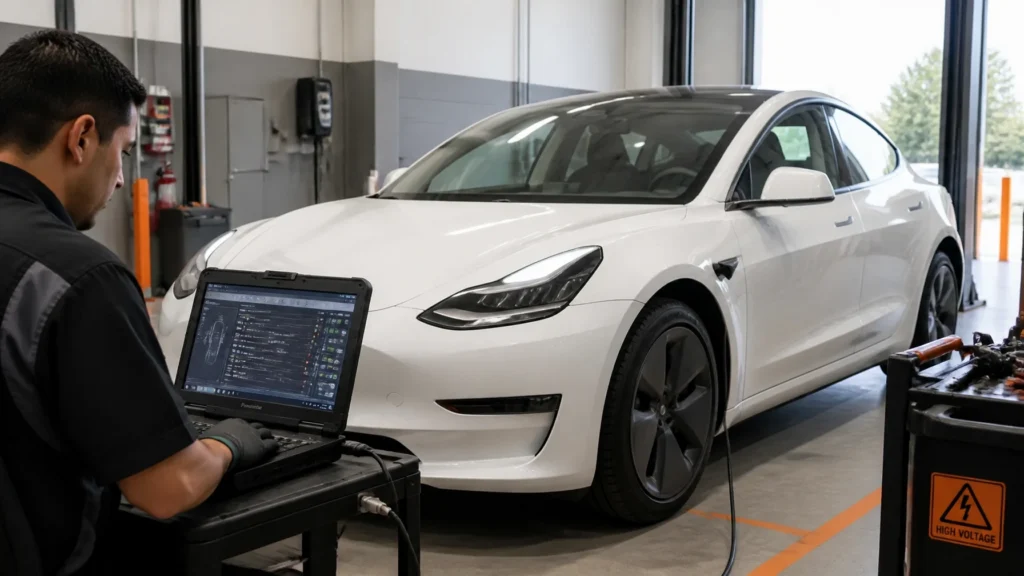
Updated August 11, 2026 | Tesla and EV collision repair | Tesla-certified | Fix Auto Network | Family-owned in Redlands for 21 years
RVCCR is a certified collision, paint, and mechanical repair facility serving Redlands and the Inland Empire. Our team works on Tesla and EV collision repairs alongside conventional auto and RV repair, using manufacturer procedures, trained technicians, OEM parts where required, and documented quality-control steps.
When a Tesla or other EV arrives after a collision, the visible damage may be only one part of the repair story. A bumper, fender, door, windshield, wheel, or quarter panel can be connected to cameras, restraint systems, body controllers, high-voltage components, and communication networks that are not visible from the outside. Before body work changes the vehicle’s condition, a full pre-repair diagnostic scan can establish what the vehicle is reporting on arrival…
That initial record can reveal faults that are not obvious during a visual inspection, guide the repair plan, help identify additional damage, and reduce disagreements later about whether a fault existed before the collision or appeared during the repair. For Tesla owners searching for a Tesla certified collision center, an EV repair shop near me, or a Tesla body shop Inland Empire drivers can trust, the scan should be part of the conversation from the beginning.
What a pre-repair diagnostic scan actually is
A pre-repair diagnostic scan is a documented electronic health check performed before collision repairs begin. The technician connects to the vehicle using the appropriate diagnostic process and records the alerts, fault codes, module communication status, and other relevant information available for that make, model, and repair condition.
The scan is not a substitute for a physical inspection. It does not replace measuring the body, inspecting the battery enclosure, checking suspension components, examining wiring, or reviewing the manufacturer’s collision repair procedures. Instead, it adds an electronic layer to the blueprinting process.
A proper collision intake may include:
- Identifying the exact vehicle, model year, configuration, and VIN.
- Recording visible damage and customer concerns.
- Checking dashboard warnings and vehicle messages.
- Following the OEM’s safety and power-down instructions.
- Accessing the vehicle’s diagnostic systems.
- Saving the scan results to the repair order.
- Comparing diagnostic information with the impact location and physical evidence.
- Using the results to plan disassembly, parts replacement, calibration, and post-repair verification.
Tesla provides a Service Mode interface through the vehicle touchscreen for diagnostics and repair support. Tesla’s public documentation explains that Service Mode is intended to help internal and third-party technicians service Tesla vehicles and includes functions such as service alerts, vehicle subsystem information, safety and restraint information, and camera-related functions. Owners can review the official documentation through Tesla’s Service Mode diagnostic information.
For deeper manufacturer-level work, a qualified technician may need Tesla’s diagnostic software platform, commonly called Tesla Toolbox, when the vehicle-specific repair procedure directs its use. The exact steps vary by model, year, system, and repair operation. That is why the technician should use current Tesla service and collision repair information rather than rely on a generic scan routine…
What the scan can reveal after a collision
Modern EVs contain multiple electronic control modules that communicate continuously. A collision, battery disconnect, low-voltage interruption, damaged harness, shifted sensor, or removed body component can create a fault that is not visible on the exterior.
The pre-repair scan may identify several categories of information.
Airbag and restraint system faults
Supplemental restraint systems include airbags, seat-belt pretensioners, occupant sensing components, restraint controllers, and crash sensors. A collision can affect these systems even when an airbag did not deploy.
The scan may show:
- Active airbag or supplemental restraint alerts
- Stored crash-related fault codes
- Communication problems involving the restraint controller
- Seat-belt pretensioner or buckle faults
- Occupant-sensing system concerns
- Crash-sensor communication issues
- Wiring or connector faults
- A restraint module that requires a specific reset, inspection, or replacement procedure
A dashboard warning is important, but the absence of a warning does not prove that every restraint-related component is unaffected. The scan gives the technician a starting record and indicates where the manufacturer’s procedures require additional testing or inspection.
The National Highway Traffic Safety Administration hosts an FCA collision bulletin that provides a useful manufacturer example of why scanning matters. That bulletin states that safety systems, including airbags, occupant restraint controllers, seat belts, forward-facing cameras, radar, blind-spot monitoring, and other driver-assistance systems must be checked for active or stored diagnostic trouble codes after a collision. It also calls for the manufacturer’s scan tool before and after collision repair. The bulletin is specific to FCA vehicles, not Tesla, but it demonstrates the broader OEM principle that visible damage alone cannot establish electronic safety-system condition. See the NHTSA-hosted collision scan bulletin.
Sensor and wiring faults
A sensor can be damaged, disconnected, contaminated, or moved without showing obvious exterior damage. A harness can be pinched during an impact or damaged during disassembly. A connector may appear attached but have a bent terminal, poor pin fit, or internal damage.
A pre-repair scan can help identify:
- A sensor that has stopped communicating
- A module that is offline
- A short or open circuit
- A voltage-related fault
- A calibration-related alert
- A network communication interruption
- A system that is reporting an internal fault
This information matters when damage occurs near bumpers, mirrors, doors, windshields, fenders, wheel wells, cameras, radar equipment, parking sensors, or other areas containing electronic components.
ADAS module errors
Advanced driver-assistance systems, or ADAS, depend on cameras, radar where equipped, control modules, mounting points, software, and vehicle geometry. A collision repair can affect one or more of these elements.
The scan may reveal:
- Forward-camera alerts
- Driver-assistance module communication faults
- Lane-keeping or forward-collision system errors
- Parking-assist faults
- Blind-spot monitoring alerts
- Steering-angle or wheel-speed data concerns
- Calibration status problems
- A sensor that cannot complete its required self-test
Scanning and calibration are related but different. A scan looks for electronic faults and communication problems. Calibration aims or configures a sensor or camera according to the manufacturer’s instructions. Completing one does not automatically complete the other.
For example, a camera may communicate with the vehicle but still require calibration after a windshield replacement or structural repair. Conversely, a calibration attempt may fail because the camera, wiring, module, mounting point, or network has a fault. The repair process has to address both the physical and electronic conditions.
Our article on Tesla-certified collision repair and EV structural safety explains why structural measurements, sensor alignment, manufacturer procedures, and final validation belong in the same repair plan.
Battery-management and high-voltage alerts
An EV’s high-voltage system requires special caution after a collision. The pre-repair scan may identify battery-management system alerts, isolation faults, charging-system concerns, thermal-management warnings, or other high-voltage-related information.
However, a scan cannot by itself certify that a damaged battery is safe. A battery-related alert may require physical inspection, isolation procedures, thermal monitoring, manufacturer instructions, or evaluation by a qualified high-voltage technician. A vehicle can also have physical damage that is not immediately represented by a diagnostic code.
The scan is one part of a larger EV safety process. It helps the repair team determine whether the vehicle needs further examination before body work begins and whether high-voltage components may influence how the vehicle is moved, stored, disassembled, or repaired.
Hidden electronic damage
The most valuable information from a pre-repair scan is often the information that changes the repair plan. A vehicle can have no obvious warning on the instrument panel while storing faults in systems that are not displayed during ordinary driving.
Hidden electronic damage may involve:
- A damaged wiring harness
- A displaced camera or sensor bracket
- A control module affected by impact or voltage loss
- A low-voltage battery event
- A communication-network interruption
- A restraint-system fault
- A battery-management alert
- A component that will not complete programming or calibration
The scan does not tell the entire story, but it can tell the technician where to look next.

Why a scan should happen before body work starts
Timing matters. A scan performed after parts have been removed, wiring has been disconnected, the battery has been powered down, or damaged components have been replaced may not show the vehicle’s original arrival condition.
That does not make a later scan useless. It means the later scan answers a different question.
A pre-repair scan documents the vehicle as received. A post-repair scan documents the vehicle after the repair. Both records are valuable, but they should not be treated as interchangeable.
It establishes a baseline
A collision vehicle may arrive with faults caused by the impact, faults that existed before the impact, or faults triggered by towing, low voltage, water exposure, battery disconnection, or other events. Without an initial record, it can be difficult to determine what the vehicle was reporting before work began.
The baseline helps the repair team:
- Separate known arrival conditions from new findings
- Identify collision-related systems early
- Plan additional inspection
- Explain supplements to the insurer
- Avoid unnecessary parts replacement
- Document why a calibration or programming step is needed
It prevents repair surprises from appearing late
If the shop waits until reassembly to discover that a camera will not communicate or a restraint module has an active fault, the repair may stop while the team investigates. That can cause parts delays, additional approvals, programming appointments, or calibration scheduling problems.
Finding the issue during intake does not always make the repair shorter. It does make the repair plan more honest.
It protects the vehicle during disassembly
Some repairs require disconnecting low-voltage power, isolating high-voltage systems, removing trim, disconnecting sensors, replacing glass, or removing body components. Each operation can affect electronic status. Documenting the vehicle first provides a reference point before those operations begin.
It supports OEM procedure compliance
Tesla’s service and collision repair information is model-specific. The current Tesla Model 3 Collision Repair Procedures provide an example of the manufacturer’s organized repair-information system. A technician should identify the correct vehicle and follow the applicable procedure rather than assume that one Tesla model can be repaired exactly like another.
When a procedure calls for a diagnostic tool, functional test, controller operation, calibration, or verification step, that step is part of the repair: not an optional add-on.
Generic OBD scanning versus manufacturer-level diagnostics
A basic OBD scan and a manufacturer-level diagnostic scan are not the same service.
A generic OBD reader may retrieve a limited selection of standardized codes, usually related to systems covered by the tool and vehicle protocol. It may be helpful for basic troubleshooting, but a clean result does not prove that all body, restraint, ADAS, battery, and communication modules are healthy.
A manufacturer-level scan is designed around the vehicle’s architecture. It may provide access to:
- More control modules
- Manufacturer-specific alerts
- Detailed fault descriptions
- Live data
- System self-tests
- Configuration procedures
- Programming or reset routines
- Calibration functions
- High-voltage diagnostic information
- Model-specific repair workflows
For Tesla vehicles, Service Mode provides an important diagnostic interface through the center display. Tesla Toolbox can provide deeper manufacturer-level functions when required by the applicable procedure and when accessed by a qualified repair facility.
The distinction is not about whether one tool is “good” and another is “bad.” It is about using the right level of information for the question being asked. A generic scan may answer, “Is this limited set of standardized data available?” A manufacturer-level workflow may answer, “Which Tesla modules are reporting alerts, what do those alerts mean, and which repair or test procedure applies?”
Owners should be cautious when a shop says, “We scanned it and nothing came up,” without explaining:
- Which system was scanned
- Which tool was used
- Whether all modules were accessed
- Whether the vehicle was in the correct operating state
- Whether the scan occurred before disassembly
- Whether the shop saved the report
- Whether calibration and post-repair testing remain necessary
What Tesla owners should demand in writing
You do not need to be a diagnostic technician to request clear documentation. Ask the shop for a copy of the pre-repair scan report or a written summary of the diagnostic results.
The report should identify, as applicable:
- Vehicle identification information
- Date and mileage
- Scan timing relative to disassembly
- Diagnostic tool or manufacturer interface used
- Active fault codes
- Stored or historical fault codes
- Module communication status
- Restraint-system findings
- ADAS and sensor findings
- High-voltage or battery-management alerts
- Low-voltage or power-related alerts
- Recommended next diagnostic steps
- Whether calibration, programming, or component testing is required
The report may contain technical language that is difficult to interpret. That is normal. The shop should explain which findings are related to the collision, which require further inspection, and which may be unrelated or pre-existing.
You should also request the post-repair scan documentation before delivery. A complete repair file may include the original pre-scan, supplemental findings, repair procedures, calibration results, post-scan, final warning-status verification, and road-test notes where applicable.
A scan report is not merely paperwork. It gives you a record of what was checked and what the vehicle reported at important points in the repair.
How the scan helps with pre-existing versus collision-caused faults
One of the most practical benefits of a pre-repair scan is that it creates a timeline.
Suppose a Tesla arrives after a front-end collision with a forward-camera alert and a damaged bumper. The pre-scan records the alert before the bumper is removed. The technician then inspects the camera area, wiring, bracket, and related structure. After repair and calibration, the post-scan shows whether the original fault has been resolved.
Now consider a different situation: the pre-scan shows no restraint-system fault, but a fault appears after interior trim is removed. That does not automatically prove the shop caused the problem. The repair team still needs to investigate whether the condition resulted from a damaged connector, a pre-existing intermittent issue, a low-voltage event, or an error during reassembly. The timeline helps everyone examine the issue using evidence rather than assumption.
The scan is not a magic causation certificate. It does not independently prove why every code exists. It is a dated technical snapshot that must be evaluated alongside:
- Impact location
- Photographs
- Teardown findings
- Wiring and connector inspection
- Component condition
- Vehicle history
- Repair operations
- Power-down and reconnect procedures
- Manufacturer diagnostic guidance
That documentation protects both sides. The owner receives a clearer explanation of what happened. The repair shop can show what the vehicle reported before work began and what changed during the repair. The insurer has better information for evaluating supplements and necessary procedures.
How much does a proper pre-repair scan cost?
For budgeting purposes, a proper pre-repair diagnostic scan for a Tesla or EV may fall in the $150 to $500 range, depending on the vehicle, diagnostic access, scan depth, damage condition, required procedures, and whether additional testing is necessary.
That range is not a universal price list. A basic electronic check is different from a manufacturer-level scan that requires advanced access, detailed system testing, high-voltage safety evaluation, or a diagnostic specialist. Some shops may include the scan in a broader collision estimate, while others list it separately.
Ask for the charge and scope in writing:
- Is this a basic code check or a full-system diagnostic?
- Will Tesla Service Mode or Tesla Toolbox be used where applicable?
- Will the scan be performed before disassembly?
- Will I receive the report?
- Is a post-repair scan included?
- Are calibration and programming separate charges?
- Will additional high-voltage testing be recommended if the scan shows battery alerts?
The lowest price is not always the most useful scan. The goal is to obtain accurate information before the repair plan becomes more complicated.
What happens if a shop skips the pre-scan?
Skipping the scan can create several problems.
Delayed repairs
Faults discovered late can interrupt reassembly, require additional parts, or create new approval and scheduling steps.
Warranty and documentation concerns
A shop that cannot show what the vehicle reported before repair may have a harder time documenting the repair process. That can create confusion about whether a warning, fault, or calibration issue was present on arrival or appeared later.
Hidden safety problems
A vehicle can look repaired while a restraint, camera, sensor, or battery-related problem remains unresolved. Visual quality does not prove electronic safety-system integrity.
Insurance disputes
If a fault appears after teardown and there is no pre-scan record, the parties may disagree about whether it was collision-related, pre-existing, or repair-induced. A baseline does not eliminate every disagreement, but it gives the discussion a factual starting point.
Unnecessary parts replacement
Without diagnostic information, a technician may have to spend more time isolating the problem or replace components before identifying the actual cause.
These risks are why owners should treat scanning as part of the repair process, not as a luxury reserved for severe crashes.

Questions to ask an EV collision center before authorizing work
If you are comparing a Tesla body shop Inland Empire owners can rely on, ask these questions before signing the repair authorization:
- Do you perform a pre-repair scan before disassembly?
- Which diagnostic platform will you use for my exact Tesla model and year?
- Do you use Tesla Service Mode and Tesla Toolbox when the repair procedure requires them?
- Will I receive a copy of the pre-scan report?
- Will you complete a post-repair scan and provide that report?
- How do you document pre-existing faults?
- How do you inspect and protect high-voltage systems after a collision?
- Will the repair require ADAS calibration in addition to scanning?
- Which OEM collision repair procedures apply to my vehicle?
- Will you coordinate diagnostic findings and supplements with my insurer?
A trustworthy shop should answer clearly. If the response is only, “We plug it in and see what happens,” ask for more detail.
For additional comparison points, review our article on how to choose an EV repair shop near you. You can also read about red flags when selecting a Tesla body shop in the Inland Empire.
Why a certified collision center matters
A Tesla or EV collision repair involves more than paint and panel replacement. It may require structural inspection, high-voltage safety procedures, manufacturer-specific parts, electronic diagnostics, ADAS calibration, mechanical checks, and final quality control.
RVCCR combines collision, paint, and mechanical repair under one roof. We are family-owned and have served the Redlands area for 21 years. Our company is certified for Tesla and EV repair and also holds credentials connected with Rivian, Ford, Honda, Mazda, Subaru, and RVDA-certified RV repair. We coordinate with major insurance carriers, provide free estimates, use OEM parts where required by the repair plan, and back our work with a written lifetime warranty.
Certification does not mean every collision has the same repair path. It means the facility has a manufacturer-specific framework for identifying the correct process. The technician still has to inspect the vehicle, select the correct repair information, document the damage, and complete the required tests.
The strongest repair plan connects the electronic scan to the physical evidence. It does not treat a scan as a marketing checkbox. It uses the results to protect the vehicle, the owner, and the repair team.
Get your Tesla or EV back to the road with confidence
A collision can interrupt your work schedule, family plans, and next road trip in an instant. The right repair process restores more than a bumper or a quarter panel. It restores the systems that help your vehicle protect you, communicate with you, charge correctly, and perform as designed.
Before body work begins, ask for the scan. Ask what it found. Ask for the report. Then choose a certified repair team that can connect diagnostics, structure, paint, mechanical work, calibration, insurance coordination, and final verification into one accountable process.
RVCCR is ready to inspect your Tesla or EV, explain the repair path, and help you move forward. Request a free collision repair estimate today, and let our team document the damage, protect the repair process, and restore your vehicle for the miles and adventures ahead.
Frequently asked questions
Is a pre-repair scan required for every Tesla collision?
The exact requirement depends on the Tesla model, repair operation, and current manufacturer procedure. A responsible collision workflow should evaluate the vehicle electronically before repairs begin, especially when the collision involves safety systems, sensors, body controllers, wiring, glass, suspension, or high-voltage components. The applicable Tesla service and collision repair information should control the specific steps.
Is Tesla Service Mode the same as Tesla Toolbox?
No. Service Mode is a diagnostic and repair interface available through the Tesla touchscreen. Tesla Toolbox is the manufacturer’s deeper diagnostic and service software platform used for functions that may include detailed diagnostics, tests, programming, configuration, and other model-specific operations. The required tool depends on the vehicle and the repair procedure.
Can a generic OBD scanner replace Tesla Toolbox?
No. A generic scan may provide useful limited information, but it should not be treated as equivalent to manufacturer-level Tesla diagnostics. If the OEM procedure calls for Tesla-specific testing, calibration, programming, or verification, the shop should follow that procedure with the appropriate access.
Does a pre-scan replace ADAS calibration?
No. Scanning checks for faults and communication conditions. Calibration aims or configures sensors and cameras according to the manufacturer’s requirements. A collision repair may require both.
Can a scan prove that a fault was caused by the collision?
Not by itself. The scan provides a dated record of what the vehicle reported. Technicians must compare it with photos, impact location, teardown findings, wiring inspection, service history, and manufacturer procedures to evaluate causation.
Should I receive both pre-repair and post-repair scan reports?
Yes. Ask for both whenever they are performed. The pre-scan documents the vehicle’s condition on arrival. The post-scan documents the vehicle after repairs, programming, calibration, and reassembly.
Why might the scan show faults after a minor collision?
Even a low-speed impact can affect a sensor, connector, camera mount, bumper harness, low-voltage supply, or communication network. The visible damage may be minor while the electronic system still needs inspection or calibration.
Does a battery alert mean the EV battery is unsafe?
Not automatically. It means the vehicle has reported information that requires proper evaluation. Battery-related alerts should be handled using the manufacturer’s high-voltage safety procedures, physical inspection, and qualified diagnostic judgment.
Can insurance refuse to pay for a diagnostic scan?
Coverage decisions depend on the policy, claim facts, insurer, and repair documentation. The shop should explain why the scan is necessary, connect it to the collision and applicable repair procedures, and document the finding for the insurer.
Where can I find a Tesla-certified collision center near Redlands?
RVCCR serves Redlands and the Inland Empire with Tesla and EV collision repair, auto collision repair, paint, and mechanical services. Start with a free estimate request so the team can review the vehicle and explain the next step.
Need a repair estimate?
Skip the wait — send us a few photos and our team will get back to you fast.
Start a Photo Estimate →