Tesla Tightened Its Wheel Repair Rules in 2026 – Is Your Collision Center Following Them?
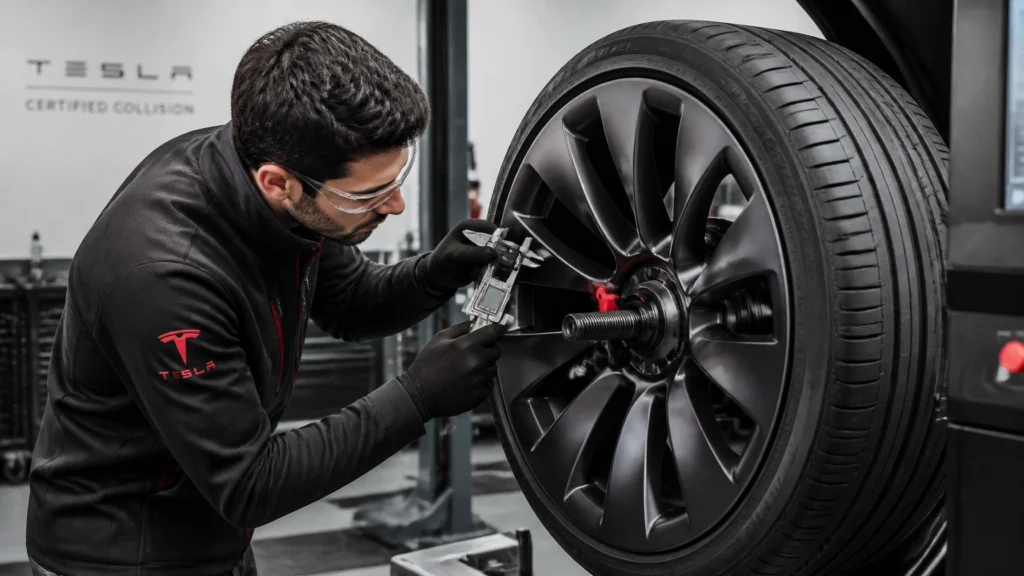
As a Tesla owner in the Inland Empire, you’ve likely grown accustomed to the high standards of technology and safety that define your vehicle. However, the collision repair landscape for electric vehicles is shifting rapidly, particularly regarding structural components like wheels. In June 2026, the industry saw a significant pivot when official reports: including extensive coverage by Autobody News on June 16, 2026: highlighted that Tesla has tightened its stance on wheel repairs for the 2025+ Model Y and other current models. These updates are not merely "suggestions" but are critical mandates found within the official Tesla Collision Repair Procedures.
Navigating the complexities of a post-collision repair requires more than just finding a shop that can "fix a dent." It requires a facility that monitors daily updates to OEM (Original Equipment Manufacturer) service manuals. At RVCCR, our status as a Tesla Certified Collision Center means we don't just guess at the specifications; we follow the exact blueprints laid out by the engineers in Austin and Fremont. The recent 2026 wheel repair mandates represent a line in the sand between shops that prioritize safety and those that prioritize cutting corners with "reconditioned" parts.
The reality of modern EV wheel construction involves specialized aluminum alloys and precise weight distributions that are essential for maintaining the range and structural integrity of your Tesla. When a wheel is compromised in an accident: whether it’s a minor curb impact or a major structural collision: the path to restoration is now narrower than ever. For Tesla owners in Redlands, San Bernardino, and Riverside, understanding these new rules is the difference between driving a safe vehicle and driving one with a ticking structural time bomb…
The 2026 Tesla Wheel Repair Update: What Has Changed?
The most critical update for 2026 focuses on the 2025+ Model Y and the broader Tesla fleet. Tesla’s official documentation on "Approved Wheel Repairs" (accessible through the Tesla Service Portal) has effectively eliminated almost every traditional "repair" method used by third-party wheel refurbishing companies.
For years, many collision centers and "mobile wheel repair" vans have offered services to straighten bent rims, weld cracks, or machine down surfaces to remove curb rash. Under the new 2026 guidelines, these practices are explicitly prohibited for Tesla-provided wheels. Tesla’s stance is clear: if the structural integrity of the wheel is compromised, the only approved solution is replacement with a new OEM wheel.
The Explicitly Prohibited List
According to Tesla’s 2025+ Model Y Collision Repair Procedures, the following processes are strictly forbidden:
- Welding and Crack Repair: Any attempt to weld a fracture or fill a crack in the aluminum alloy is prohibited.
- Straightening (Hot or Cold): Using hydraulic presses or heat to "bend" a wheel back into its original shape.
- Bending (Hot or Cold): Any manipulation of the rim's flange or barrel.
- Machining: Removing material from the wheel surface to smooth out damage or "true" the wheel.
- Chrome Plating: Aftermarket chrome plating or the use of chrome-plated OEM wheels that did not come from the factory that way.
This shift is a response to the unique stresses placed on EV wheels. Because Teslas are significantly heavier than their internal combustion engine (ICE) counterparts due to the battery pack, and because they produce instant torque, the wheels are subjected to forces that traditional "reconditioned" wheels simply cannot guarantee to withstand.

Why Modern Tesla Wheels Can’t Be "Fixed" Like Older Rims
To understand why Tesla has banned these common repairs, we have to look at the metallurgy and engineering of the wheels themselves. The wheels on a Model Y or Model 3 aren't just aesthetic choices; they are functional aerodynamic components that help the vehicle achieve its rated range while supporting 4,000 to 5,000+ pounds of weight.
The Danger of Heat Straightening
When a shop "straightens" a wheel, they often apply heat to make the metal more malleable. Even "cold straightening" involves stressing the metal. Aluminum has a specific grain structure and temper. When you bend it back, you create microscopic stress fractures. On a standard gas car, this might lead to a slow leak. On a Tesla: where the wheel must manage the immense weight and the vibration of high-torque acceleration: a weakened wheel can lead to catastrophic failure at highway speeds.
The Problem with Welding Aluminum
Welding an aluminum wheel is even more problematic. The heat required to weld aluminum effectively changes the heat treatment of the surrounding metal. Unless the entire wheel is stripped, heat-treated again in an industrial kiln, and X-rayed for internal voids, the weld represents a permanent weak point. Since Tesla does not provide a "re-heat-treating" specification for repair shops, any weld is considered an uncertified, unsafe modification.
By choosing a Tesla certified collision center, you ensure that your vehicle is evaluated by technicians who understand these metallurgical limits. We don't take risks with your safety; if a wheel is bent or cracked, we source a brand-new factory wheel to maintain the vehicle’s original safety rating.
The Tesla Service Portal Procedure Step by Step
One of the clearest dividing lines between a certified Tesla collision facility and a general body shop is access to the Tesla Service Portal. The wheel repair rules discussed in this article are not pulled from rumor, social posts, or third-party summaries. They come from Tesla’s own repair ecosystem, and access is controlled. To open the latest collision repair procedures, a shop must have active Tesla certification credentials and a current software subscription tied to that program. A non-certified shop cannot simply search the open web and obtain the same live procedural content.
Here is what the process looks like in real practice when a Tesla-certified shop evaluates wheel damage after a collision or impact:
-
Log into the Tesla Service Portal.
The estimator, blueprint technician, or repair planner signs in using the shop’s active Tesla-approved credentials. Access is role-based and tied to current certification status. -
Enter the VIN for the specific vehicle.
The vehicle identification number matters because Tesla procedures are model-specific and can vary by year, trim, architecture, and wheel package. A 2025+ Model Y procedure is not something a shop should assume is identical to an earlier build. -
Pull the correct service information for that exact model.
Inside the portal, the technician opens the collision and body repair documentation associated with that VIN. This is where a certified shop confirms whether the wheel is eligible for cosmetic refinishing only, or whether replacement is required. -
Navigate to the wheel-related procedure under the Body Systems documentation.
Tesla organizes structural and body-related procedures by system. The technician locates the wheel repair content under the body repair information, then opens the current wheel procedure for that model and configuration. -
Read the prohibition list exactly as written in the current Tesla procedure.
This is the critical step. The shop does not rely on memory or on what was allowed last year. The planner checks the latest published prohibition list covering operations such as welding, straightening, bending, machining, and other non-approved processes. If the damage falls into any prohibited category, the wheel moves out of the repair column and into the replacement column. -
Document the wheel condition with clear photos.
Tesla-certified shops are expected to document damage thoroughly. That means images of the face of the wheel, the barrel, the bead area, any cracks, gouges, curb rash, distortion, and any visible impact point on the tire or suspension area. Good photo documentation matters because it supports the estimate, supports insurer discussions, and creates a record showing why the shop followed replacement instead of informal repair. -
Assess whether the damage is cosmetic or structural.
Surface scuffing with no material removal, no deformation, and no crack may be considered for cosmetic refinishing if the current procedure allows it. Any bend, crack, weld history, or evidence of prior machining moves the wheel outside approved repair. -
Submit the repair plan for OEM replacement when required.
Once the procedure confirms replacement, the shop writes the estimate accordingly and orders the correct OEM wheel. The decision is based on Tesla documentation, not on whether a third-party vendor says the old wheel can be “saved.” -
Retain documentation for file support.
Photos, portal references, and estimate notes should stay with the repair file. That protects the customer, the shop, and the insurer from confusion later if someone questions why replacement was necessary.
This step-by-step process matters because Tesla updates procedures over time. A shop that repaired wheels on another brand ten years ago using heat and straightening may assume that same approach is acceptable on a current EV. On a certified Tesla repair, assumptions are not enough. The shop must verify the current procedure for the exact VIN, follow the published limitations, and document the file accordingly.
That is one reason a Tesla certified collision center offers a very different ownership experience after a crash. The repair plan is built from the live Tesla procedure, not from habit, guesswork, or what a subcontracted wheel vendor claims is “standard.”
The Only Approved Repair: Cosmetic Refinishing
Does this mean every scratch requires a brand-new wheel? Not necessarily. Tesla does allow for "Cosmetic Refinishing," but even this process has become more technical and restricted in 2026. Cosmetic refinishing is strictly defined as the repair of surface-level damage (like light curb rash) that does not involve the removal of structural metal or the application of heat.
However, the "how" is just as important as the "what." Tesla’s 2026 guidelines emphasize strict masking protocols during the painting and clear-coating process.
The Masking Protocol: Why It Matters
When a wheel is refinished, certain areas must remain raw metal. If a shop paints over these surfaces, it can lead to the lug nuts loosening over time or the wheel not sitting flush against the brake rotor. Tesla’s procedures require masking of:
- Mounting Surfaces: The back of the wheel that touches the hub.
- Lug Nut Contact Surfaces: The "seats" where the lug nuts apply pressure.
- The Pilot Hole: The center hole that aligns the wheel on the hub.
If your local Redlands auto body shop simply sprays the entire wheel with a new coat of black or silver paint without masking these areas, they are violating Tesla's safety standards. Over time, the paint under the lug nuts can compress or "squish," leading to a loss of torque. In extreme cases, this can result in the wheel wobbling or even detaching from the vehicle.

The Hidden Risk of "Reconditioned" Wheels in Insurance Claims
One of the biggest challenges Tesla owners face after an accident is dealing with insurance companies that want to use "reconditioned" or "LKQ" (Like Kind and Quality) wheels to save money. A reconditioned wheel is a used wheel that has been "repaired" by a third-party vendor using the very methods: welding, straightening, and machining: that Tesla explicitly prohibits.
In the Inland Empire, many non-certified shops will accept these reconditioned wheels from insurance adjusters without question. They look shiny and new on the outside, but their internal structure is a mystery. You have no way of knowing if that wheel was previously cracked and welded back together in a warehouse.
Protecting Your Warranty and Safety
At RVCCR, we advocate for our customers during the insurance process. Because we are a factory-certified shop, we can point to the Tesla Collision Repair Procedures to show the insurance adjuster that a reconditioned wheel is not a safe or "equal" replacement. We insist on OEM parts because they are the only parts guaranteed to meet the crash-test standards your Tesla was born with.
Using non-approved wheels can also complicate your warranty. If you experience a suspension failure or a hub issue and the Tesla Service Center finds a non-approved, reconditioned wheel on the car, they may deny your warranty claim, citing that the uncertified part caused excessive vibration or stress on the drivetrain.
What a Non-Compliant Wheel Repair Costs an Owner
The temptation behind a non-compliant wheel repair is easy to understand. A driver is already dealing with a collision, a deductible, rental car pressure, and insurer negotiations. When someone offers a faster or cheaper path, it can sound reasonable. The problem is that a wheel is not trim. It is not cosmetic hardware. It is a load-bearing, safety-critical component, and the downstream costs of getting this decision wrong can be much higher than the initial savings.
If a non-certified shop welds, machines, or straightens a Tesla wheel, the first cost may not appear right away. The wheel may look acceptable at delivery. The paint may be fresh. The tire may balance well enough to avoid an immediate complaint. But the owner has now accepted a non-approved structural modification on a critical component.
Future Service Visits Can Expose the Issue
If the vehicle later goes to Tesla for suspension work, alignment diagnosis, vibration concerns, tire wear, or unrelated service, the wheel condition can draw attention. A repaired crack, evidence of heat, machining marks, or non-OEM replacement history may be visible during inspection. Once that happens, the conversation changes from “Can this be repaired?” to “This part should not be on the vehicle.”
Warranty Recourse Can Disappear
If that wheel later fails structurally, the owner generally has no meaningful warranty recourse tied to the non-approved repair itself. The reason is straightforward: the wheel was modified in a way Tesla did not approve. Once a prohibited process has been performed, the risk shifts to the party that authorized or installed the altered component. That puts the owner in a difficult position if the failure damages the tire, suspension, hub, fender, or nearby components.
A Later Collision Can Become More Complicated
There is also a claims issue that many drivers do not think about at the time of the first repair. If the vehicle is involved in a later collision and the wheel fails during or after that event, the insurer may closely review whether the prior wheel condition contributed to the loss. If the component had been previously modified outside OEM procedure, that can complicate the claim and may become a point of dispute.
Trade-In and Resale Value Can Take a Hit
A dealer appraising a Tesla trade-in is not only looking at paint and panel fit. Wheels matter. If the vehicle has visible non-OEM wheel replacements, evidence of improper refinishing, or a repaired wheel that does not meet expected standards, the dealer can deduct the cost of proper replacement from the trade value. Private buyers may do the same once they understand that the wheel is not OEM-compliant.
The Cheap Option Often Becomes the Expensive Option
A reconditioned wheel may save roughly $200 to $400 upfront compared with a new OEM replacement, depending on the wheel package, claim structure, and local sourcing. But that short-term savings can disappear quickly if the owner later pays for:
- a second teardown and inspection,
- a replacement OEM wheel,
- tire replacement if the tire was stressed by run-out or deformation,
- alignment and suspension checks,
- reduced trade value,
- or out-of-pocket corrections after a denied warranty or disputed insurance issue.
In real ownership terms, that “saved” few hundred dollars can become $2,000 or more in future repair expense, resale loss, and avoidable risk. That is before you factor in the most important cost of all: the safety consequences of a wheel failure at speed.
Reconditioned Wheel Vendors: What They Don't Tell You
Many drivers hear the phrase “reconditioned wheel” and assume it means the part has been restored to factory condition. In practice, that phrase often means the wheel has been cosmetically improved and structurally altered using methods that are common in the refurbishing industry but not approved by Tesla for current-model wheel repair.
A typical wheel reconditioning workflow can include several operations:
- CNC machining to shave away curb rash, gouges, or face damage,
- heat-assisted straightening to move a bent flange or distorted barrel back into shape,
- welding to fill cracks or damaged metal areas,
- filler, primer, paint, and clear coat to make the finished wheel look uniform again.
From a distance, the finished product can look excellent. That is part of the problem. Appearance does not prove structural integrity.
The Engineering Approval Problem
None of those structural correction processes carry Tesla’s engineering approval for the wheel applications discussed in this post. If Tesla says a wheel cannot be welded, bent back, or machined as a structural remedy, then a vendor’s confidence in its own process does not override the OEM requirement.
Heat Changes the Wheel
Welding introduces heat into the aluminum. Straightening often introduces heat or at minimum renewed stress. Once the metal has been heated or forced back into shape, the original condition of the wheel is no longer the same as manufactured. The original heat treatment in and around the affected area has been altered. That is one reason these repairs are so difficult to defend on a modern EV wheel with significant weight and torque loads.
Structural Integrity Is Hard to Prove
A vendor may say a wheel has been “tested,” but owners should ask what that really means. Visual inspection and spin balancing do not prove that a previously cracked or heated wheel has full structural integrity. Verifying hidden defects would require advanced non-destructive evaluation methods such as X-ray inspection or dye-penetrant testing. Those are the kinds of processes that would be relevant if someone wanted to investigate subsurface cracking or weld-related defects. They are not part of the standard retail wheel reconditioning experience most consumers are being sold.
The Load Rating Question
A reconditioned wheel may be clean, round enough to mount, and freshly painted. That still does not answer the key question: does it retain the original load-carrying capability Tesla engineered into the wheel? If the wheel has been machined, welded, or straightened, the original load rating in real-world use is no longer something the vehicle owner can verify with confidence. And if the answer is uncertain, that uncertainty belongs nowhere near a heavy, high-torque EV driven at freeway speeds in Southern California.
The 2026 Model Y Wheel Specification Sheet
When people think about wheel damage, they often picture scratches and curb rash. Tesla does not look at wheels that casually, and for good reason. A wheel is a dimensional, load-rated component with exact engineering targets. Once you understand how specific those targets are, it becomes easier to see why Tesla draws a hard line against machining, welding, and straightening.
For the 2025+ Model Y Performance configuration discussed in current collision repair conversations, the wheel package is generally described in terms of large-diameter forged aluminum construction, staggered sizing, and Tesla-specific fitment requirements. While the exact wheel part number must always be confirmed by VIN and configuration, the following categories are the kinds of specifications that matter during a compliant repair:
- Wheel construction: forged aluminum
- Nominal diameter: 21 inches
- Load rating: typically 1,600+ pounds per wheel
- Approximate wheel weight: about 30 to 35 pounds each
- Bolt pattern: Tesla-specific five-lug fitment
- Offset: model- and axle-specific
- Front and rear width differences: some configurations use approximately 9.5-inch front wheels and 10.5-inch rear wheels
- Wheel fastener torque specification: 129 lb-ft for the lug nuts
Those details are not trivia. They explain why a structural wheel repair is not just a cosmetic decision.
Diameter and Width Matter
A staggered wheel setup means the front and rear wheels may not even be interchangeable in the way owners expect. Width differences affect tire fitment, sidewall behavior, clearance, and handling. If a damaged rear wheel is “repaired” and then returned to service with altered geometry, the problem can show up in vibration, uneven tire wear, or vehicle stability behavior.
Offset and Mounting Surfaces Matter
Offset affects where the wheel sits relative to the hub, suspension, and fender. The mounting pad and lug nut seat geometry matter too. If material is removed through machining, or if surfaces are coated improperly during refinishing, the wheel may no longer clamp exactly as designed. That is not a theoretical concern. Clamping force and hub centering are basic safety issues.
Torque Specification Matters
Tesla’s 129 lb-ft lug nut torque specification is not arbitrary. It works together with the wheel design, mounting surfaces, studs, and clamping geometry. If a wheel has been altered structurally or coated where it should remain bare, the system may not hold torque the way Tesla intended.
Load Rating Matters
A wheel carrying more than 1,600 pounds in a heavy EV has very little room for compromised metallurgy. Add potholes, emergency maneuvers, cornering loads, and hard acceleration, and the safety margin becomes even more important. A wheel that has been machined or heat-straightened may still roll down the road, but that does not mean it still performs to the original engineered specification.
That is the heart of the issue. A Tesla wheel is not compliant because it looks straight. It is compliant because it still meets the exact dimensional and structural requirements Tesla designed. Once prohibited repair methods alter the wheel, a shop cannot honestly say it remains in factory condition.
How to Verify Your Collision Center Is Following 2026 Rules
If you are currently looking for an "EV repair shop near me" in the Inland Empire, you need to ask more than just "Can you fix a Tesla?" You need to verify their adherence to the 2026 technical updates. Here are three questions every Tesla owner should ask their estimator:
- "Can I see your Tesla Certification credentials?"
A shop shouldn't just say they are "Tesla friendly." They should be listed on the official Tesla Find Us map as a Certified Collision Center. This ensures they have the specific tooling and access to the 2026 service manuals. - "What is your policy on reconditioned wheels?"
If the shop says they use them to save you money on your deductible, walk away. A shop following Tesla’s 2026 rules will tell you that reconditioned wheels are prohibited for safety reasons. - "How do you handle wheel refinishing masking?"
Ask if they follow the Tesla-specific masking protocol for the mounting surfaces and pilot holes. A knowledgeable technician will know exactly what you’re talking about.
At RVCCR, we maintain a clinical environment where every step of the repair: from the initial RV collision repair (for our motorhome clients) to complex Tesla structural work: is documented and checked against the latest OEM bulletins.

The Evolution of the 2025+ Model Y Architecture
The reason these wheel rules are so strict in 2026 often traces back to the "Giga Casting" and structural battery pack architecture of the 2025+ Model Y. In these newer vehicles, the chassis is more rigid than ever before. While this is great for handling and safety, it means that the wheels and suspension must absorb a significant amount of road energy.
That architectural change affects the repair conversation in a practical way. When the body structure is more integrated and rigid, wheel and suspension inputs matter more, not less. The wheel becomes part of a system that must manage road shock, steering response, tire loading, and braking behavior with very little tolerance for hidden weakness. If a wheel has been structurally altered, the problem is not isolated to the rim itself. It can change how force is transferred into the tire, hub, suspension links, and steering components.
When a wheel is "soft" because it was heat-straightened, it no longer vibrates at the frequency the Tesla engineers intended. This can interfere with the sensitive sensors used for vehicle dynamics control and driver-assistance calibration. Even if a driver cannot identify the issue immediately, a compromised wheel can show up later as vibration, steering feel changes, abnormal tire wear, or persistent road-force complaints that consume time and money to diagnose.
There is also a blueprinting issue here. On a current Tesla, a certified repair center is not simply replacing obvious damaged parts. The shop is comparing the condition of the wheel, tire, hub, suspension, and surrounding systems against OEM procedure to determine what must be replaced, what can be refinished, and what must be measured. A non-compliant wheel repair interrupts that process because it introduces a variable Tesla did not engineer and does not approve.
By following the updated wheel repair rules, we aren't just making the car "look good": we are ensuring the digital and mechanical systems of the vehicle remain in proper working alignment after a loss.
Local Expertise for Inland Empire Tesla Owners
Living in the Inland Empire presents unique challenges for vehicle wheels. Between the extreme summer heat in San Bernardino and the potholes that can develop on the I-10 and I-215 corridors, wheels take a beating. A wheel that has been "repaired" using unapproved methods is even more susceptible to failure when hitting a pothole at 70 mph in 105-degree weather.
Our family-owned shop has served Redlands for over 21 years. We’ve seen the automotive industry transition from simple steel frames to the complex, high-voltage machines we drive today. Our commitment to staying "certified" isn't just about a plaque on the wall; it’s about the peace of mind we give to families who trust us to repair their vehicles correctly.
Whether you’re driving a brand-new 2026 Model Y or a high-mileage Model S, the rules of physics don’t change. A compromised wheel is a safety risk. Our team uses factory-approved diagnostic tools to check for run-out and structural balance, ensuring that every wheel that leaves our shop: whether new or cosmically refinished: is 100% roadworthy.
Your Path Back to the Road
Dealing with a collision is stressful, but the repair process shouldn't be. By understanding the updated Tesla wheel repair rules, you are empowered to make the best decision for your vehicle's longevity and your family's safety. Don't let an insurance company or a non-certified shop dictate the quality of your repair.
If you suspect your wheels have been damaged: even if there are no visible cracks: come see us for a professional evaluation. We provide free estimates and will walk you through the official Tesla documentation so you can see exactly what your vehicle requires. We handle the coordination with your insurance carrier, ensuring they respect the OEM mandates that protect your investment.
The most important takeaway is simple: a wheel can look acceptable and still be non-compliant. That is why a proper inspection must go beyond a quick visual check. The repair center should verify the current Tesla procedure, inspect the wheel for structural damage, review whether there is evidence of prior machining, straightening, or welding, and determine whether cosmetic refinishing is the only allowable path. If it is not, the correct answer is OEM replacement.
For Inland Empire owners, speed matters after a loss, but accuracy matters more. A rushed decision made to satisfy an insurer’s first estimate can create a much larger problem later. When the repair is documented correctly the first time, the owner is in a stronger position with the carrier, with future service visits, and with eventual resale or trade-in.
Bring your Tesla to RVCCR for a free 2026 wheel compliance check. We’ll document the wheel condition, reference the current Tesla Service Manual, and provide a written estimate for OEM replacement if needed. We coordinate with your insurance carrier to ensure the repair follows Tesla’s mandated procedures.
Your Tesla was built for innovation, speed, and safety. Our mission is to restore that original brilliance so you can drive forward with total confidence. Contact RVCCR today to schedule your certified Tesla inspection and get back on the road with factory-standard protection in place.
Need a repair estimate?
Skip the wait — send us a few photos and our team will get back to you fast.
Start a Photo Estimate →